Prometheus’s $41B Bet on Physical AI
– 6 min read
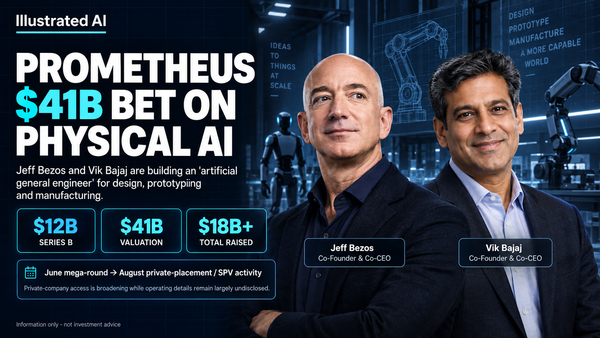
Money talks, but sometimes it roars. Prometheus didn't merely raise funds — it pulled in an extraordinary wave of capital that instantly reframed the next phase of AI. A $12 billion Series B at a $41 billion valuation isn't normal. It's the kind of event that makes markets stop and ask what's really going on beneath the surface.
Invest in top private AI companies before IPO, via a Swiss platform:
 SmartProfit Finder AG
Having already raised roughly $6.2 billion at launch, total capital climbed to over $18 billion within a year. That acceleration points to a belief that Prometheus isn't chasing a niche — it's targeting an enormous economic problem with technology powerful enough to rewrite how physical products are created.
The syndicate gives this real weight: JPMorgan Chase, Goldman Sachs, BlackRock, DST Global, and Jeff Bezos. This isn't a few venture firms making a bold call. It's heavyweight institutional capital preparing for a long, expensive race where winners may control critical infrastructure for an entire new industry category.
Prometheus sits at the intersection of technological optimism and financial seriousness. It's being valued as though it could speed up the creation of real-world machines and systems across multiple industries. If that happens, the upside could be enormous. If it doesn't, this round will be remembered as a monument to enthusiasm.
The raise reveals something about private markets broadly: capital is no longer content chasing chatbots and productivity software. Investors want bigger ideas — ones that reshape the foundations of industry. This funding round is a market event signalling that AI is beginning to target the heavier, slower, more expensive machinery of the physical economy.
The most exciting part of the Prometheus story isn't the fundraising. It's the idea: building an artificial general engineer for the physical world — software that helps design and manufacture complicated physical systems faster, smarter, and with less waste.
Real-world engineering is brutally hard. A car, satellite, aircraft component, or medical device requires layers of engineering, testing, simulation, redesign, material choices, and cost balancing. Every decision involves trade-offs. Make something stronger and it gets heavier. Speed up production and quality may suffer. Engineering is the art of compromise under constraint.
Prometheus wants AI embedded in this heavy-duty process — helping engineers run possibilities, test designs virtually, identify weak points, and shorten the path from concept to production. Unlike a digital assistant, this AI would live in the world of tolerances, thermodynamics, manufacturing constraints, and performance optimisation.
The potential impact is vast. If engineering teams can run more simulations faster, discover bottlenecks earlier, and identify better design trade-offs before building costly prototypes, the result is fewer delays, lower development costs, and faster time to market. For aerospace, automotive, and computing sectors, those gains aren't marginal — they're decisive.
There's also strategic beauty here. The deeper AI goes into complex industrial workflows, the harder it becomes to dislodge. Once tools are embedded in engineering systems, trained on specialised data, and integrated into production, barriers to entry rise sharply. This isn't a narrow software niche — it's a potential platform position within industry itself.
Digital tools have transformed communication and finance, but large sections of the physical economy remain slow, fragmented, and difficult to optimise. Physical AI — using intelligence to improve how real-world products are conceived, tested, and manufactured — targets exactly that gap.
Most physical industries operate under punishing constraints. Mistakes are expensive. Timelines are long. A single development delay ripples through supply chains and capital budgets. If AI reduces those frictions, the gains hit core industrial economics: faster cycles, fewer costly surprises, smarter optimisation, less waste between teams.
Take aerospace. Aircraft components must balance strength, weight, heat tolerance, cost, and safety. A tool helping engineers explore better trade-offs faster influences profit margins, competitiveness, and innovation pace. Similar logic applies to chip packaging, factory systems, and advanced materials — sectors moving trillions in value through complex engineering decisions daily.
Truly disruptive technologies don't just improve tasks — they change who can compete and where profits concentrate. If physical AI lowers the cost and time of engineering, effective users gain powerful edges. Industries known for long cycles could accelerate. Smaller teams could tackle more ambitious projects. Supply chains might adapt around new speeds of iteration.
For investors, disruption in the physical economy creates unusually durable advantages. Industrial platforms, once embedded in engineering workflows and connected to proprietary data, become deeply woven into a business's operating fabric. That supports stronger retention and more defensible positions than consumer apps ever could.
When intelligence starts reshaping atoms, factories, and engineered systems, AI stops being impressive and starts becoming industrial.
Every great technology story carries tension between what could happen and what has actually been demonstrated. Prometheus is no exception. There is no public revenue figure, no disclosed customer count, and no public listing roadmap. Around the time of its Series B, the company had roughly 150 employees across San Francisco, London, and Zurich — a highly specialised team, but a small one relative to its towering valuation.
The market is valuing future importance more than present operating proof. That can be rational in frontier technology. It can also be dangerous when expectations run far ahead of technical reality — especially in physical AI, where the challenge is far harder than generating fluent text. Engineering is unforgiving. Errors aren't just awkward; they can be expensive, unsafe, or commercially destructive.
Prometheus must eventually show usefulness in production environments. Can it help teams make better decisions? Shorten development cycles measurably? Integrate without creating new complexity? Earn trust where failure costs are high? Those questions separate narrative from durable business value.
Industrial customers also move cautiously. They require reliability, legacy-system compatibility, regulatory compliance, and clear ROI before changing critical processes. Even powerful technology can face slow uptake if implementation is difficult. Proving value may take lengthy pilots and multi-department integration — making progress harder to judge from outside.
Competition is another unknown. If physical AI becomes important, other well-funded teams will emerge. Large industrial software providers, simulation firms, and major AI players may all push toward the same opportunity. A large market always attracts formidable rivals.
Still, these uncertainties sharpen rather than weaken the significance of Prometheus. The company's valuation is both exciting and fragile: exciting because it reflects belief in something transformational; fragile because transformation is one of the hardest outcomes to achieve. The dream is bold. The burden of proof will be bolder still.
Funding rounds create excitement, but the real story unfolds afterward. For Prometheus, the next phase is about evidence. Investors will watch for product deployment in real industrial settings — software actually used in design and manufacturing workflows, not just pitch decks and private valuations.
Traction matters more than flashy user counts. In industrial markets, strategic partnerships, expanding pilots, and integration into important engineering environments signal that customers trust the product enough to invest operational data and decision-making in it. More transparency on commercial metrics would help move the story from speculation toward genuine assessment.
Category formation will be a critical signal. If other physical-AI platforms attract major capital, it confirms Prometheus isn't a one-off phenomenon — a genuine market is forming. That distinction matters enormously for long-term investor conviction.
The broader theme is clear: the private AI frontier is widening. Capital is moving toward applications touching robotics, energy, manufacturing, and physical design. Companies succeeding here may become invisible but essential layers of industrial decision-making — their impact felt not in viral growth, but in better machines, faster development cycles, and lower costs across real-world sectors.
The next AI race may not be won on a screen. It may be won on the factory floor, in the design lab, and across the physical economy.