Factory’s $5B Bet on Autonomous Software Engineering
– 5 min read
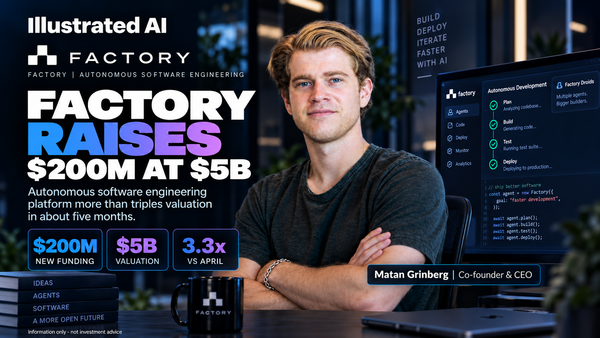
Factory has raised $200 million at a $5 billion valuation, more than tripling its reported $1.5 billion valuation from April 2026. The financing brings the enterprise AI coding company’s total capital raised to more than $400 million.
Invest in top private AI companies before IPO, via a Swiss platform:
 SmartProfit Finder AG
Participants include Blackstone, Khosla Ventures, Sequoia Capital, Insight Partners, Evantic Capital, Sound Ventures, NEA, Mantis VC and Clearlake, alongside individual investors including Marc Benioff, Brad Gerstner and Nico Rosberg. Factory says the capital will support research, product development and global commercial expansion.
The valuation increase reflects investor interest in AI systems that operate across enterprise software-development workflows rather than assisting only with individual coding tasks. Factory’s model-independent approach also suggests that value may accrue not only to model developers but to platforms controlling how models are selected, governed and deployed inside businesses.
However, Factory has not disclosed revenue, renewal rates or other financial metrics sufficient to establish whether commercial performance has increased at the same rate as its valuation. The investment case must therefore be assessed through customer adoption, production usage, retention and independently verified productivity improvements.
The old image of AI in software development was simple: smart autocomplete helping a programmer write faster. The new image is far more ambitious. Instead of assisting with a line of code, the system acts like a coordinated production floor. A coding assistant is a tool. A software factory is a system. It is the difference between giving one worker a better screwdriver and building an automated assembly line.
Automating work across coding, testing, and deployment means AI does not just participate in one step — it helps manage movement across the entire chain. That shift is powerful because software development is both repetitive and high value. Engineers spend enormous time on tasks that follow patterns: writing functions, fixing bugs, updating tests, and moving code through release pipelines. Many follow established rules, making them ideal candidates for staged automation.
Yet speed without governance creates risk. A tiny bug can break payments or expose sensitive data. Enterprises do not simply want software created faster — they want it created faster without losing safety and accountability. If Factory can reduce development time without weakening software quality or security, customers may be able to release products and features more efficiently. The scale of that benefit will require customer-level productivity evidence.
Instead of depending on a single AI model, an enterprise platform can select different models according to task requirements, cost, performance and governance considerations. This matters because AI models are changing at remarkable speed. Prices move. Capabilities improve. One model may excel at code generation; another may be cheaper for repetitive tasks; another may be preferred for compliance reasons.
Model independence may give customers greater flexibility and reduce their exposure to changes in a single provider’s pricing, availability or capabilities. Not every task deserves the most expensive frontier model. Intelligent routing can be the difference between an AI rollout that scales and one that becomes too expensive to justify.
In many technology shifts, lasting value gathers in the infrastructure that makes inventions usable at scale. Railways mattered, but so did freight systems and schedules. AI models matter, but so does the system making them practical inside large organizations. Long-term value may accrue to platforms capable of orchestrating several models while preserving customer choice and controlling costs.
AI capabilities can appear convincing in controlled demonstrations. The true test is whether they deliver value consistently under operational, financial and governance constraints. Cost, governance, and trust determine which technologies survive the transition from exciting experiment to core infrastructure.
AI runs on computing resources that can become expensive quickly. Efficient routing that cuts spending while maintaining performance is crucial — when economics improve, adoption becomes more durable. Governance answers the practical questions enterprises cannot ignore: Who approved what the AI did? What changes were made? Where did the data go? Without clear answers, large organizations will hesitate to trust AI with important work.
Trust is what allows automation to spread into core operations. It comes from visible controls, reliable performance, audit trails, and the confidence that a human can step in when needed. The future is likely guided autonomy — AI handles a growing share of routine work within a framework of approvals, policies, and logging. Enterprise adoption is likely to depend on systems that preserve human review for consequential changes.
Factory says its platform is used by hundreds of thousands of developers and names Nvidia, Blackstone, Royal Bank of Canada, Palo Alto Networks, Adobe and T-Mobile as customers. These are company-reported adoption indicators; Factory has not disclosed how many customers are in paid production, the scale of individual deployments or the revenue represented by these relationships.
Factory also says its Router automatically selects models at the task level and has reduced token spending by more than 60% while maintaining what it describes as frontier performance. This result has not been independently verified and should be assessed alongside customer-level performance evidence.
The valuation establishes high expectations, but execution will determine whether the financing is commercially justified. Investors will first watch depth of enterprise adoption — whether early customers are merely experimenting or actually standardizing around the platform. Pilot programmes demonstrate interest, while broader production adoption provides stronger evidence of customer value.
Revenue quality matters equally. Investors should examine retention, expansion in customer spending and whether the platform is becoming part of recurring production workflows. Third comes the balance between autonomy and oversight — can the platform complete meaningful end-to-end workflows with proper controls, or only assist in small fragments? Every increase in autonomous capability raises the value proposition and the need for trust simultaneously.
Competitive differentiation may prove the hardest challenge. Coding assistance is becoming common, and features that once looked rare quickly become standard. The more defensible platforms may be those that manage workflow complexity, governance and model selection. If AI systems can succeed in software development with strong governance and economics, other workflow-heavy domains become accessible next — broadening the strategic importance of the platform model considerably.
The bottom line: Factory’s $200 million financing and $5 billion valuation reflect strong investor interest in enterprise AI coding systems. The evidence to watch is paid production adoption, customer expansion, retention, independently verified productivity improvements, model-routing economics and disclosed revenue growth. Factory’s valuation has advanced rapidly; commercial evidence must now demonstrate whether its platform can produce durable enterprise value.