Colossal’s Blood-Draw Cloning Breakthrough and Valuation Signal
– 4 min read
Drawing blood is emerging as a new front door to conservation biobanking and cloning, and Colossal Biosciences is helping push that idea forward. What once required a skin biopsy may now begin with a routine veterinary blood sample—and in biotechnology, seemingly small process improvements can materially expand what becomes practical.
Invest in top private AI companies before IPO, via a Swiss platform:
 SmartProfit Finder AG
Scientists found a way to take cells from blood and grow them into cloning-ready form. Blood-derived cells doubled far faster than traditional tissue-derived fibroblasts, cutting cell bank establishment time roughly in half. For endangered animals that may be aging, ill, or dangerously few in number, time is survival.
A blood-based method fits naturally into wildlife management. Samples taken during standard exams reduce animal stress while expanding scientific value. Easier collection did not mean lower quality—blood-derived cells showed genomic stability comparable to tissue alternatives. A routine veterinary moment becomes the beginning of a long-term genetic preservation strategy.
Every endangered species carries a shrinking genetic pool. As populations decline, diversity narrows, making species more vulnerable to disease and environmental shocks. Cell banking preserves living biological blueprints—options that may support future breeding, cloning, or species recovery efforts.
Blood-derived cells established usable lines in roughly half the traditional time. That speed matters when biology does not pause for institutional planning. Faster and less-invasive workflows could make opportunistic biobanking more practical across a wider range of endangered mammals, although the method will need to be validated across additional species.
Critically, proof-of-concept embryo work in gray wolves showed implantation and viable fetuses—demonstrating these cells function in real reproductive contexts, not just petri dishes. Conservation expands from habitat protection into time management, buying future choices before genetic diversity disappears permanently.
The public notices the moonshot. The market eventually values the platform underneath it. Blood-derived cloning work is not linked to one high-profile program—it is reusable infrastructure supporting existing endangered species across sequencing, cell engineering, assisted reproduction, and biobanking working as an integrated stack.
A tightly connected system of tools, data, and operational know-how is far harder to replicate than a single discovery. More samples generate more data, improving understanding, strengthening reproductive strategies, attracting partnerships, and producing more samples—a genuine flywheel.
High-profile de-extinction projects serve as technology accelerators, pushing teams to solve difficult problems whose solutions can then support wider conservation. The enduring story is a conservation operating system—remembered less for reviving legends and more for preventing new losses.
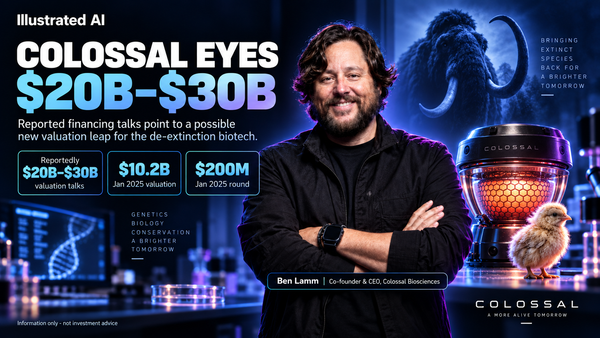
A recently disclosed investment provides a reference point of roughly $10.3 billion on a fully diluted basis—a substantial valuation for a long-duration biotechnology company whose commercial model remains early and only partially disclosed. This appears to be a secondary-style transaction, not a primary fundraising round, making it an informative signal rather than a definitive market verdict.
Separate reporting suggested the company had been in discussions around $20–30 billion. That gap between disclosed transactions and aspirational valuations reveals genuine uncertainty about pricing frontier biotech when science advances faster than commercialization. Enthusiasm is warranted; certainty is not.
Investors should connect valuation with platform maturity. Each demonstration that these tools solve practical problems adds substance to the story. Each time expectations race ahead of proof, risk increases. This is how private-market legends begin: first curiosity, then a price, then a test.
Three milestones will determine whether promise becomes power. First, a confirmed new financing round would signal growing strategic value and influence partnerships and recruitment. Second—and most critical—scientific replication across many species. One demonstration launches a narrative; cross-species repeatability builds infrastructure. Standard practice is where enduring value lives.
Third, operational execution on large-scale biobanking. Colossal's collaboration with the U.S. Fish & Wildlife Service creates a real-world test of whether its conservation platform can operate at much greater scale. Success will depend on field coordination, laboratory throughput, data integrity and long-term stewardship—not simply scientific novelty.
Technical progress and near-term revenue are not the same thing. Deep biotech creates value slowly, through capabilities before products. But if preserved cells, reproductive tools, and genetic data accumulate at scale, this platform could become a central node in conservation biology—a keeper of biological options in an age of accelerating ecological pressure.
The next chapter will be defined by proof: Can the science travel across species? Can operations scale? If yes, this becomes a story about a new toolkit for life itself.