CesiumAstro’s $730M Raise Fuels Ambitious AI Satellite Network Plan
– 4 min read
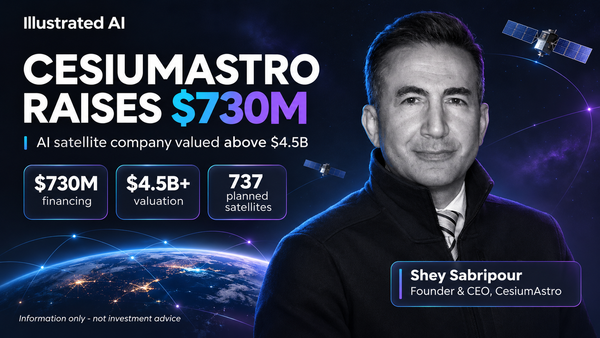
CesiumAstro announced on 5 November 2026 that it had closed a $730 million financing package comprising $630 million in equity and $100 million in debt, at a company valuation above $4.5 billion. Janus Henderson led the equity round, while EXIM and JPMorgan provided the debt financing. The capital supports expansion into developing and operating satellite infrastructure; it does not establish a commercially operating constellation or recurring service revenue.
Invest in top private AI companies before IPO, via a Swiss platform:
 SmartProfit Finder AG

The company says capital announced during 2026 exceeds $1.2 billion. Its earlier February package comprised $270 million in equity and $200 million in financing. These figures combine different financing sources and should not be presented as lifetime equity funding, unrestricted cash or evidence that the proposed constellation is fully financed.
The most disruptive development here is not better satellite equipment or stronger investor backing. It is the attempt to move from supplying communications technology to operating a space-based network. That single shift changes almost everything. Consider the difference between selling smart traffic lights and owning a city's transport grid. A supplier participates in demand created by others. Operating a network could create service-revenue opportunities, while adding launch, replenishment, licensing, customer-acquisition and ongoing operating costs. Contracted demand and attractive recurring economics remain to be demonstrated.
CesiumAstro's foundation in phased-array antennas, custom semiconductors, and software-defined payloads forms the technical bedrock of the next ambition. The proposed network, Synchronicity, envisions a 737-satellite constellation with onboard computing and AI-managed communications resources. This is where the story feels less like conventional aerospace and more like a fusion of telecom, cloud computing, and intelligent automation in orbit.
The move also changes competitive dynamics. Vertical integration becomes central to the thesis. If the company controls more of the technology stack, it may optimize performance, cost, and adaptability across the whole system. The jump from product to platform is one of the oldest and most powerful moves in business history.
In space infrastructure, AI is not just a tool for convenience. It can become the invisible traffic controller of an entire communications system, deciding where capacity is needed, how signals are routed, and how resources shift as demand changes. A software-defined, AI-managed network treats the satellite system less like static hardware and more like a flexible digital platform.
CesiumAstro describes Synchronicity as a planned network combining onboard computing, AI-assisted resource management and Ku-, Ka- and V-band communications. These capabilities are intended to improve flexibility and reduce reliance on terrestrial processing. Actual latency, efficiency, reliability and utilisation benefits require validation in deployed systems.
If satellites become software-defined platforms, the center of gravity in space shifts. A satellite that adapts through software has a different lifecycle value than one whose capabilities are frozen at launch. The vision connects semiconductors, software-defined networking, distributed computing, and space communications into a single convergence point where multiple waves of innovation reinforce one another.
CesiumAstro says Element-1 launched and began on-orbit operations in October 2026. This is a meaningful company-reported flight milestone, but the announcement does not provide independently assessed performance results establishing Synchronicity’s proposed network capabilities, reliability or economics.
Moving from one satellite to hundreds is a different industrial challenge entirely. Manufacturing rates must rise, supply chains must stay reliable, regulatory permissions must be secured, and customer commitments must match capacity. History is full of companies that proved a technology and still struggled to commercialize it at scale. The road from "it works" to "it works profitably and repeatedly" is much longer than it looks.
The healthy approach is to see milestones as stacked evidence, not final proof. The first on-orbit mission is a meaningful brick. Regulatory progress adds another layer. Commercial contracts add another. Repeatable manufacturing adds another. One satellite can prove a capability. It cannot prove a business model built on hundreds. That next proof must still be earned.
The future will be shaped less by headlines about ambition and more by evidence that the system is becoming real, licensed, funded, built, and bought. Four areas deserve close attention.
First, authorization and timetable. A communications network needs regulatory approvals, spectrum rights, and a credible deployment roadmap. Without these, technology remains trapped in possibility. Second, contracted demand. Long-duration agreements and mission-critical applications are more meaningful than broad statements of market interest. Third, unit economics. Can each satellite be built and deployed efficiently enough for the network to make money at scale? Fourth, manufacturing expansion. CesiumAstro has announced a $500 million Austin-area expansion over five years, including 270,000 square feet of manufacturing space. Planned investment and facilities should be distinguished from qualified production capacity, manufacturing yields and accepted spacecraft deliveries.
Investors should also separate transaction signals from operating signals. A financing round reflects belief and negotiation. Operating signals, deployed satellites, active customers, service reliability, and economic performance, are what build durable value. The company has earned attention. What it must earn next is trust in execution at scale.
The bottom line: CesiumAstro’s financing and company-reported Element-1 operations support its expansion towards satellite-network ownership. They do not establish a licensed, fully financed constellation, validated AI performance or profitable service economics. Investors should watch authorisations, binding customer contracts, launch commitments, manufacturing yields, spacecraft reliability and returns after deployment, replenishment and debt-service costs.