Agility Robotics Goes Public: Humanoid AI Faces Its Market Test
– 4 min read
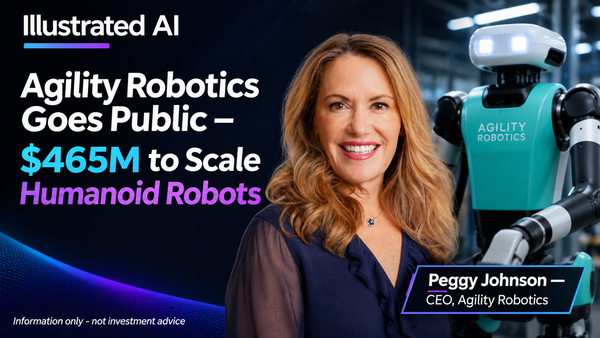
Agility Robotics began Nasdaq trading under AGLT on 5 November 2026, following completion of its combination with Churchill Capital Corp XI on 4 November. The company describes itself as the first US-listed pure-play humanoid robotics company with active commercial deployments. The combination and related financings provided approximately $465 million in gross capital before transaction expenses.
Invest in top private AI companies before IPO, via a Swiss platform:
 SmartProfit Finder AG

Public markets are accountability machines. They ask sharp questions: How many robots are deployed? How reliably do they work? Are customers reordering because the machines genuinely save money? The listing transforms science-fiction excitement into an industrial scoreboard, turning a futuristic idea into a testable business model in full public view. It may also become a reference point for the entire humanoid industry — if progress disappoints, skepticism spreads quickly; if deployments expand and costs fall, the whole sector benefits.
Gross capital is not net capital. Transaction costs reduce what remains freely deployable, and robotics is relentlessly capital-hungry. The announced financing structure comprised approximately $164 million from the SPAC trust account, $201 million from a Foxconn-led common-stock PIPE and $100 million in equity funding received before closing. Gross capital includes that earlier funding and should not be treated as cash newly available at listing. Existing investor and partner relationships should also be distinguished from participation in the transaction financing.
Capital in robotics is simultaneously a weapon, a bridge, and a stopwatch. It funds engineering talent, supply chains, and software. It bridges years of heavy spending before deployment volume creates stable revenue. And it runs out. Every quarter, investors will measure whether spending is producing measurable commercial progress. Public ownership transforms capital from a headline into a benchmark — the real drama lies not in how much was raised, but in what that money builds.
Agility reports more than 65,000 cumulative hours of operation for earlier Digit robots and more than 100,000 totes moved at GXO’s Georgia facility. These provide evidence of operating experience, but do not establish how many hours were productive or autonomous, fleet-wide uptime, incident rates or profitable deployment economics.
Planned expansion to two additional U.S. sites in early 2027 deepens the significance. A single site can be dismissed as a special case; multi-site deployment tests true repeatability. Still, operating hours are not proof of profitability. The real question is whether tasks are completed often enough, cheaply enough, and reliably enough to make sense economically for both customer and provider.
Deployment data can reveal failures and inform subsequent improvements. Whether it creates a durable advantage depends on data quality, permitted use, training and validated gains in task success, reliability or support requirements. More operating hours alone do not establish a learning advantage. History will not be written by the best demo. It will be written by the machine that keeps showing up for work.
Digit is designed for repetitive industrial workflows in environments built for people. Compatibility still depends on task requirements, layout, safety assessment and integration. Digit 5 is designed to support closer human–robot working and broader manipulation capabilities; these are development objectives rather than evidence of suitability for every workplace. Early customer access is expected in the first half of 2027, with general availability targeted for year-end.
RoboFab, the company's 70,000-square-foot Oregon manufacturing facility, is designed for annual capacity of up to 10,000 robots. But designed capacity is not current output. Manufacturing yield — the share of production meeting quality standards without costly rework — may matter more than any marketing announcement. Low yields compress margins. Weak field reliability raises service costs. Rising service costs weaken customer economics. The winning formula requires synchronized progress across production, reliability, and adoption.
The ambition is to establish a repeatable industrial loop: design, manufacture, deploy, learn, update, repeat. If that loop runs smoothly, the business could evolve from high-risk developer into scaled automation company — one of the most valuable transformations in technology investing.
The company reports more than $300 million in committed multi-year orders for Digit 5. That signals serious customer interest — but these orders are conditional, dependent on milestones, specifications, and delivery terms. They are not recognized revenue. The right interpretation is leading indicator of demand, not final proof of commercial success.
The central investor question remains: what turns customer curiosity into repeatable revenue? For operators, the calculation is straightforward — can the robot perform valuable tasks across enough shifts, with enough uptime, and low enough supervision to justify full installed cost including setup, software, maintenance, and downtime risk? For investors, the checklist adds gross margin, deployment time, service burden, and customer concentration.
Competition makes execution even more urgent. Figure AI, Apptronik, established industrial automation companies, and lower-cost Chinese producers are all advancing. Disruptive markets reward not just the best technology, but the company that aligns technology, scale, cost, and timing most effectively. A more elegant robot can lose to a cheaper one if the economics are compelling enough.
The bottom line: Agility’s listing provides public-market access and capital to support commercial expansion. Company-reported operating experience and conditional orders are meaningful milestones, but do not establish profitable scale or independently validated fleet-wide safety. Investors should watch net cash, cash consumption, order conversion, active paid robots, productive utilisation, intervention rates and margins after manufacturing and field support.