Baseten’s Soaring AI Inference Valuation
– 5 min read
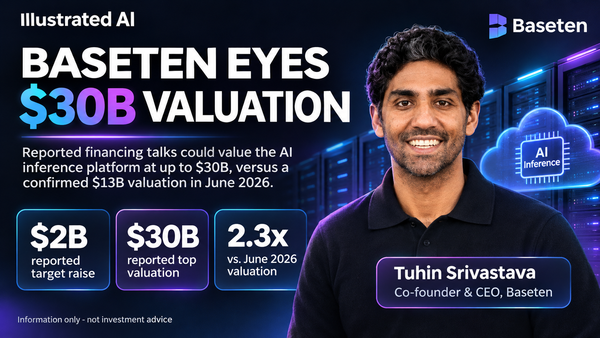
Bloomberg reported on 30 October 2026 that Baseten was nearing approximately $2 billion in financing, with Sands Capital expected to lead. The reported structure includes tranches valuing the company at $26 billion and $30 billion. These are prospective terms rather than a company-announced completed round, and the highest tranche should not be treated as the price paid by every investor.
Invest in top private AI companies before IPO, via a Swiss platform:
 SmartProfit Finder AG

There is a moment in every technology boom when attention swings from spectacle to utility. In the current AI race, that engine is increasingly inference. Training is where a model learns; inference is where it actually works — every question answered, every document analyzed, every note drafted. Training, post-training and inference serve different commercial roles. Inference creates recurring computing demand as deployed models serve users, while continued model development remains important to capability and competitiveness.
This turns inference into the real battlefield. If training builds the engine, inference runs the transportation network. Investors are now flooding toward companies building this infrastructure because AI must become dependable enough to sit inside real workflows. Responses must arrive fast. Costs must not explode. Reliability wins over theatre.
The highest long-term value often hides not in the flashiest front-end experience, but in the systems making that experience possible. Sustained production usage could support recurring revenue, but its durability depends on customer retention, pricing, contract terms and competition. A company sitting in the flow of daily inference becomes a toll collector on the road between AI capability and AI consumption. The spotlight has shifted from creating intelligence to delivering it — repeatedly, efficiently, and at scale.
Baseten focuses on something less flashy and potentially more enduring than headline AI models: the systems layer helping businesses deploy, manage, and serve those models in production. Choosing a model is only one piece of the puzzle. The harder problem is what comes after — managing compute, handling demand spikes, controlling costs, and maintaining quality.
Baseten absorbs that complexity, sitting between raw compute and end-user applications. It orchestrates GPU capacity, manages model runtimes, enables autoscaling, and provides observability tools. The goal is making AI deployment feel less like building a power station and more like flipping a switch.
Its deeper appeal is strategic: businesses can run AI on their own terms, using open models without surrendering flexibility or building an entire infrastructure team. In a fragmented, rapidly changing landscape — new chips, new models, shifting costs — a platform offering deployment flexibility and optimisation could reduce some infrastructure burdens. Portability and switching costs still depend on model compatibility, runtimes, hardware support, integrations and contractual terms. Most companies simply want to focus on their own product. If an outside platform handles the difficult mechanics of model serving, internal teams are free to build what actually differentiates them. That is often the most persuasive value proposition of all.
Baseten announced a $1.5 billion Series F on 22 June 2026 at a $13 billion valuation. The reported October tranche valuations are approximately 2.0 and 2.3 times that headline figure. These comparisons describe financing valuations, rather than realised investor returns; share rights, dilution and different entry prices affect the economics.
Still, the broader signal is powerful. Substantial capital is now treating inference infrastructure as one of AI's most strategically important layers — a major shift from earlier fascination with training costs. Fast-rising valuations reflect a market pricing in future dominance before it becomes obvious. Whether the valuation is justified will depend on revenue growth, retention, infrastructure costs, dilution and sustainable margins. Sector growth alone does not establish an attractive investment outcome.
But valuation is not destiny. It is a statement about expectations. A big price tag sends ripples across the ecosystem — founders recalibrate ambition, competitors intensify, customers take comfort from a well-funded provider. Ultimately it signals that investors no longer treat AI infrastructure as back-office plumbing. They treat it as a prize asset class.
Big valuations imply possibility. They are unsettling because possibility is not proof. First, demand must prove durable — customers must move from experimenting with AI to depending on it inside recurring business processes. Second, differentiation must hold. Does the platform genuinely reduce latency, simplify deployment, and make engineering teams faster in ways that endure?
Then comes the hardest question: unit economics. GPUs, networking, and power are expensive. If the company merely passes through infrastructure costs while earning thin software margins, the business may look large without being particularly attractive. Gross margin after compute, net revenue retention, and cost per useful output all matter far more than headline revenue.
Reliability and portability are equally critical tests. Enterprises need consistent availability. And in a fragmented ecosystem — multiple chips, clouds, and model providers — a platform reducing switching costs becomes more valuable precisely because the landscape remains unstable. Yet that same attractiveness invites fierce competition from large cloud providers, model developers, and other specialists.
The true question is whether the business can turn technical usefulness into economic durability. Can it grow without letting compute costs swallow the reward? Can it build a moat where everyone sees the same prize? Huge numbers demand humble analysis. Beneath every bold mark lies a simple challenge: prove the machine creates more value than it consumes.
Sometimes a single funding discussion reveals where an entire market is heading. Value is migrating from the laboratory to the factory floor. The world already knows advanced AI can be built. The pressing question is how to keep it running cheaply, reliably, and at industrial scale. Railroads created value because goods moved efficiently. The internet created value through infrastructure making digital services dependable. AI is following the same pattern.
Integration into customer workflows could support repeat spending and increase switching costs. A durable competitive advantage would require evidence of retention, reliable service, differentiated performance and attractive economics after compute and support costs.
Yet if inference is becoming more important, it is also becoming more contested. That tension makes the sector compelling: explosive demand meets structural uncertainty, creating room for outsized returns and expensive mistakes equally. The most important emerging principle is simple — useful work matters more than raw activity. The companies enabling more practical output with less waste may shape the economics of the whole industry.
The bottom line: Baseten’s confirmed June financing and reported October fundraising indicate substantial investor interest in AI infrastructure. The proposed tranche valuations are distinct from a completed transaction and do not establish sustainable profitability. Investors should watch final financing terms, recognised revenue, customer concentration, retention, service reliability and margins after compute and engineering support.