Radiant’s £20bn AI Campus Bet: Power, Land and Compute
– 6 min read
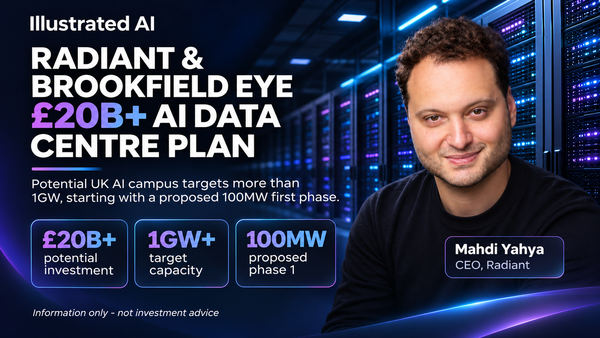
Drax announced on 3 November 2026 an agreement to develop a strategic partnership with Brookfield and Radiant for an AI data centre on its North Yorkshire power-station estate. The project targets more than 1GW of capacity. Brookfield estimates potential investment exceeding £20 billion, including semiconductor chips, with approximately £2.5 billion envisaged for Phase 1. These are development estimates rather than fully committed or deployed capital.
Invest in top private AI companies before IPO, via a Swiss platform:
 SmartProfit Finder AG

Big technological shifts rarely arrive politely. They burst through when separate forces lock together. AI needs enormous computing power, but that power must live somewhere — requiring electricity, land, cooling, fibre connections and significant capital. When those ingredients combine, a new economic engine forms.
The proposed North Yorkshire AI campus sits at the meeting point of three scarce resources: power, land and compute. Each is valuable alone, but together they become transformative. At over one gigawatt of ambition, this is not routine real estate — it signals an attempt to build a major AI infrastructure hub, a digital factory for the machine learning age.
Crucially, this proposal begins with an existing industrial estate carrying serious energy credentials. In modern AI, the race is no longer won simply by ordering the newest chips — it is won by those who can convert industrial infrastructure into operating AI capacity faster than rivals. Powered sites can be a major constraint alongside chip availability, networking, cooling, financing and customer demand.
This rearranges investment logic. Grid access, permitted sites and cooling systems have become precious strategic assets. Scarcity creates value, and AI is spreading that value into a new layer of infrastructure operators who assemble power, land, hardware and software into one commercial platform. Ownership of such a bottleneck can function like a toll bridge on a crowded highway — customers buy not just space, but access to functioning AI capacity.
A UK-based campus could expand domestic access to AI infrastructure. Its location alone does not establish domestic ownership, operational control or data sovereignty; those depend on ownership arrangements, operators, contracts and governance.
The real shift here is not that a giant campus has been built — it is that a strategic development agreement has been signed to pursue one. Understanding this distinction is where clear thinking begins.
The proposal combines Drax’s land and power infrastructure with Radiant’s AI infrastructure expertise and backing through the Brookfield–Qai joint venture. Phase 1 targets up to 100MW, with commercial operations from Q1 2028. Progress depends on planning, regulatory and network approvals, an acceptable tenant, commercial agreements and each party’s final investment decision.
Drax identifies 4GW of grid access and 2.6GW of dispatchable generation capacity at the site. These figures should not be treated as approved electricity supply available immediately to the data centre. Phase 1 would draw power directly from the grid.
A strategic agreement creates a framework for execution. It aligns incentives and opens doors to customers and funding. But it is not a green light. Construction, equipment procurement, utility planning and commercial contracting all sit ahead. In AI especially, enthusiasm can race ahead of build reality — delays in any single area can slow everything.
For investors, long-term value emerges through milestones rather than headlines: Has a customer signed a binding commitment? Have regulators approved plans? Has funding moved from possible to committed? Have megawatts been commissioned? Each stage reduces uncertainty and increases the credibility of future cash flows.
The initial 100-megawatt phase is not merely a small beginning — it is the credibility engine for everything following. Markets may celebrate the giant future number, but sophisticated observers will watch the early phase most closely. It is where dreams first meet invoices, engineers, permits and customers.
The central contest in AI was once assumed to be about chips alone. That view now looks too narrow. The true scarcity increasingly lies in the ability to power and operate chips at scale. The gold rush has moved from silicon to the full energy-and-infrastructure chain that makes silicon productive.
AI workloads are hungry. Training models and serving millions of users require vast electricity, constant cooling, high-performance networking and purpose-built buildings. Everything starts with one question: where can enough reliable power be found? A site with meaningful power availability is no longer just an industrial location — it becomes a strategic launchpad.
Imagine thousands of elite race cars arriving for competition but finding only a handful of fuel stations. That is the current AI infrastructure dynamic. Demand for compute rises rapidly while suitable powered sites remain limited. Bottlenecks are where economic value concentrates, and power has become the decisive input determining whether AI chips generate revenue or remain expensive inventory.
This broadens the definition of an AI opportunity. Infrastructure owners and operators — energy-linked sites, data-centre platforms and integrated compute providers — may capture meaningful value simply by solving the practical deployment problem. Large AI customers want reliability, cost visibility and speed to capacity. A platform delivering those things becomes a strategic service provider, not merely a landlord, enabling stickier relationships and stronger commercial positioning.
AI flips the old script: the humble substation and cooling loop suddenly matter as much as the software stack. Without power, all other pieces struggle. That is why energy-linked AI infrastructure is increasingly treated as a new strategic asset class — sitting at the intersection of digital demand and physical scarcity, where powerful economics can emerge when managed well.
A new business model is emerging: the AI infrastructure platform. Neither pure property owner nor pure software company, it combines industrial infrastructure with high-performance computing complexity — a hybrid that may become one of the defining structures of the AI era.
An integrated infrastructure platform could coordinate land, electricity, data-centre development and compute deployment. For this project, the operating model, hardware responsibilities, customer arrangements and allocation of commercial risks remain subject to further agreements.
Backing from large infrastructure capital signals the opportunity is viewed through a long-duration asset lens. The investment thesis spans utilisation rates, electricity economics, financing costs, equipment refresh cycles and contract quality — part infrastructure, part technology, part industrial operations. That mix can be powerful, requiring nuanced analysis.
Coordinating power, development and compute could create execution advantages. Complexity also introduces cost and delivery risks; a durable advantage requires reliable capacity, competitive pricing and attractive returns. Infrastructure investors are accustomed to long timelines and large upfront spending — AI demand adds a growth dynamic on top, potentially attracting significant institutional capital.
The exciting implication: AI may produce a new class of strategic company fusing utility, cloud operator, software orchestrator and industrial developer. The story is no longer only about who writes the smartest model — it is also about who builds the smartest machine for delivering compute at scale.
Grand visions capture attention, but markets eventually ask: what needs to happen next? A project becomes valuable not through large ambition but through a concrete sequence of milestones transforming possibility into cash flow.
Demand: A creditworthy anchor tenant with binding commitments could support financing and reduce utilisation risk. Contract duration, termination rights, pricing and payment obligations matter as much as the customer’s name.
Permission: Planning approvals, grid agreements and network coordination are absolutely central. Environmental and community considerations can shape timing and operating conditions — investors ignore permitting risk at their peril.
Capital commitment: There is a major difference between a large potential investment figure and fully committed capital under a final investment decision. Serious investors will want to know equity commitment levels, debt structure and conditions before capital is released.
Delivery: Bold plans must confront engineering reality. Can build timetables be met? Can equipment be sourced? A megawatt on a presentation slide is not the same as a megawatt operating in the field.
Every milestone cleared substantially improves the story. A signed customer reduces commercial uncertainty. An approval reduces regulatory uncertainty. Committed financing reduces funding uncertainty. Commissioned capacity reduces execution uncertainty. As uncertainty falls, the project becomes more investable and more strategically valuable — derisked step by step.
The competitive backdrop makes speed essential. The platform moving first from concept to operating capacity may gain customer relationships and strategic standing difficult for rivals to dislodge. Early proof attracts more customers, more capital and more confidence in a reinforcing cycle.
The future belongs neither to wild optimism nor reflexive scepticism — but to those who can distinguish remarkable possibility from confirmed reality, then track the path between the two.
The bottom line: The Drax partnership establishes a framework for a proposed AI data-centre development, rather than commissioned capacity or fully committed investment. Investors should watch planning and network approvals, binding tenant agreements, final investment decisions, power costs, construction delivery and returns after hardware, financing and operating expenses.