Zipline’s Drone Delivery Valuation Surge
– 5 min read
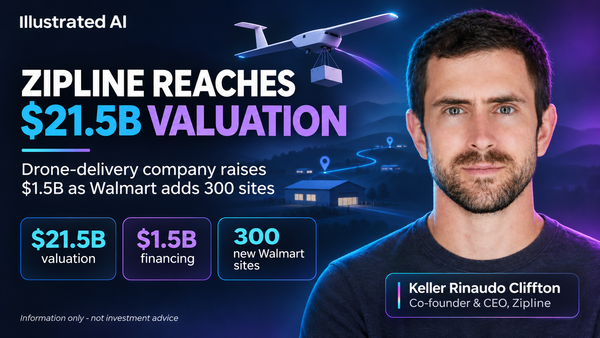
Zipline announced a $1.5 billion financing on 5 November 2026 at a $21.5 billion post-money valuation, led by Paradigm, WCM Investment Management and Layer Global. It plans to expand US manufacturing, hiring and its delivery network. The financing establishes investor backing, rather than independently demonstrated nationwide operating economics.
Invest in top private AI companies before IPO, via a Swiss platform:
 SmartProfit Finder AG

The valuation is approximately 2.83 times the $7.6 billion Zipline announced in January 2026. This reflects negotiated financing terms, rather than a corresponding increase in revenue or realised investor returns.
The conversation is now shifting toward network scale, economics, and repeat use. Disruptive technology becomes truly disruptive only when it changes behavior. The potential habit here is simple: ordering goods and expecting them in minutes, not hours. If that expectation becomes normal, retail logistics changes shape entirely. Warehouses, store locations, software coordination, and consumer patience all transform around immediacy.
Zipline is not merely building aircraft. It is assembling routing software, operational control, distribution partnerships, fleet management, and delivery execution into a single system. The large valuation increase reflects belief that an important threshold has been crossed. The stated expansion plans create further execution requirements across manufacturing, deployment, regulatory approvals and service reliability. Financing does not remove the need for testing and operational validation.
The most powerful technology stories begin where need is urgent. Zipline built its name delivering blood and medical supplies in Rwanda, proving autonomous aircraft could solve real problems where traditional transport was too slow. Experience in medical logistics provides relevant operating knowledge, but retail delivery requires separate validation across aircraft designs, delivery locations, demand patterns and customer requirements.
Moving from medicine to retail represents a jump in complexity. Consumer delivery is chaotic. Demand fluctuates, margins are thin, and service quality is judged by consistency, not innovation alone. Zipline’s Platform 2 aircraft hovers while lowering a delivery unit on a tether. This avoids landing the main aircraft at the customer’s property, while still requiring a suitable delivery area and appropriate operating safeguards.
Retail partnerships accelerate trust by placing new technology inside familiar consumer relationships. A shopper uncertain about autonomous aviation already trusts a known retailer. When that retailer offers drone delivery, the technology piggybacks on existing commercial confidence, lowering the psychological barrier to adoption and helping the service become part of daily life rather than an occasional indulgence.
Every disruptive technology reaches a moment when distribution matters more than invention. The Walmart expansion is not simply a customer win. It is a distribution signal. Existing stores function as ready-made logistics anchors, holding goods, sitting close to households, and already embedded in regular purchase behavior. This lets autonomous delivery layer onto an established commercial map rather than building a retail footprint from scratch.
The planned addition of 300 sites shifts the question from whether the technology works in isolated pockets to whether the network can deliver repeating service across a country-sized market. For investors, partnerships with large incumbents alter the path to scale by providing reach, demand, credibility, and physical assets, while the retailer gains meaningful differentiation on speed and convenience.
Planned locations are not active ones. Permits must be secured, operations coordinated, and consumers must actually use the service. Disciplined excitement means viewing a 300-site plan as a major step forward while insisting that deployment speed and activation rates will determine whether commercial significance matches the headline. Convenience wins markets because people repeat what feels easy.
Zipline reports more than one million deliveries in Dallas–Fort Worth during 2026 and a median interval of 19 minutes from checkout to delivery in October. These company-reported figures indicate activity and delivery speed, but do not establish customer retention, on-time performance across all orders, incident rates or profitable service.
For a cohort of its longest-tenured restaurant partners, Zipline reports that its share of those restaurants’ delivery revenue rose from 10.8% in March to 34.9% in October. This indicates increased channel share within that cohort, rather than Zipline-wide revenue growth or customer retention across the full network.
These figures require caution. They are company-reported and cohort-specific, not audited financial statements, and do not reveal profitability or cash burn. What they do suggest is that the company may be moving past one-time novelty into repeatable commercial behavior, shifting the key question from "Will anyone use this?" to "Can this usage be served profitably at scale?" That is a much better problem to have.
Opportunity can be real and still fail to reward investors. The value may lie less in the drone itself and more in the full-stack operating system built around it: aircraft design, autonomy software, dispatch, airspace navigation, merchant integration, fleet maintenance, and local infrastructure. Full-stack models can optimize the entire system but carry higher fixed costs, operational complexity, and execution risk.
A larger network could improve utilisation and reduce unit costs if demand density and operating efficiency offset additional infrastructure and support costs. Any learning advantage requires permitted data use and validated improvements in performance. But national deployment adds substantial fixed cost, aircraft need servicing, regulations need navigation, and weather introduces variability. Revenue growth alone cannot settle the investment case. Key markers to watch include how quickly planned sites actually open, how frequently customers reorder, what each delivery costs once depreciation is included, and whether merchants stick with the service after initial excitement fades.
The phrase physical AI explains much of the investor excitement. AI has transformed information workflows; the next chapter is software actually moving objects through time and space. Companies owning that control layer could become disproportionately valuable. Yet ownership of the future is never granted by headlines. A spectacular flight wins attention. A signed retailer deal wins optimism. Only profitable repeatability wins staying power. The sky is where the drones fly. The investment case will be won on the ground.
The bottom line: Zipline’s financing, planned Walmart expansion and company-reported delivery activity provide concrete commercial milestones. They do not establish nationwide service readiness, superior safety or profitable delivery economics. Investors should watch site activations, repeat ordering, successful-delivery rates, weather-related downtime, human-support requirements and contribution margins after aircraft depreciation, maintenance and local infrastructure costs.