Tutor Intelligence Raises $75M to Scale Learning Robots in Warehouses
– 5 min read
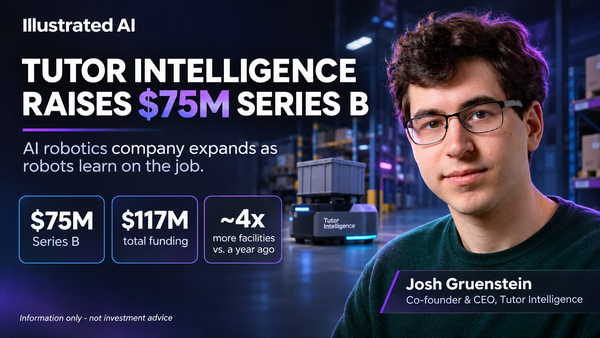
Tutor Intelligence announced a $75 million Series B on 2 November 2026, led by Andreessen Horowitz with participation from Union Square Ventures and Neo. The company says total capital raised now stands at $117 million. The funding will support robot-model training, manufacturing and deployment.
Invest in top private AI companies before IPO, via a Swiss platform:
 SmartProfit Finder AG

The most exciting shift in robotics isn't a machine dancing on a stage. It's a robot showing up for work. In warehouses and fulfillment centers, robots are handling repetitive tasks that once depended entirely on human labor. Tutor says its robots now work in almost four times as many facilities as a year earlier. This indicates reported deployment expansion, but does not establish equivalent growth in paid operating hours, revenue or profitability.
For years, robotics promised revolution but delivered slow adoption. Machines were expensive, hard to install, and designed for narrow tasks. Tutor changes the rules by offering robot work as a service. Tutor offers usage-based pricing by the hour or by the pick, with deployment and maintenance included. This could reduce upfront purchasing requirements, although customer savings depend on utilisation, pricing and integration costs. Tutor also offers outright purchase with an annual service plan.
The machines themselves are built for practical tasks: case handling, two-arm picking, moving products. The commercial opportunity isn't humanoid dreams. It begins with picking, lifting, and sorting. Tutor reports that nearly a third of organisations receiving its robots over the past year were existing customers adding units. This provides evidence of customer expansion, but does not establish retention across the full customer base, consistent performance across sites or profitable deployment economics.
Tutor combines robot models with guidance from remote human operators called tutors. Operational data can inform subsequent training, but the reviewed announcement does not quantify human involvement or demonstrate declining intervention rates. Improvements depend on data quality, permitted use, training and validation before deployment.
Tutor’s investor describes deployments as occurring ahead of full autonomy, making the human contribution material to both performance and costs.
Experience across different sites could help Tutor identify failure modes and improve its models. Transferring skills between robots requires compatible hardware, suitable training and validation under the receiving robot’s operating conditions.
Paid deployments could contribute revenue and useful training data. Whether this creates a compounding advantage depends on measurable improvements in task success, human-support requirements and total deployment costs.
The most disruptive element may not be the technology but how it gets sold. Paying by the hour or by the pick changes customer psychology entirely. Businesses buy measurable output rather than hoping expensive equipment pays off. This widens the addressable market, drawing in operators who were previously curious but cautious. Reducing friction often matters as much as improving performance.
The tradeoff is that the provider carries the operational burden. Machines must be manufactured, installed, monitored, and maintained. Capital doesn't disappear; it shifts. This is why fresh financing matters. Scaling requires spending ahead of revenue, placing robots into the world and earning returns over time. If utilization stays strong and intervention costs fall, the economics become very attractive. If machines sit idle or service demands surge, they become heavy fast.
Controlling the full service stack creates strategic depth. The company observes the entire system closely, refines workflows, and stays embedded in daily operations. Integration and service relationships could increase switching costs, but retention depends on reliability, pricing, contract flexibility and available alternatives. The provider stops being a vendor and becomes part of the operating fabric, aligning directly with what customers actually care about: throughput, cost, reliability, and flexibility.
Fast expansion grabs attention, but investors ask the tougher question: is growth creating durable economics or just visible momentum? Facility count is not revenue, and revenue is not profit. One site might use few robots lightly while another runs many around the clock. The headline number tells a story, but not the whole story.
What matters most is whether utilization is strong, whether human intervention declines over time, and whether gross margins improve after accounting for hardware, teleoperation, and field support. A robot can be deployed and still be economically weak if it requires constant support. Tutor targets more than 1,000 robots under contract by the end of 2027. This is a forward-looking commercial target, rather than a count of robots currently installed, operating or generating revenue.
The ideal flywheel looks like this: more deployments generate more learning, learning reduces intervention, reduced intervention improves margins, better margins support faster rollout. If that loop tightens, value compounds quickly. If new sites keep requiring heavy customization or maintenance demands rise, the economics may not justify aggressive expansion. Growth has arrived. Now the task is to see whether it hardens into real economics.
Robotics is one of the most contested frontiers in technology. Some rivals bring deep precision from traditional automation. Others aim for broad general-purpose intelligence. Tutor sits between: earning revenue in current workflows while steadily expanding capability. This middle path may prove decisive because timing matters. Specialist systems can struggle to adapt; general-purpose robots can take too long to monetize.
Operational experience could support differentiation if Tutor can use it to improve performance and reduce costs. A durable data advantage requires appropriate rights, useful coverage of difficult cases and validated gains relative to competitors. Dataset growth alone does not establish a moat.
The winners in disruptive markets build systems of reinforcing strengths, not just one clever idea. Intelligence, hardware reliability, service economics, and customer trust must all compound together. Every deployment that becomes operational habit makes replacement harder. This race runs through factories, warehouses, software stacks, and customer balance sheets. Whoever combines execution with learning best may help define the next industrial era.
The bottom line: Tutor’s financing and company-reported deployment growth support expansion of its robot-work service. They do not establish fleet-wide autonomy, a durable learning advantage or profitable economics. Investors should watch active paid robots, utilisation, task success, human-support hours, repeat customer spending and margins after hardware, maintenance and field support.