Callosum’s $100M Bet on Smarter AI Infrastructure
– 4 min read
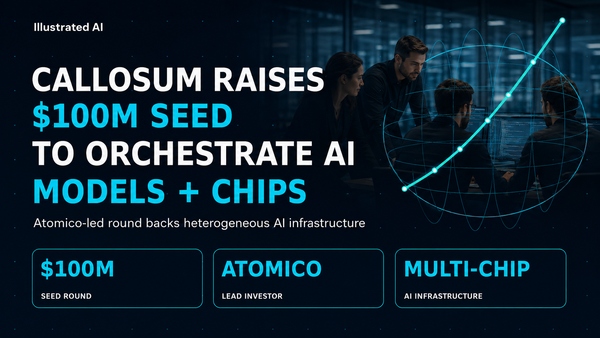
A $100 million seed round signals that investors believe something important is shifting beneath the surface of AI. This is a bet that the next great layer of AI will not be bigger models or faster chips, but software intelligence that decides which model and which chip should handle each task.
Invest in top private AI companies before IPO, via a Swiss platform:
 SmartProfit Finder AG
Modern AI is becoming crowded. There are many models, many hardware types, and many jobs businesses want AI to perform. Some need speed, some accuracy, some low cost. Sending every task through the same system is like using the same vehicle for every journey. One size no longer fits all.
Infrastructure businesses can be less visible than flashy consumer apps, but they often shape the economics of entire industries. Railways made industrial expansion possible. Cloud computing made digital businesses easier to build. In AI, orchestration software may become the hidden system that determines where value flows.
The breakthrough idea is simple: stop treating all AI work as identical. Break it into smaller pieces and send each to the model and hardware best suited for it. This is heterogeneous orchestration. In a hospital, not every patient sees the same doctor. Efficiency comes from matching the task to the specialist. AI needs that same coordination.
Without orchestration, developers must manually decide which model to use, which hardware to access, how to manage costs, and how to avoid bottlenecks. Orchestration software hides that complexity, acting like an expert dispatcher making thousands of background decisions so developers can focus on the product rather than the plumbing.
The practical value is significant. A simple customer request might need only a lightweight model on cost-efficient hardware. A complex complaint needs stronger reasoning. Rather than treating every interaction as requiring maximum firepower, orchestration allocates resources intelligently, reducing waste while preserving quality where it matters most.
Great infrastructure wins by being almost invisible, quietly removing friction so people move faster. By exposing sophisticated orchestration through APIs, developers can tap into task-specific AI without manually managing the maze of models and chips underneath.
As AI systems grow more varied, the burden on developers becomes heavy. Picking models, testing hardware combinations, monitoring performance, and controlling costs can consume more effort than building the application itself. A platform that abstracts this complexity can level the field, making advanced AI infrastructure accessible to more teams.
Low-latency orchestration is especially critical for multi-agent workloads, where several AI entities interact to solve problems. Delays multiply across the chain, making the difference between fluid performance and frustrating lag. When a company becomes the interface through which developers access optimized infrastructure, it embeds deeply into workflows and becomes difficult to replace.
Business reality is moving the spotlight from spectacular models to operational efficiency. Inference is the everyday act of using a trained model to perform work. A small inefficiency repeated millions of times becomes a major expense. Inference turns AI from a lab exercise into an industrial process, and industrial processes live or die by economics.
There is a historical pattern here. In maturing technology markets, value shifts from the initial breakthrough to the infrastructure that allows it to scale. Early aviation needed brilliant aircraft, but commercial flight also required air traffic control and logistics. The internet needed websites, but also routers, data centers, and cloud platforms. AI may be entering its own infrastructure era.
A successful orchestration platform benefits regardless of which model provider wins a given month or which chip architecture gains momentum. It does not need to back one horse if it can become the track on which many horses run.
The opportunity in AI orchestration is clearly large, but large opportunities attract serious competition. If a company can sit between developers and a rapidly diversifying ecosystem of models and hardware, it may occupy a highly influential position. The more complex the ecosystem becomes, the more valuable a trusted coordinator can be.
Neutrality can be a major strength. A company not tied to a single model family or hardware provider may optimize more objectively across the ecosystem, appealing to customers who do not want vendor lock-in. Yet capital is only ammunition, not victory. The company that collects the best performance data, forms the right partnerships, and wins customer trust pulls ahead. The one that stumbles finds the market moving on quickly.
For investors, that means watching for evidence, not narrative. Are customers seeing lower compute bills? Are workloads running faster? Are partnerships deepening? The idea is powerful. The market is real. The next fortune may belong not to the loudest promise, but to the quiet system that makes everything else work better.