ByteDance Expands AI Video Into Full Creative Workflows
– 4 min read
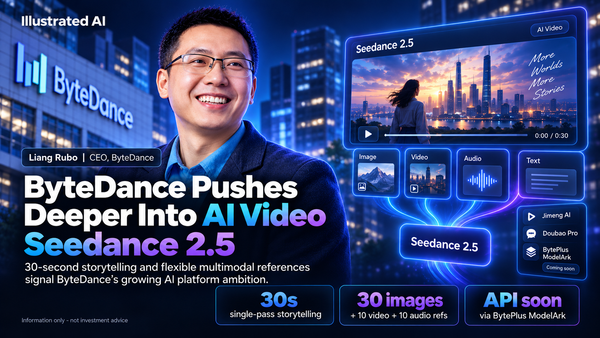
AI video is moving from novelty toward genuine production use, and ByteDance's Seedance 2.5 is a strong example of that shift. Early systems impressed in bursts—a few striking seconds, then inconsistency. Seedance 2.5 extends single-pass generation from 15 to 30 seconds while adding richer multimodal references and more precise editing controls.
Invest in top private AI companies before IPO, via a Swiss platform:
 SmartProfit Finder AG
Moving from 15 to 30 seconds of single-pass generation sounds minor, but it signals something deeper: the model is learning to remember what matters. Characters stay recognizable. Style survives the cut. Camera motion feels intentional.
The old question was whether AI could make a cool clip. The new question is whether it can join a production workflow—combining text, images, footage, sound, and style references into something that resembles how content is actually made. That shift opens vast markets: advertising, education, product marketing, industrial visualization, and internal business communication.
The most important change is that AI video is starting to behave like a production system. Real creative work never begins with a blank page. Brands have style guides. Educators have diagrams and lesson structures. Manufacturers need visuals matching real environments. The challenge is coordination, not just generation.
Seedance 2.5 can work with up to 50 multimodal references in a single generation—30 images, 10 video clips and 10 audio clips—giving creators greater control over characters, products, environments, motion, sound and visual style. Timestamp-level editing, green-screen features, and reference-based controls bring AI into genuine iterative workflows where professionals refine rather than rebuild.
Quality now means consistency, not just visual appeal—the hero stays recognizable, transitions preserve narrative, objects hold their position. Greater consistency and editability can reduce rework and make AI video more practical for repeated professional use. These tools may also lower some production barriers for smaller organizations and augment professional workflows by shifting more effort toward direction, selection and refinement.
Brilliant technology fails without distribution. The companies that shape industries combine strong models with strong reach. When AI video appears inside tools people already use, adoption accelerates naturally—no new service to learn, no habits to break.
API access is equally critical. Once capabilities become embeddable, agencies integrate them into campaign systems, educators build lesson pipelines, and manufacturers deploy training visuals. This creates the potential for a two-sided distribution model: consumer products can build awareness and usage, while enterprise and developer channels may support recurring commercial demand.
Model quality matters, but distribution, integration and customer relationships may ultimately matter just as much. Technical leads shrink fast in AI. A business pairing strong models with deep product integration and customer relationships survives that speed far better than one relying on a single breakthrough.
AI video could materially change production economics as it becomes reliable enough to support repeatable workflows. Longer coherent sequences, stronger reference consistency and targeted editing can reduce rework and manual production steps.
Instead of one final asset pushed everywhere, teams can build reusable production systems: same core idea, adjusted scenes, languages, or styles for different audiences. Video shifts from static output toward programmable media. High-end professionals test more creative directions; smaller organizations gain access they previously could not afford. Together, these capabilities could broaden the range of organizations able to produce customized video at scale.
Professional workflows may also shift, with less effort devoted to repetitive generation and more emphasis on concept, direction, judgment and refinement. If these tools reliably reduce production effort, they could increase the amount of creative work teams can produce with the same resources. When reliability keeps improving, that economic logic becomes hard to ignore.
Real progress will be measured by execution, not announcements. Four signals matter most.
Developer adoption: Seedance 2.5 is now available through BytePlus for API integration, making usage, pricing, integration quality and geographic availability important indicators of enterprise traction. Recurring use: Agencies, brands, and educators building repeated workflows signal durable demand far more than isolated publicity examples. Workflow depth: Character consistency, editability, and audio-video synchronization separate practical tools from frustrating experiments. Platform convergence: Integrating video with image, audio and language-model tools can deepen workflows and increase switching costs as interconnected capabilities become embedded in everyday production.
The central question for investors is whether technical advances convert into a durable platform: breakthrough models joined with product reach, developer access, and recurring business use. Companies that achieve that transition could evolve from standalone media tools into broader operating layers for digital creativity.
The future belongs not to the loudest demo, but to the platform that becomes part of how work gets done.