Anthropic’s Power Deal Signals AI’s Next Bottleneck: Energy
– 5 min read
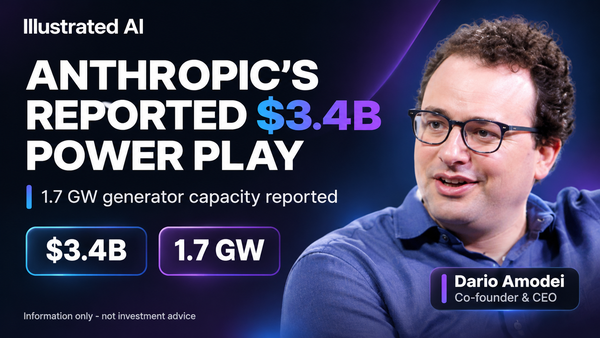
The Financial Times reported on 8 November 2026 that Anthropic agreed in late September to an approximately $3.4 billion transaction securing commitments for 1.7GW of gas-fired generators from OnePWR Solutions. Reuters relayed the report but said it could not independently verify it; neither company responded to its requests for comment. The reported capacity is not evidence of installed or operating generation.
Invest in top private AI companies before IPO, via a Swiss platform:
 SmartProfit Finder AG

Separately, OnePWR’s adviser, Piper Sandler, lists a September 2026 sale of its power-generation platform to an unnamed frontier AI lab for $3.4 billion. This corroborates the transaction’s size and broad description, but does not independently establish Anthropic’s identity as buyer or the 1.7GW equipment figure.
The reported multibillion-dollar power arrangement linked to Anthropic signals that the bottleneck in AI is shifting. The limiting factor is no longer only the best chips — it is access to dependable electricity to make those chips useful. Buying brains for the machine is not enough if there is no heartbeat keeping it alive.
The commitment covers 1.7 gigawatts of gas-fired generating capacity — an enormous figure representing industrial-scale planning. AI infrastructure has grown so large that power procurement is now a strategic weapon. The winners may not simply be those with the best models, but those best able to turn physical resources into operating AI capacity.
That shift rewrites the AI investment map. When power requirements rise fast enough, AI economics start resembling a modern industrial buildout — turbines, transformers, cooling systems, permits, and timelines. Advanced technology begins to resemble railroads and utilities: highly strategic, expensive, and shaped by hard constraints.
AI is still about intelligence. But scaling intelligence now depends on energy. That is not a side note. It is the new battleground.
1.7 gigawatts deserves plain-language translation. This figure is usually associated with utilities or major metropolitan energy needs. It signals that computing demand is becoming an economy-shaping force, moving the conversation from "Can this company afford the chips?" to "Can it build and sustain an industrial energy base?"
Infrastructure commitments can be more revealing than funding headlines because they imply urgency. A company does not chase this capacity unless it believes future demand justifies the effort. Even so, nameplate generation capacity is not guaranteed delivered electricity — there is a critical difference between reserving equipment and running a productive energy system.
This shift shows how quickly AI has escaped traditional tech categories, now touching energy markets, utility planning, and heavy equipment manufacturing. Direct power procurement can increase capital requirements and execution risk. Whether it creates a strategic advantage depends on commissioning speed, reliability and total costs relative to available alternatives. If a company locks in power while rivals hesitate, it may gain a meaningful edge bringing compute online faster.
Behind AI's smooth user experience sits a sprawling, capital-heavy supply chain full of choke points. Chips are only one layer. A cutting-edge processor without a live facility, robust cooling, and stable power is like a race car engine on a warehouse floor — impressive, but not productive.
According to FT reporting relayed by Bloomberg, Anthropic took over OnePWR’s existing Caterpillar generator orders rather than acquiring OnePWR itself. Access to existing orders could shorten procurement, but the commercial benefit depends on delivery schedules, site readiness, installation and commissioning.
The supply chain story also highlights specialized human expertise. Heavy-duty generators must be transported, installed, integrated, tested, and maintained. This broadens the talent war beyond AI researchers — the future increasingly depends on electricians, project managers, and field deployment teams.
For investors, this means more potential beneficiaries than headline AI names. Specialist power-equipment providers, contractors, grid technology companies, and power-management specialists may all gain if this pattern continues. The smartest supply chain may ultimately capture the prize.
AI is moving from the romance of innovation to the discipline of infrastructure. Capital intensity is rising. AI applications can generate recurring revenue, but their margins remain sensitive to inference costs, pricing and customer usage. Owning or financing physical infrastructure adds further capital, maintenance and operating commitments. Investors should expect a more industrial financial profile across parts of the AI value chain.
Higher capital intensity changes competitive advantage. A company with strong technology but weak infrastructure access may struggle to convert research into commercial scale. Model quality still matters, but so do procurement capability, permitting skill, and operations management.
AI investing may also broaden beyond laboratories and platform companies. Equipment manufacturers, electrical infrastructure suppliers, data-centre developers, and grid technology firms may all participate in growth. During every major buildout, deeper value often spreads across suppliers and infrastructure providers — railways required steel, electrification required transformers, and AI appears to be entering a similar phase.
Investors should remain careful. Reported arrangements are not confirmed operational outcomes. Delivery schedules may shift, costs may rise, and headlines can run ahead of hard facts. Discipline matters most when excitement is highest. When a technology trend starts demanding real assets at real scale, it usually means the opportunity is serious — but now it comes with blueprints, generators, and construction crews.
Big developments arrive first as headlines and only later as reality. Direct confirmation from parties involved is the most immediate thing to watch — it clarifies whether commitments are firm, conditional, or staged. In fast-moving markets, the difference between "reported" and "confirmed" is the difference between narrative and validated strategy.
Deployment schedules matter enormously. A reserved generator creates no value until installed and integrated. Permits, fuel arrangements, and regulatory approvals often determine whether projected capacity becomes real capacity. Ownership structure and operating model distinctions — temporary bridge solution versus long-term architecture — affect economics and strategic flexibility significantly.
Generator nameplate capacity is distinct from dependable net output and power available to computing equipment. Fuel supply, maintenance, redundancy, cooling and other facility loads affect how much productive compute the equipment can support.
The most revealing clue will be usable compute capacity. If secured electricity leads to faster deployment of training clusters or reduced delays serving customers, strategic value becomes clear. Capital expenditure and recurring operating costs are not the same thing — serious analysis needs both the breakthrough and the harder discussion about long-run efficiency.
The bottom line: The reported Anthropic arrangement indicates an effort to secure power equipment directly. It does not establish commissioned generation, lower electricity costs or faster deployment of AI clusters. Investors should watch confirmation of transaction terms, equipment deliveries, site approvals, fuel arrangements, net available power and returns after installation, maintenance and operating costs.