Anthropic’s MHS Pushes AI Into the Physical World
– 6 min read
The next great leap in AI is moving into the real world, where machines mix chemicals, move robotic arms, and manage tools worth millions. The hardest part of automation has rarely been intelligence — it has been translation. Every piece of equipment speaks its own language, creating a maddening patchwork that isolates powerful systems from one another.
Invest in top private AI companies before IPO, via a Swiss platform:
 SmartProfit Finder AG
The Model Hardware Standard (MHS) breaks that bottleneck by giving AI agents one consistent way to understand and control programmable physical equipment — a universal translator for machines. An AI agent can discover what a device does, what its limits are, and how to operate it without reinventing the wheel every time.
The business significance is enormous. In labs and factories, time is lost not because machines can't perform tasks, but because they can't work together. Human workers end up serving as the glue between devices, adding cost, delay, and error. MHS changes that by creating a standardized driver layer with structured metadata describing a machine's capabilities and safety boundaries — so AI isn't guessing. This matters because physical systems are unforgiving: a hardware mistake can ruin samples, damage instruments, or create safety hazards.
For years, AI has lived in digital workflows. MHS opens the door to AI that orchestrates physical processes across scientific experiments, manufacturing, robotics, and industrial operations. Standards often become the hidden roads on which whole industries travel. If MHS gains traction, it becomes infrastructure — the invisible framework that makes physical AI practical at scale, reducing integration costs, speeding deployment, and changing the economics of automation entirely.
A cutting-edge laboratory may be full of brilliant researchers and expensive instruments, yet daily workflows still depend on manual coordination and software patchwork. Different vendors build equipment with different priorities, and connecting it all can become a project in itself. Every device may require a different driver, control method, and data format — forcing engineers to spend weeks just getting machines to communicate reliably.
This hidden tax on innovation slows experiments, stalls automation plans, and forces organizations to spend technical talent on maintenance instead of discovery. MHS attacks this directly: a machine describes itself through standardized metadata, exposes simple control primitives, and an AI agent can inspect and coordinate it with other equipment using the same overarching structure — dramatically simpler than building bespoke bridges repeatedly.
Interoperability is a force multiplier. It turns isolated tools into networks and lets one innovation unlock another. Many organizations hesitate to automate because custom integration feels risky and expensive. A standard lowers that fear, suggesting automation can be repeatable rather than artisanal — exactly the shift that moves a market from experimentation to adoption.
Every major platform shift has required a simplification layer. Personal computers needed common operating systems. The internet needed shared protocols. Physical AI likely needs something similar. If MHS succeeds, laboratories could reconfigure workflows faster, factories could connect mixed device fleets with less engineering pain, and new instruments could plug into existing AI-driven systems without forcing complete redesigns.
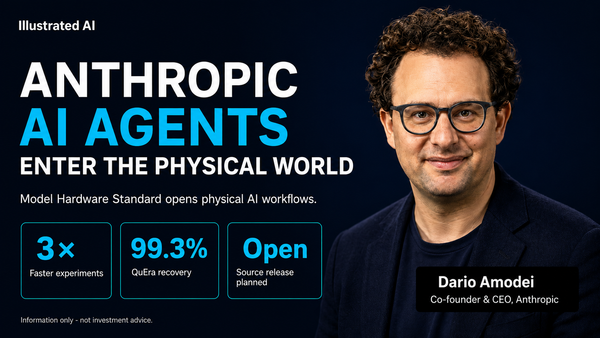
At Carnegie Mellon University, researchers used MHS to coordinate a liquid handler, plate reader, robotic arm, and monitoring cameras across three computers with incompatible interfaces. The result: serial-dilution dose-response experiments ran roughly three times faster than before, and the integration was built in approximately eight hours — compared with several weeks for a typical vendor-built setup. That difference changes the payback period of automation entirely.
At QuEra Computing, MHS maintained the laser system of a quantum computer, recovering laser lock in 695 of 700 trials — a 99.3% success rate across seven disturbance classes. Recovery took seconds rather than the five to ten minutes a human expert might need. Critically, safety controls remained independent of the AI model, combining flexible intelligence with hard constraints. That architecture is essential for physical AI to become trusted infrastructure.
Other pilots extend the picture: Genentech applied MHS to a protein-assay workflow; University of Washington researchers used it for remote instrument monitoring and collision-free machine handoffs; HHMI Janelia unified complex microscopy setups previously dependent on multiple vendor programs. This breadth suggests horizontal potential rather than a single niche — and horizontal technologies are often the most powerful, spreading across sectors to create platforms rather than products.
Early pilots are not proof of universal success, but they make the thesis tangible. Physical AI becomes real not when a robot waves for a camera, but when mixed equipment fleets work together faster, more reliably, and with less human intervention. The breakthrough is not spectacle. It is orchestration.
The most valuable technology opportunities are often layers — sitting between systems as the place where value accumulates. Operating systems did this for computers. Search engines did it for the web. In physical AI, a common hardware standard could become exactly that kind of layer, expanding AI's role beyond digital work into the physical processes where instruments, machines, and robotics drive real output.
The real opportunity lies in orchestration: coordinating many machines across heterogeneous fleets while preserving deterministic control, safety constraints, and emergency stops. AI becomes the conductor — interpreting goals, sequencing actions, monitoring conditions, and adapting — while trusted control systems enforce non-negotiable rules. Most industrial environments aren't greenfield builds; they're mixtures of old and new equipment, proprietary systems, and custom scripts. Making all of that easier to orchestrate gains lasting influence over how work gets done.
A network effect lurks beneath the surface. Every additional supported device increases ecosystem value. As more devices become compatible, more customers have reason to participate. This compounding utility turns a standard from a convenience into infrastructure. If MHS is truly model-agnostic, its appeal broadens dramatically — potentially becoming a common layer that developers, labs, hardware makers, and industrial users all rally around.
Long-term AI value may depend as much on distribution, integration, and ecosystem position as on model quality alone. The model may be the brain, but standards determine where the brain can plug in. A company that becomes the default pathway into physical workflows captures strategic relevance far beyond chat metrics — not merely participating in a trend, but helping define it.
The critical question is no longer whether the concept sounds promising — it's whether early gains can repeat across more settings and more demanding environments. Watch for repeatability: do integration savings hold up in independent labs and multi-vendor facilities? Can AI agents coordinate mixed hardware without extensive custom intervention? If yes, confidence in the standard will rise sharply.
Safety is where physical AI differs fundamentally from software automation. Mistakes involving instruments, chemicals, lasers, or robotics carry real-world consequences. Winning platforms won't be the most adventurous — they'll be the ones trusted enough to operate around valuable equipment. Watch how well MHS preserves hardware interlocks, deterministic scripts, and emergency-stop mechanisms.
Adoption breadth will matter enormously. A handful of demos is useful; a growing library of reusable drivers and active production integrations is far more important. MHS is currently available as a limited research preview, with an open-source release planned after further safety evaluation.
Watch for workflow permanence: are organizations embedding these systems into routine processes rather than merely experimenting? Are deployment teams choosing the standard repeatedly because it lowers operational friction? Those are the markers of real traction. If MHS succeeds, it could influence purchasing behavior across entire value chains, with suppliers designing devices with standardized metadata and buyers expecting new equipment to be AI-ready.
The central insight: physical AI is moving from abstract ambition toward operational reality, and standards may determine who benefits most. Driver counts, vendor support, production deployments, and repeatable time savings may not make dramatic headlines — but they are the building blocks of lasting value. When AI learns to speak fluently to machines, whole industries can move faster. If MHS becomes that language, it will matter far beyond the lab.