AMD’s $8.2B World Labs Deal Signals Spatial AI’s Rise
– 5 min read
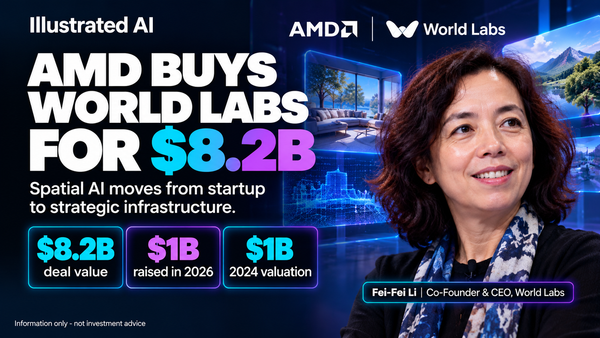
AMD has agreed to acquire World Labs, the spatial-intelligence company co-founded by Fei-Fei Li, in an all-stock transaction valued at approximately $8.2 billion. The transaction is expected to close by the end of 2026, subject to regulatory approvals and customary closing conditions. The agreement is a significant signal that spatial intelligence is moving from a specialised research field towards the centre of computing strategy.
Invest in top private AI companies before IPO, via a Swiss platform:
 SmartProfit Finder AG
Most people have experienced AI through flat digital interactions: writing emails, answering questions, generating images. Most widely used generative-AI systems are optimised primarily for language or two-dimensional media. World Labs is developing models intended to generate, reconstruct and simulate three-dimensional environments using inputs including text, images and video. Whether these systems possess a reliable understanding of physical relationships or causality remains an open technical question. These capabilities could extend generative AI beyond flat digital content into simulation, design and applications connected to physical environments.
The next wave of economic value may come from systems that do more than chat. A warehouse robot must navigate aisles and recognize obstacles. An architect's design tool must understand dimensions and structure. Industrial training platforms must create believable, responsive environments. In each case, space is not decoration. Space is the task.
World models represent a leap from pattern recognition to environment simulation. Language models are generally trained to predict tokens, while world models attempt to represent or generate aspects of environments across space and, in some cases, time. World Labs’ systems are designed to create and reconstruct spatially coherent environments, but the term “world model” covers several different architectures and capabilities. Depending on its architecture and training data, a world model may learn representations of viewpoints, movement and changes within an environment. Whether those representations reliably capture physical rules must be established through testing.
Multimodal capability is especially important because reality doesn't arrive in one format. Words, video, photos, and digital layouts are all pieces of the same underlying reality. A strong world model fuses these into one coherent understanding, unlocking far richer applications than single-format models allow.
Disruption also comes from changing the economics of creation. Building detailed 3D environments has historically required large teams, expensive workflows, and long production cycles. If these systems reduce the labour and computing required to construct usable 3D environments, they could lower some production costs in design, entertainment and simulation. World Labs has not disclosed enough customer, pricing or productivity data to quantify those savings.
A semiconductor company acquiring an AI research lab reveals something important: the future of computing may be decided not only by who manufactures hardware, but by who best understands the workloads next-generation AI will actually run.
Spatial intelligence workloads differ significantly from language workloads. Systems that simulate 3D environments, process video, and fuse multimodal inputs place different demands on memory, data movement, and system architecture. AMD says the acquisition will help it develop hardware, software and systems around the requirements of emerging models. This could create opportunities for closer coordination between model research and computing-platform development, although AMD has not disclosed a specific co-design roadmap or resulting commercial products.
The boundaries between hardware and AI research are dissolving. Chips are becoming strategic expressions of what companies believe future computation looks like. Being merely present in the AI market is no longer enough. Companies want to become indispensable by shaping the infrastructure of future workloads before those workloads become obvious to competitors.
Beneath the valuation lies something more valuable than software or hardware: people. The company was co-founded by Fei-Fei Li, one of the most recognized figures in computer vision and spatial AI. When a researcher of that stature joins a major technology company in a senior scientific role, it signals intent to be a serious participant in the intellectual future of AI, not merely a hardware manufacturer.
Prominent research leadership may help AMD recruit and retain specialised AI talent. Strong scientific leadership makes a company more appealing to engineers and collaborators who want to work on difficult problems with real-world impact. Cohesive research teams develop shared instincts, methods, and culture that are hard to replicate. That may be far more valuable than any single model release.
World Labs emerged from stealth in 2024 after raising $230 million at a reported valuation of approximately $1 billion. It raised another $1 billion in February 2026; the company did not disclose that round’s valuation, although outside reports placed it near $5 billion. AMD’s proposed $8.2 billion all-stock acquisition represents another substantial increase in implied value, but it should not be described simply as an eightfold rise from the company’s earliest valuation. The increase in implied value illustrates how rapidly strategic buyers and private investors can reprice capabilities they consider important. It does not by itself establish revenue growth, commercial adoption or financial performance.Once a capability is treated as strategically central, more money, talent, and infrastructure begin to chase it.
The broader concept at stake is physical AI: intelligence moving beyond digital tasks into applications tied to real-world environments. Robots navigating factories, simulation systems used to train machines, autonomous platforms and interactive design tools can benefit from models that represent space and motion. Spatial intelligence could therefore become an important component of physical-AI systems.
The physical world is full of expensive, complex processes that could benefit from better machine understanding: logistics, manufacturing, construction, mobility, and more. If AI can map, simulate, and reason within those environments, it becomes an operational tool woven into the machinery of the economy, not merely a productivity assistant on a screen.
The bottom line: AMD’s proposed $8.2 billion all-stock acquisition of World Labs demonstrates the strategic value that chip companies are assigning to spatial intelligence and world-model research. The transaction would bring Fei-Fei Li to AMD as executive vice-president and chief scientist, but it has not yet closed, and World Labs has not disclosed revenue or broad commercial adoption. Investors should watch regulatory completion, research-team retention, product integration, computing economics and evidence that World Labs’ technology creates measurable demand for AMD hardware and software.