Wonderful’s $5B Surge Signals Enterprise AI’s Platform Shift
– 3 min read
AI has moved beyond experimental pilots. Businesses once tested chatbots and small automation tools that impressed in presentations but rarely reshaped operations. Now AI is being judged by whether it can run across an entire enterprise, connect systems, and become part of daily operations. The winning products are no longer just features. They are becoming infrastructure.
Invest in top private AI companies before IPO, via a Swiss platform:
 SmartProfit Finder AG
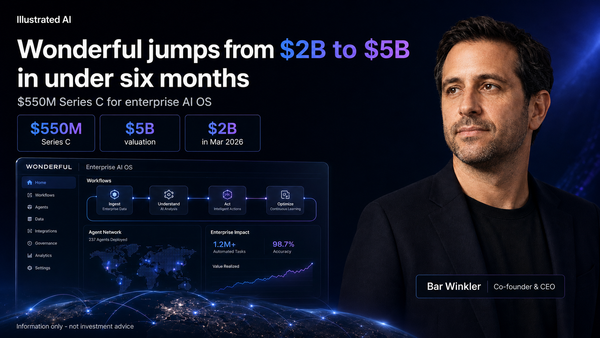
Wonderful illustrates that shift. On September 2, the company closed a $550 million Series C at a $5 billion valuation, led by Insight Partners with participation from Salesforce and existing investors. Capital is no longer chasing novelty. It is chasing control points. In enterprise AI, the emerging prize is the software layer that determines how AI is deployed, where it touches workflows, and how it connects across the organisation. A platform sitting across the business can automate whole task sequences, coordinate digital agents, and deliver value across multiple departments. That starts to look less like an app and more like an operating system for work itself.
A leap to a $5 billion valuation is not merely a financial milestone. It signals that investors believe enterprise AI is consolidating around platforms rather than scattered tools. Private capital tries to identify category leaders before categories fully mature, paying aggressively when a company shows signs of shaping a trend rather than simply participating in it.
Large funding rounds also create strategic options: faster hiring, broader product development, and global expansion. In fast-moving software markets, speed itself becomes a moat. A major financing also influences customers, recruits, and partners. The round becomes self-reinforcing.
Many companies today juggle disconnected AI tools across departments, creating fragmented workflows and inconsistent data access. An enterprise AI operating system solves this by providing a central layer integrating models, connecting data, managing workflows, and coordinating digital agents, turning scattered intelligence into organised action at company scale.
The strategic strength of this position is that it sits above individual model choices. Models will improve and providers will change, but the company controlling the orchestration layer remains valuable. Once embedded across multiple processes and data sources, switching costs rise sharply and expansion opportunities multiply. The platform becomes institutional infrastructure, not just a convenience.
Bold narratives must meet operational reality. Serving more than 35 markets signals a product shaped for diverse commercial environments. Workforce expansion reflects the demands of building enterprise-grade software: product, engineering, sales, and compliance teams all needed to scale trust alongside technology. Revenue growth is the market's lie detector. It confirms that enterprises are moving beyond experimentation into production deployment.
The difference between a pilot and production is everything. Production requires systems to work repeatedly, reliably, and at scale. New capital can accelerate this shift, but execution remains the defining challenge. The strongest platforms use growth as a test of discipline, building coherent systems customers trust rather than rushed collections of features.
Beyond the headline figures, four indicators matter most. First, product depth: can the platform handle real enterprise complexity, including integrations, security, and governance? Second, customer expansion: are customers deepening usage and embedding the platform into ordinary operations? Third, economic quality: is growth efficient, with strong retention and controlled costs? Fourth, competitive defence: rivals may approach from workflow automation, productivity software, and large incumbents bundling AI features.
The greatest value in AI may not belong to those who create intelligence, but to those who organise it. A platform making AI easy to deploy, monitor, and scale across a real organisation may prove more valuable than one offering a clever model interface alone. Durable value will depend on adoption, retention, operating efficiency and competitive differentiation.
Enterprise AI is growing up fast. The real winners may be the platforms that make intelligence useful, scalable, and impossible to ignore.