AI Data Center Cooling Goes Strategic with Kelvion’s $4.1B Exit
– 4 min read
Every technology revolution has a quiet hero. In the AI age, it is cooling. That may sound ordinary, but managing heat has become one of the most critical challenges in building AI infrastructure at scale.
Invest in top private AI companies before IPO, via a Swiss platform:
 SmartProfit Finder AG
AI systems demand enormous computing power. As processors grow more powerful, they generate tremendous heat — a physical limit that degrades performance, shortens equipment life, and drives up costs. The dream of AI is digital; the obstacle is deeply physical.
Modern AI data centers are denser, hotter, and far less forgiving than server rooms of the past. Cooling is no longer background infrastructure. It is a control valve for growth — unlocking higher performance, reducing energy waste, and making expensive hardware viable. Without it, expansion stalls.
This reordering of priorities changes the story for thermal management companies. Businesses once viewed through an industrial lens are now being recast as critical AI infrastructure providers. Better cooling also supports sustainability goals, helping operators expand capacity without losing control of energy costs — making it an economic advantage, not just an engineering requirement.
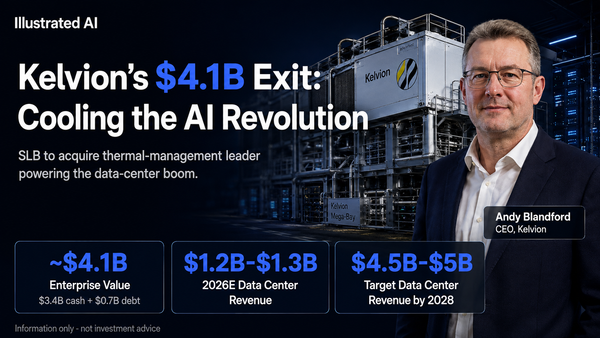
Big transactions sometimes redraw the map of what matters. A deal valued at roughly $4.1 billion has done exactly that, thrusting thermal management into the center of the AI infrastructure conversation.
The structure is telling: approximately $3.4 billion purchase price plus $0.7 billion of assumed debt. The target projects 2026 revenue of $2.3–$2.4 billion and adjusted EBITDA of $350–$400 million — meaningful scale with real profitability. Data-center revenue alone is expected to reach $1.2–$1.3 billion in 2026, making it the largest and fastest-growing segment. By 2028, the combined data-center business is projected to reach $4.5–$5.0 billion — the combined business is targeted to more than double in a short period.
This matters because investors often assume AI upside lives only in software and semiconductors. Yet every major technology wave creates ecosystems of winners. Railroads rewarded steel producers and equipment makers. The internet rewarded fiber networks and cloud providers. AI needs enablers, and thermal management is proving to be one of them.
The valuation sends a clear market signal: cooling is no longer an afterthought. It has become part of the competitive foundation of the AI age — and when the market pays billions to secure that foundation, the conversation changes fast.
Behind every elegant digital service stands physical machinery pushing against the laws of nature. As AI systems scale, heat has become one of the industry's defining bottlenecks.
Modern AI racks operate at far higher power densities than traditional systems — more energy concentrated into tighter spaces. Conventional cooling methods can struggle under these conditions, forcing operators to leave capacity underused, overspend on electricity, or risk costly downtime.
Bottlenecks create bargaining power. When an industry depends on a scarce capability, providers of that capability gain influence. Thermal specialists are no longer just hardware vendors — they are problem solvers at the heart of AI deployment, shaping design choices, operating costs, and expansion timelines.
As AI advances, this challenge will intensify. More powerful models require more computation, which generates more heat, which forces smarter infrastructure choices. The businesses that help the industry break through that thermal wall may not always be glamorous, but they could become some of the most valuable enablers in the entire ecosystem.
The most interesting corporate moves happen when companies see the world changing and act decisively. This transaction reflects how the boundaries between traditional industry and high-growth technology infrastructure are blurring.
The acquiring company brings deep expertise in energy technology and complex engineering — capabilities increasingly relevant to AI infrastructure. Data centers supporting advanced AI are massive, power-intensive, and operationally complex, requiring robust electrical systems, thermal controls, fluid handling, and precision engineering. In other words, exactly what sophisticated industrial companies understand.
This pivot positions the buyer not merely as an industrial participant, but as a provider of critical infrastructure solutions for the AI era. Technology waves often reward companies that translate existing strengths into fast-growing adjacent markets. When the problem is physical rather than purely digital, experience can matter as much as novelty.
The broader implication: AI is pulling industrial technology into a new orbit. Thermal control, power systems, and infrastructure integration are becoming vital growth categories. For investors, a corporate pivot into AI infrastructure can reshape valuations and growth expectations — especially when industrial discipline meets one of the fastest-growing infrastructure themes in the world.
Once a market recognizes a strategic bottleneck, attention spreads quickly. The first question is execution — can strong narratives convert into sustained revenue growth, timely delivery, and real operating performance? Watching regulatory approvals and integration progress separates headline enthusiasm from durable results.
Beyond the deal, the more compelling development is the read-through for adjacent categories. Liquid cooling, power distribution, heat rejection equipment, and facility optimization all address the same problem set. AI data centers depend on an interconnected stack of physical systems — creating a broader investment theme around enabling infrastructure.
Discipline remains essential. Not every infrastructure-linked company deserves premium valuations. Some have only tangential AI exposure; others face intense competition with limited differentiation. The smarter focus is on businesses with genuine technical relevance, evidence of customer demand, and a clear role in solving bottlenecks that intensify as AI scales.
The growth targets are a crucial test. Revenue projections of $4.5–$5.0 billion by 2028 imply dramatic scaling. Visible progress toward that goal would reinforce thermal management's place in AI portfolios. Stumbles would remind the market that infrastructure booms are rarely smooth.
Transformational themes follow a pattern: early excitement centers on obvious winners, then capital shifts toward businesses that remove the emerging constraints. Cooling sits squarely in that second wave — addressing a real, escalating problem linked directly to the economics of AI deployment.
AI may capture the imagination, but cooling helps make it real.