DeepSeek’s $74B AI Funding Push and Pre-IPO Surge
– 5 min read
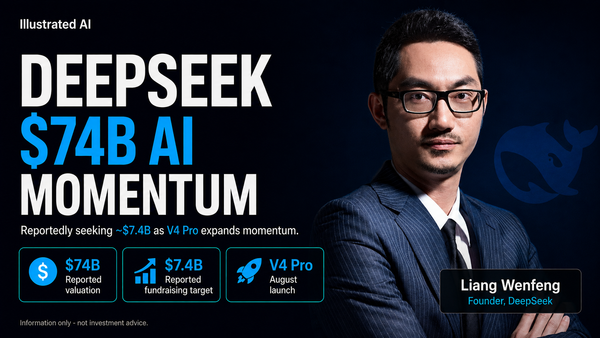
DeepSeek's latest financing ambition transforms the company from an admired technical challenger into one of the most closely watched capital stories in global AI. The reported target is striking: roughly 50 billion yuan in new funding, around $7.4 billion, at a valuation near $74 billion. Earlier signals pointed to just above $51 billion. That leap suggests investors now see DeepSeek not merely as a promising lab, but as a potential heavyweight platform capable of shaping markets.
Invest in top private AI companies before IPO, via a Swiss platform:
 SmartProfit Finder AG
Private-company valuations are stories about the future. This reported jump signals belief in a far larger commercial opportunity ahead. Frontier AI companies are building engines that can write, reason, search, automate tasks, and act as digital coworkers. A company winning even part of that market becomes deeply embedded across software, healthcare, finance, and manufacturing.
DeepSeek's fundraising combines three powerful forces: scale, timing, and narrative. Raising billions places it in a different league. The round reportedly coincides with preparation for a possible 2027 public listing. And DeepSeek built its reputation by challenging the idea that only the richest labs could produce world-class AI. Now it champions efficiency while seeking capital to compete at the frontier. For investors, efficiency paired with balance-sheet firepower is rare and magnetic.
DeepSeek disrupted frontier AI by proving that smart architecture and cost discipline could compete with massive spending. That insight broadened the entire competitive conversation. Yet the latest phase reveals a familiar truth: disruption can lower barriers, but scale still matters. Advanced AI demands relentless cycles of research, training, deployment, and optimization. Each step consumes capital.
Efficiency does not eliminate the need for capital; it increases the potential return on capital. Think of a faster engine in a larger vehicle. The machine still needs fuel, but every unit carries it farther. A company that uses resources better than rivals becomes more competitive once it accesses major funding. DeepSeek appears to be moving from proving a point to building an empire, capitalizing on its original thesis rather than abandoning it.
If DeepSeek pairs lower-cost innovation with large-scale execution, rivals face pressure to justify their own economics. Customers gain leverage. The first wave changes assumptions. The second changes business models. DeepSeek appears to be crossing that boundary now.
Big valuations make noise, but products make money. The release of V4 Pro advances DeepSeek's strategy through stronger agent capabilities, flexible reasoning effort, and support for familiar API formats. Agent capabilities move AI from answering to acting, handling multi-step workflows and goal-oriented tasks. Flexible reasoning lets the model match computational effort to task complexity, improving the balance between speed, quality, and cost.
API compatibility may be the least glamorous but most commercially powerful feature. When a model supports widely recognized formats, developers integrate it faster, reducing switching costs and shortening deployment timelines. Convenience is a genuine competitive edge.
Pricing strategy reveals a company thinking like an operator. Peak and off-peak API rates, with off-peak set at half the peak level, smooth utilization and give customers a path to lower costs by timing workloads intelligently. AI is rapidly becoming an economic service. Businesses ask how much it costs, how predictable billing is, and whether usage can be optimized. DeepSeek's pricing structure answers those questions directly.
The combination of strong technical reputation, aggressive pricing, and open access creates powerful network effects. More developers mean more applications, more feedback, and greater commercial stickiness. DeepSeek appears to be building a platform businesses can plug into, not simply a model they can admire.
Private markets reward possibility. Public markets demand proof. DeepSeek's reported financing appears to serve as a bridge to a possible 2027 listing, making it part of a transition plan rather than merely fresh capital. A company preparing for public scrutiny shifts from being judged by excitement to being judged by discipline, transparency, and evidence.
Public investors ask harder questions: revenue quality, cost structure, governance, regulatory exposure, and execution consistency. That pressure often sharpens management behavior well before any official filing. The reported financing could strengthen infrastructure, support expansion, and give the business room to mature before facing daily market judgment.
A Shanghai listing would place DeepSeek within a domestic public-market ecosystem and potentially broaden its access to local institutional capital. For a frontier AI company, computing access and industrial partnerships are strategically critical, making venue choice meaningful.
Going public is ultimately a declaration that a business model can withstand broader scrutiny. For DeepSeek, that would signal confidence that its efficiency-led reputation can translate into a mature operating business. The dream has to become a system. The story has to become a structure. That transition can create tremendous value when executed well.
DeepSeek operates in a global field crowded with powerful players and massive budgets. Its reported appeal rests on a distinctive position: open-weight distribution, aggressive pricing, and strong performance achieved with constrained compute. These form a real identity in a market where differentiation can otherwise blur into a contest of scale.
Open-weight distribution spreads technology broadly, building developer loyalty and ecosystem growth. Aggressive pricing forces rivals to defend their economics. Compute efficiency creates structural room to maneuver. Together, these suggest a potential durable advantage rather than a temporary marketing edge.
Capital is oxygen in frontier AI. The reported financing can support faster model development, stronger hiring, larger compute reservations, and better enterprise support. The reported involvement of strategic industrial capital adds further depth, bringing relationships and real-world deployment pathways that pure financial capital cannot replicate.
The essential question is whether DeepSeek can turn strategic identity into lasting position. Can it keep improving models fast enough? Can it convert usage into meaningful revenue while preserving cost advantages at scale? These are the questions separating excitement from durability. DeepSeek sits at the center of multiple tectonic shifts: AI moving from research to utility, capital markets moving from curiosity to commitment, and competition expanding from model quality to full-stack platform strength.
DeepSeek's next phase will test whether its combination of efficiency, open-weight technology, competitive pricing and substantial new capital can translate technical momentum into durable commercial scale. That transition-from model challenger to full-scale AI platform is the development investors should watch most closely.