Visma’s Dutch AI Platform Consolidation
– 5 min read
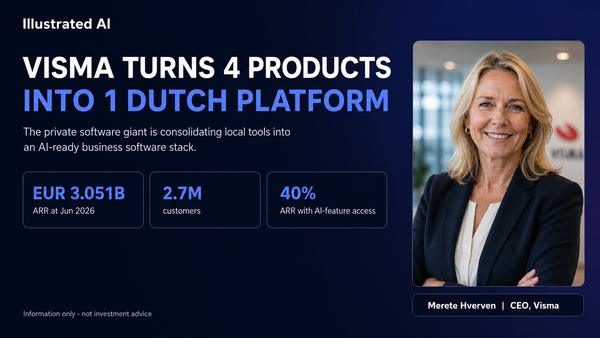
Big change in business software rarely starts with fireworks. In the Netherlands, four separate products—payroll, accounting, invoicing, and financial reporting—were brought together under one platform. They were no longer neighboring tools. They became parts of one connected machine.
Invest in top private AI companies before IPO, via a Swiss platform:
 SmartProfit Finder AG
Small businesses don't experience administration in pieces. A salary payment affects accounts. An invoice affects cash flow. A tax obligation affects reporting. Traditional software forces people to jump between systems as if these links don't exist. The result is friction, duplicate work, and avoidable errors.
The platform approach attacks that directly. A payroll entry feeds accounting. Invoicing connects to reporting. Financial information moves through the workflow without people constantly carrying it from one digital room to another. This is more than a rebrand—a rebrand changes the label; a platform shift changes what's inside and how the parts fit together.
The scale makes this compelling. The combined platform already reaches around half a million entrepreneurs and accountants in the Dutch market, built on real habits and real business dependence. Once software sits across payroll, bookkeeping, invoicing, and reporting, it becomes part of how a business functions—not just something the business buys.
Revenue in the first half of the year reached over EUR 1.6 billion. Adjusted EBITDA climbed to EUR 547 million. Annualised repeatable revenue moved above EUR 3 billion across 2.7 million customers. These are not startup statistics—they signal serious economic gravity.
Repeatable revenue means the business is predictable. Customers subscribe, renew, and keep using software embedded in core operations. That predictability lets management invest confidently and gives investors visibility that markets prize highly. Combined with strong margins, this means each new customer or added module contributes to a model that's already economically sound.
Scale also strengthens competitive defense. A company with recurring revenue, broad customer base, and strong margins can fund product development, acquisitions, and AI capabilities through market cycles. Customers may tolerate a slightly weaker edge feature if the broader platform saves hours across everything else. Convenience becomes a moat. Workflow depth becomes lock-in.
The result is a company that looks less like a collection of apps and more like infrastructure—software that businesses rely on regardless of market noise. Scale turns size into strategic leverage: revenue funds innovation, subscriptions increase visibility, profitability supports reinvestment, and customer breadth amplifies every product decision.
The most important use of AI in business software happens quietly, inside workflows people use every day. The company describes itself as AI-first—a phrase that carries weight when backed by broad deployment. AI features are already embedded across strategic platforms, accessible to customers representing a significant share of annual recurring revenue.
Business administration is full of repetitive interpretation: invoices must be read, classified, matched, and recorded; accounting data must be organized; reports must pull meaning from numbers. AI accelerates those tasks by spotting patterns, automating routine judgments, and reducing manual effort.
When payroll, invoicing, accounting, and reporting sit inside one platform, AI gains a much broader field. It can create workflow intelligence rather than mere task intelligence—detecting that an invoicing pattern could affect cash flow, flagging a payroll timing issue, and preparing reporting implications before a problem grows. Examples already deployed include automated accounting-data interpretation, invoice automation, and virtual-CFO advisory tools.
The real defensible edge isn't AI branding—it's combining AI with local domain expertise, regulatory knowledge, and deeply integrated workflows. That contextual intelligence is hard to copy. For investors, the key question is whether AI increases product usefulness, customer dependence, and monetization. If it shortens workflows, improves accuracy, and lifts retention, it's becoming part of the business model, not a sideshow.
This company doesn't follow the familiar startup script. Instead, it offers a case study in building power through recurring revenue, disciplined acquisitions, local market leadership, and deeper integration. A shareholder transaction in 2023 valued the company at EUR 19 billion, with later private-market marks above EUR 20 billion.
The playbook is built around a decentralized portfolio of local software leaders—respecting that payroll rules, tax expectations, and compliance needs differ by country. That foundation created breadth. The next phase is deliberate integration: connecting selected products into national platforms that deepen customer relationships and focus AI investment where it matters most.
Acquisitions create size, but integration creates leverage. When products are woven together, cross-selling becomes easier, switching costs rise, data becomes more useful, and development spending serves a broader purpose. This suggests a path to compounding that doesn't depend solely on buying more companies—the real unlock comes from extracting more value from assets already owned.
The Dutch consolidation signals a move from collection to coordination, from ownership to orchestration. This is disruption arriving not through chaos, but through disciplined integration, steady economics, and the quiet construction of platforms that become hard to leave.
The real test is whether the platform changes behavior. Four metrics will reveal the truth.
Cross-module adoption: If customers using one tool begin taking up payroll, invoicing, and reporting within the same platform, the strategy is working. Each extra module raises revenue per customer and deepens the relationship.
Retention: If integration reduces churn, it means businesses find it harder to justify leaving because the software solves more daily work in one place—one of the loudest indicators of product strength.
AI usage: Access alone isn't enough. The meaningful question is whether users trust and regularly use AI features in core workflows—automated invoice processing, faster report interpretation, better advisory prompts. Monetization follows: does AI support premium pricing, improve retention, and encourage broader module adoption?
Repeatability: If this playbook proves effective in the Netherlands, attention turns to other national markets. Can local leaders elsewhere be combined into coherent platforms without losing the expertise that made them valuable? If yes, the Dutch move is a template for broader transformation.
The clues will become visible. Higher module adoption, stronger retention, broader AI usage, and repeatable integration across countries are measurable outcomes. The bigger lesson: in enterprise software, the most important revolutions aren't always dramatic. They happen when core workflows connect, intelligence embeds, and a large recurring-revenue base quietly upgrades into something more powerful. One platform, deeper workflows, smarter automation—if execution matches ambition, this is software getting stronger.