Databricks’ $190B AI Platform Push
– 4 min read
Big shifts in technology rarely announce themselves loudly. They arrive disguised as a product update or a new platform feature. That is the real excitement surrounding Databricks. What once looked like a data company is becoming something far larger: a central operating layer for enterprise artificial intelligence.
Invest in top private AI companies before IPO, via a Swiss platform:
 SmartProfit Finder AG
Businesses do not want AI in isolation. They want a system connecting private data, internal processes, security rules, and multiple AI tools in one place. Databricks is moving aggressively into that role, building a governed ecosystem where many top models can be used safely and efficiently.
This changes everything. Early AI excitement focused on models themselves. But companies run on systems, not benchmarks. A powerful model without connections to databases, supply chains, and customer records is like a brilliant employee locked outside the office. Databricks is becoming the doorway through which businesses access multiple frontier AI models while retaining control over their data.
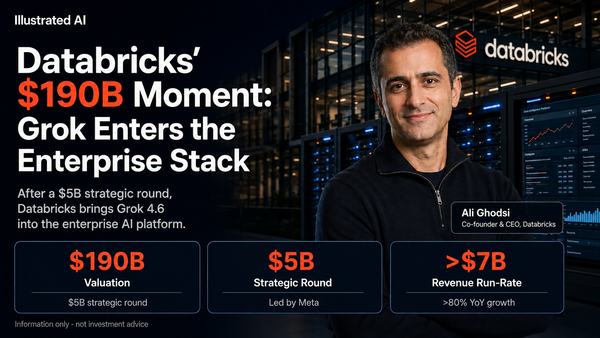
The addition of Grok 4.6 as a hosted model on Databricks looks technical on the surface. Underneath, it signals that enterprise AI's future belongs to platforms offering choice rather than allegiance.
AI models improve constantly. Strengths vary by task. Businesses do not want to rebuild infrastructure every time the AI race changes leaders. By hosting multiple frontier models, Databricks reinforces a powerful idea: the platform is the stable foundation, while models become appliances that can be swapped without tearing down the walls.
Grok 4.6 brings enterprise-relevant features including a large context window for processing lengthy contracts and complex reports, configurable reasoning effort to balance speed and cost, and function calling that lets the model trigger workflows and interact with systems. A model that drafts an email is useful. One that drafts the email, checks the account record, and launches a follow-up process is transformative.
A giant valuation alone does not explain why a company matters. What makes Databricks striking is pairing that number with a revenue run-rate exceeding $7 billion, year-over-year growth above 80%, and fresh strategic capital giving management room to invest without defensive short-term decisions.
Growth is easy when a company is tiny. Maintaining rapid expansion at multi-billion-dollar scale suggests the company is tapping a market trend with substantial force. Customers are not just staying for the original product. They are spending more as the platform becomes central to new layers of work.
The $190 billion figure implies the market sees Databricks as potential foundational infrastructure for enterprise intelligence, not merely a fashionable tool. That raises both the bar and the prize.
Technology history is full of expensive mistakes from betting too narrowly. In AI, that danger is especially high as models improve rapidly and competitive advantages narrow fast. Databricks' neutral platform strategy may therefore prove more powerful than championing a single model.
Different models excel at different tasks. A neutral platform manages this complexity, helping companies decide which model to use, how to connect it to data, govern access, monitor usage, and integrate outputs into real business systems. Governance is not optional in enterprise settings. When AI touches proprietary data, legal, compliance, and security teams need rules they can trust.
There is also an economic advantage. If model providers compete aggressively on price, a platform sitting above them benefits from increased usage regardless of which model wins a given job. Roads often matter more than cars. Databricks is building the road.
Every disruptive company eventually faces the same test: can it become habitual? That is the contest Databricks now faces. Competition is fierce. Cloud providers bundle model access with infrastructure. Model developers push deeper into enterprise tooling. Specialist vendors target narrow but important slices of the market.
Databricks must prove customers want to consolidate their AI stack around one platform rather than mixing separate tools. If it succeeds, customers gain speed, simplicity, stronger controls, and lower coordination costs. Several signals will matter: growth in AI-related consumption, adoption of agent and database services, and margin discipline as model-serving costs rise.
If this ambition succeeds, Databricks could become one of the hidden engines of the AI era. Not always the loudest brand, but a critical layer underneath enterprise adoption. The race is no longer just about building smarter AI. It is about owning the environment where intelligence gets put to work. Databricks is charging straight toward the center of it.