Wayve’s London Autonomous Driving Rollout
– 4 min read
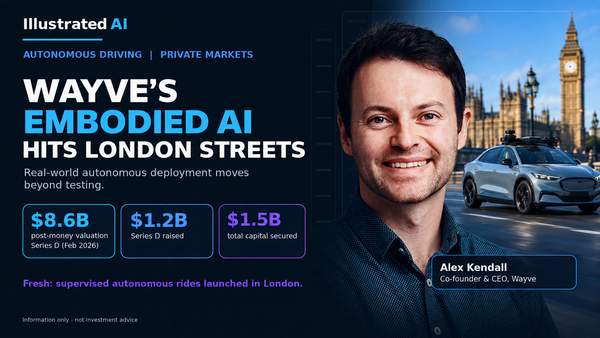
When an AI system starts making decisions on a real city street, everything changes. Wayve now provides a concrete example. London riders requesting an UberX, Uber Electric or Uber Comfort can be matched with a Ford Mustang Mach-E equipped with the Wayve AI Driver, bringing the company's autonomous-driving technology directly into a public ride-hailing service.
Invest in top private AI companies before IPO, via a Swiss platform:
 SmartProfit Finder AG
The public nature of this launch changes the psychology of adoption. People can now choose whether to ride in a vehicle driven by software. Technological revolutions gain mainstream momentum when ordinary people begin interacting with them directly. Once the public participates, a market forms around actual behavior rather than speculation. For investors, partners, and regulators, every trip becomes evidence. Every successful ride strengthens the claim that the product works beyond test tracks. When AI begins driving on city streets, the future stops being a slide deck. It becomes measurable.
The company reached a post-money valuation of $8.6 billion after raising $1.2 billion in a Series D round, with a broader $1.5 billion pool secured for commercial rollout. At this level, investors are no longer paying only for potential — they are paying for execution. The London deployment arrives after the large funding round, not before. The public rollout now serves as the first major opportunity to test whether capital can convert into operational momentum.
The evidence does not need to appear all at once. It arrives through proof points: reliable service, user acceptance, scalable operations, and repeatable revenue. Large capital raises raise the bar. Investors expect measurable traction, not a science project wrapped in a luxury valuation. If deployment goes well, the company gains leverage with partners and stronger future fundraising terms. If it disappoints, questions emerge fast. A multibillion-dollar bet has been placed. The streets now decide how much belongs to hope and how much to durable value.
Traditional autonomous driving relies on detailed maps and location-specific tuning — impressive in narrow environments but expensive and hard to scale. The more disruptive approach is end-to-end learning, where the AI Driver interprets the world directly and generalizes across different roads and environments without heavy local engineering. The system must merge vision, timing, prediction, and control — noticing a cyclist, anticipating their path, judging nearby traffic, and deciding the safest response in fractions of a second.
The company's "zero-shot" ambition suggests the system can operate in places it was never specially prepared for, making autonomous capability behave less like a handcrafted product and more like reusable software. If true, the implications are enormous: faster expansion, lower deployment costs, and commercialization beyond a handful of carefully prepared locations. A generalized system could support higher margins and broader licensing opportunities. The excitement is not merely that a car can drive itself — it is that the company is trying to rewrite how autonomous driving is built entirely.
Rather than building a fleet empire, the company licenses its AI Driver to automakers and partners with mobility platforms that already have vehicles and users. It wants to be the intelligence layer, not the entire transportation stack. Platform economics are often more powerful than operator economics — a software layer can earn revenue across many fleets, brands, and geographies while remaining comparatively flexible. The same core intelligence powering supervised rides today could eventually support hands-off capability in privately owned consumer vehicles, dramatically expanding the addressable market.
The partner roster across cloud computing, semiconductors, ride-hailing, and global automaking positions the company at the intersection of the full autonomy supply chain. This multiplies optionality — if consumer vehicle integration accelerates, automaker licensing becomes a major revenue engine; if mobility fleets expand faster, ride-hailing partnerships drive adoption. The company is not simply building autonomous vehicles. It is trying to become the operating intelligence inside transportation — a far more powerful place to sit.
Markets move on evidence, not excitement. Rider acceptance is the first signal — do people repeatedly choose autonomous vehicles, or does curiosity fade? Fleet expansion introduces operational strain that reveals whether the model is truly scalable. Performance in London's dense urban environment matters because it exposes weaknesses quickly, and sustained stability as usage rises will be closely watched. Commercial conversion is the most critical long-term question: can deployments turn into licensing agreements across multiple brands and regions?
The roadmap toward consumer vehicles beginning in 2027 suggests ambitions well beyond ride services. Physical-world intelligence could become one of the most important economic themes of the coming decade. Every key claim is now testable — generalization, adoption, and commercialization can all be measured. The companies that cross from visionary story to operational reality can define industries for years. The road ahead is busy, unpredictable, and measurable. Big valuation, bold technology, real streets. Now the numbers have to drive.