VAST Data and the Rise of AI’s Data Infrastructure
– 4 min read
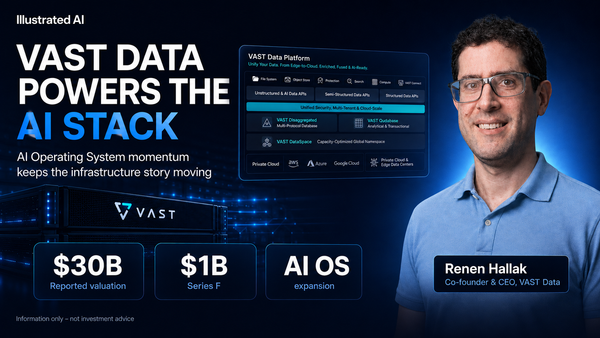
The biggest fortunes in AI are no longer shaped by chips alone. The real contest is moving into the data layer—the plumbing behind the spectacle. Data has become the fuel, memory, and control center of modern AI, which is exactly why companies focused on this layer are surging from the background to the center of investor attention.
Invest in top private AI companies before IPO, via a Swiss platform:
 SmartProfit Finder AG
VAST Data sits where AI ambition meets operational reality. Beneath every impressive result is an unforgiving question: how does information get collected, stored, organized, and delivered fast enough to be useful? If the data layer fails, even the most advanced chips are left waiting—and waiting is expensive.
AI systems are not just compute machines. They are data machines. The economics live in the infrastructure that keeps algorithms fed with timely, reliable information. As AI spreads across industries, someone has to make data flow simple rather than chaotic. That is where the narrative becomes powerful.
Sometimes the most powerful idea is not building something new, but turning a messy collection of tasks into one coherent system. Instead of forcing companies to piece together separate tools for storage, analytics, search, and streaming, a unified AI platform brings those functions into a single environment. In a world drowning in complexity, that simplicity can be revolutionary.
AI models need access to enormous information stores across edge systems, cloud platforms, and GPU clusters simultaneously. A fragmented architecture struggles to keep up. A unified platform acts like a central nervous system—information comes in, gets organized, and reaches wherever the business needs it, without traffic jams or integration headaches.
Architecture shapes economics. Reducing infrastructure sprawl lowers maintenance costs. Improving GPU utilization delivers substantial financial impact. Most importantly, a platform sitting at the center of data workflows becomes structurally difficult to replace—and investors notice when a business becomes strategically important rather than merely useful.
Investor excitement becomes durable only when a company points to measurable performance and real commercial traction. Throughput and uptime tell a dramatic story. When workloads involve expensive GPU clusters, delays burn money and erode trust. Any platform reducing that waste immediately becomes more valuable.
As AI moves from experimentation into production, reliability stops being optional. Organizations cannot build serious systems on infrastructure that fails under pressure. When reference customers include major AI infrastructure players and large institutional users, the message is clear: this technology has crossed the threshold from promise to proven relevance.
Strong performance and credible customers create a feedback loop. Better technology attracts demanding clients. Demanding clients push the technology further. Over time, a reputation proven across demanding production environments can strengthen customer confidence and competitive positioning.
AI becomes truly valuable only when organizations trust it enough for serious environments. Once systems handle sensitive information or influence important decisions, trust becomes just as critical as performance. Many enterprises are not held back by lack of curiosity—they are held back by legitimate operational fears.
Embedding security into the data layer addresses risk where it originates. Sensitive records, proprietary data, and training inputs all pass through that layer. An integrated approach makes protection part of the system's normal behavior rather than an afterthought, giving organizations the guardrails they need at every stage.
Trusted platforms command stronger, longer relationships. Replacing the system responsible for governing and protecting AI data is a major decision. Security and governance act as adoption accelerators—turning possibility into permission. A company combining high performance with intelligent risk management serves both AI enthusiasm and enterprise caution simultaneously.
Every technological revolution begins with a narrow storyline. Early AI attention clustered around models and chips. But revolutions do not create value in only one place. As systems scale, opportunity spreads across the entire stack—especially among businesses that remove friction from AI adoption.
Market re-ratings happen when a company is recast from an ordinary provider into a strategic AI enabler. Infrastructure layers do their work quietly, yet they sit close to customer pain, spending priorities, and the workflows that determine whether a technology becomes widespread. These hidden layers can become some of the most valuable positions in the stack.
The conclusion is sharp. AI competition is no longer focused only on model intelligence. It is about who moves data best, secures it most convincingly, and turns massive infrastructure into practical results. As AI becomes an economic layer spreading into everything, value cascades into platforms that make it usable, efficient, and scalable. As AI becomes embedded across more industries, the data platforms that improve infrastructure utilization, reliability and scalability could become increasingly important parts of the AI value chain.