AGIBOT: Humanoid Robots Scale Into Commercial Reality
– 4 min read
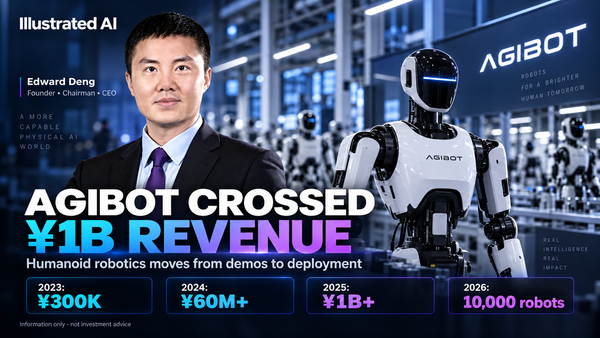
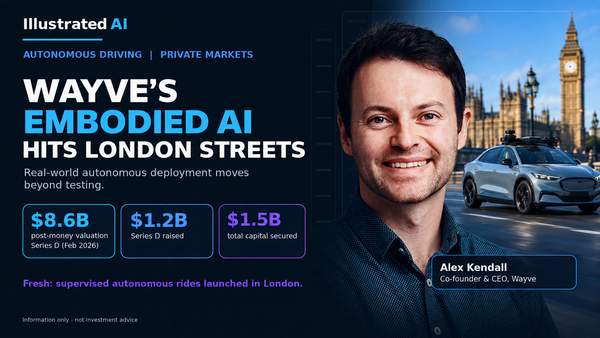
AgiBot provides a concrete example of that transition. The Shanghai-based embodied-AI company says its 15,000th robot rolled off the production line in June 2026, while founder and CEO Deng Taihua reported that company revenue increased from around RMB60 million in 2024 to RMB1.1 billion in 2025. The story has moved from theater to throughput. Businesses now ask whether a robot can perform tasks thousands of times with consistency, safety, and economic value.
Invest in top private AI companies before IPO, via a Swiss platform:
 SmartProfit Finder AG
The most important measure today is execution, not elegance. Real operations have uneven floors, changing lighting, shifting objects, and incomplete instructions. A commercially meaningful robot must handle that friction. The emergence of large-scale deployment signals that humanoid robots are being judged as products, not just engineering achievements. Products must be manufactured efficiently, supported after sale, and priced acceptably. That is where real value is created.
Human environments were built for human bodies. A humanoid machine can operate in warehouses, production lines, and service spaces without requiring costly redesigns, potentially bringing automation to settings previously too complex or variable. Once deployment reaches volume, companies gather critical evidence about failure rates, maintenance needs, and customer willingness to expand. Scale turns a science project into an economic experiment, and the companies that execute successfully could help build an important operating layer for physical AI.
Rapid revenue growth provides an important signal that commercialization may be moving beyond small-scale experimentation. In robotics, where customers invest heavily in testing, training, and integration before buying, sharp revenue acceleration suggests buyers are treating robots as operational tools rather than experiments. That shift in business psychology changes everything.
Rapid revenue growth can support commercial expansion, but not all revenue is equal. Investors still need to examine margins, cash requirements, repeat purchases and deployment economics. Sophisticated observers look beyond headlines, asking whether customers reorder, whether service revenue follows hardware revenue, and whether margins improve with volume.
Fast revenue growth also creates strategic leverage with distributors, enterprise buyers, and capital providers. However, momentum must meet discipline. The harder questions follow: Can growth continue without sacrificing quality? Can recurring revenue replace lumpy transactions? Do deployments genuinely improve customer productivity? Those answers determine whether the surge begins a durable company or peaks as an early wave.
Scale is where dreams meet reality. Building thousands of robots quickly, consistently, and affordably requires supply-chain coordination, quality assurance, assembly discipline, and delivery planning. Every weak link becomes expensive at volume. Production milestones signal that a company is industrializing, not just inventing, and the factory becomes as important as the lab.
There is also a critical cost story. As production ramps, unit costs can decline through purchasing scale, process improvements and manufacturing learning. If humanoid robotics enters that curve, adoption could accelerate dramatically. But scale amplifies risk too. Inventory ties up capital, wider installed bases raise warranty obligations, and unexpected demand slowdowns can turn capacity into a burden.
A company reaching manufacturing scale early builds advantages that are hard to copy: more field feedback, faster hardware improvements, better supplier terms, and refined deployment playbooks. In robotics, long-term commercial relevance is likely to depend less on spectacular demonstrations than on the ability to manufacture consistently, support deployments reliably and improve economics over time. The factory is where the future either becomes affordable or stays theatrical.
A humanoid robot becomes valuable not simply because it exists, but because it improves. That improvement depends on data. Real-world environments are messy: things slip, surfaces reflect oddly, humans move unpredictably. A robot trained only on perfect examples will struggle when reality refuses to cooperate. Rich, real-world datasets are therefore essential.
Crucially, failure generates some of the most valuable data. When a robot drops an object or misjudges a path, it reveals edge cases that make robust deployment possible. This creates a powerful flywheel: more deployed robots generate more data, better data improves models, better models drive more deployments, and the cycle compounds.
At sufficient scale, operational data could become an important source of differentiation. Hardware architectures can be replicated over time, but large, high-quality datasets capturing real-world successes, failures and human interventions may be considerably harder to reproduce. For investors, the data layer may ultimately matter more than the hardware headline. Metal can be duplicated; dense, high-quality real-world experience cannot. In embodied AI, data is the memory of the machine and the force that can translate deployment scale into better system performance.
Once a company proves it can build and sell at home, the next test is whether success travels. Different countries bring different regulations, labor costs, customer expectations, and partnership dynamics. Going global also tests business-model flexibility. Robot-as-a-Service models lower adoption barriers by converting capital expenditure into operating expense, creating recurring revenue potential, though they shift performance risk and maintenance obligations onto the provider.
AgiBot has also begun the process of pursuing a Hong Kong initial public offering, introducing another layer of financial scrutiny. Private markets reward vision; public markets demand transparency. Investors want audited numbers, gross margins, customer concentration, cash burn, and deployment economics. In a capital-intensive industry, those details are the heart of the investment case. Public-market discipline separates fascination from fundamentals and can actually strengthen companies that answer hard questions convincingly.
Together, international expansion and listing readiness form a crucible. The company must prove humanoid robots can create a durable business with global reach and investable economics. Technology opens the door, but global execution and financial truth decide who walks through it.
Conclusion: The story is no longer about whether humanoid robots look impressive. It is about whether they can learn, scale, earn, and endure. That is where disruption becomes investment reality.