Treeline’s Roche-Backed Lymphoma Drug Push
– 2 min read
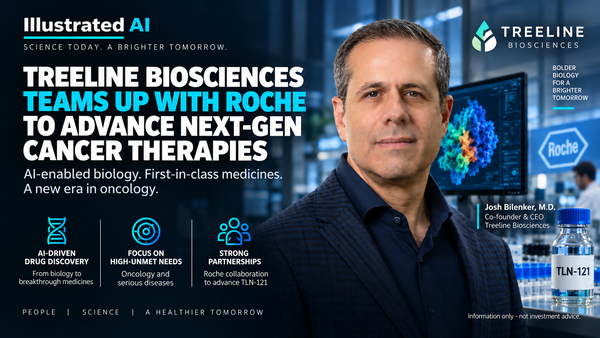
Treeline Biosciences is turning heads for good reason. Backed by roughly $1.2 billion in private funding, strengthened by a collaboration with Roche, and advancing a differentiated cancer drug, this is a company moving from promising concept to serious contender. A planned merger with Standard BioTools would create a Nasdaq-listed company under ticker TRLN, with more than $900 million in pro-forma cash expected at closing and projected operating runway into 2029. In biotech, that level of capital can provide substantial flexibility to advance multiple clinical programs through important development milestones.
Invest in top private AI companies before IPO, via a Swiss platform:
 SmartProfit Finder AG
Many targeted cancer drugs work by inhibiting protein activity. TLN-121 is designed to degrade it rather than simply inhibit its activity. Its target, BCL6, helps certain lymphoma cells survive. Rather than inhibiting BCL6, TLN-121 is designed to degrade it—marking it for destruction by the cell's own cleanup machinery. This targeted protein-degradation approach offers a different therapeutic strategy from conventional inhibition. Treeline reports that preclinical studies showed enhanced anti-tumor activity when TLN-121 was combined with CD20xCD3 T-cell-engaging antibodies, providing the rationale for testing it alongside Roche's glofitamab and mosunetuzumab. Combination dosing is expected to begin in Q4 2026.
In a Phase 1 update, 16 of 19 efficacy-evaluable patients across relapsed or refractory lymphoma groups showed an overall response, including six complete responses. No dose-limiting toxicities were reported at the data cutoff. These are encouraging early signals—not a final verdict, but sufficient to support further clinical investigation. The Roche collaboration provides additional external validation of the combination-development strategy, although it does not establish clinical efficacy.
CEO Josh Bilenker previously founded Loxo Oncology, which produced three FDA-approved medicines before being acquired by Eli Lilly for $8 billion. CSO Jeff Engelman led oncology research at Novartis. Their track record matters. Treeline also integrates biology, chemistry, and computation into one in-house discovery system—not AI as branding, but computational and machine-learning tools used to understand protein targets, prioritize chemical candidates and improve predictive models. With additional programs including pan-KRAS inhibitor TLN-372 advancing toward 2027 milestones, the investment thesis extends well beyond any single asset. If the model proves repeatable, Treeline could emerge as a durable oncology platform—not just a one-drug story.