Wayve Signals Commercial AI Rollout with Ex-Waymo CFO Hire
– 3 min read
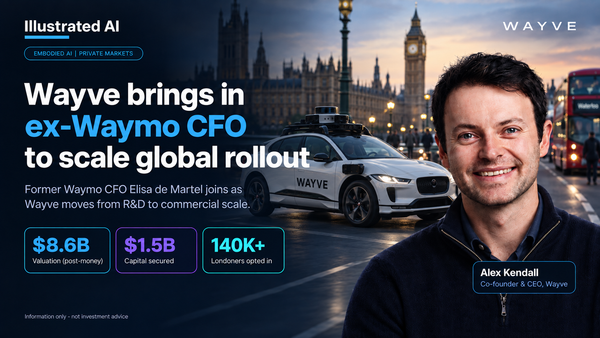
Wayve is moving beyond proving its technology works. The real challenge now is making it scale, earn revenue, and survive public deployment. That shift is why hiring Elisa de Martel as CFO carries unusual weight. She brings experience from Waymo, one of the few organizations that has navigated the transition from pre-revenue AI story to operational transportation system. A seasoned finance leader at this stage is not counting costs. She is shaping pricing, partnerships, capital allocation, and long-term value creation.
Invest in top private AI companies before IPO, via a Swiss platform:
 SmartProfit Finder AG
The distinction between a research story and a commercial one matters. Research is judged by possibility. Commerce is judged by delivery. Investors stop asking "Can this work?" and start asking "How repeatable is it, and can it grow without burning mountains of cash?" That is the conversation Wayve is now entering.
Wayve raised a $1.2 billion Series D at an $8.6 billion post-money valuation. Including additional milestone-based capital committed by Uber, the company says it has secured $1.5 billion to support commercial deployment. Its investors include Microsoft, Nvidia, Uber, Mercedes-Benz, Nissan, Stellantis, AMD, Arm and Qualcomm, bringing together companies from cloud computing, semiconductors, mobility platforms and automotive manufacturing.
Large funding raises the bar. It signals that influential players see a globally significant opportunity, but it also demands proof. The phrase "capital secured for rollout" points to deployment, not just development. The central question becomes whether real-world use can create a self-reinforcing cycle of more data, more trust, more partners, and stronger economics.
Wayve and Uber have launched supervised autonomous rides in London. More than 140,000 Londoners had opted in for a greater chance of being matched with a Wayve vehicle at launch. A trained, Transport for London-licensed driver remains onboard to supervise each trip. This initial phase can provide operational experience and evidence about passenger demand before any progression toward unsupervised services.
London is a demanding environment: dense, unpredictable, and complex. Embedding the service inside Uber's existing app lowers friction and removes the need for riders to change habits. For investors, this phase is where the story becomes measurable. Every ride generates operating metrics that reveal whether the business is moving from concept to commercial habit.
Wayve’s commercial strategy emphasizes licensing its AI Driver to automakers and supplying autonomous-driving technology to mobility platforms. Partners can provide the vehicles and manage fleet operations. This positions Wayve primarily as a technology provider rather than a vertically integrated robotaxi operator.
Wayve says its end-to-end AI system is designed to operate without high-definition maps or location-specific engineering. If the technology performs consistently across vehicles and markets, its licensing model could require less capital than owning and operating entire fleets. However, its scalability and long-term economics still need to be demonstrated through larger production deployments.
Four proof points will define the next chapter. First, whether the London fleet grows smoothly into a repeatable operation. Second, whether riders return, turning novelty into routine. Third, whether the planned Tokyo pilot with Uber and Nissan—scheduled for late 2026 and subject to discussions with relevant authorities—provides evidence that the technology can transfer successfully between markets. Fourth, whether additional automaker production programs signal that the industry sees lasting value in the platform.
The bottom line: Wayve’s appointment of Elisa de Martel reflects its transition from research-led development toward commercial deployment. The evidence to watch now is paid-ride volume, safety performance, fleet expansion, automaker production programmes, geographic transferability and the economics of its licensing model.