LatticeFlow AI and the Rise of Technical AI Governance
– 5 min read
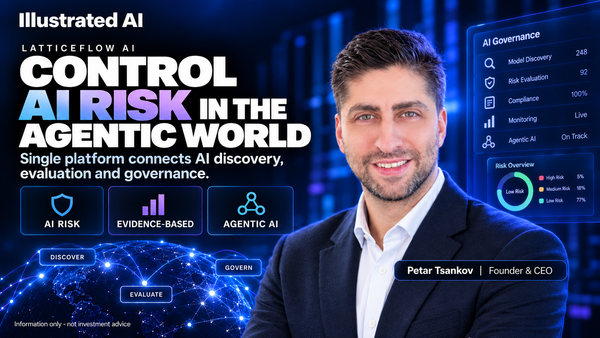
AI systems are increasingly being connected to business data, software tools and operational workflows. As these systems become capable of taking actions, organisations need mechanisms for identifying deployments, testing their behaviour and monitoring risk over time.
Invest in top private AI companies before IPO, via a Swiss platform:
 SmartProfit Finder AG
LatticeFlow AI is developing an enterprise platform built around three functions: discovering AI systems, evaluating their technical performance and connecting the resulting evidence to governance frameworks. The company positions this approach as an alternative to governance based primarily on policies, questionnaires and periodic reviews.
LatticeFlow AI says its platform can identify AI assets, run technical evaluations and map findings to relevant risks and controls. These capabilities may help organisations strengthen oversight, but they do not independently establish that an AI system is safe or legally compliant. Customers remain responsible for interpreting the evidence and meeting their regulatory obligations.
Before governing AI, a company must answer one deceptively simple question: what AI is actually being used? In large organizations, AI arrives through software upgrades, department experiments, and employee workarounds. Marketing teams use generative AI for content. Developers use coding assistants. Support operations connect chatbots to live workflows. None of it appears in a central register. This hidden spread is shadow AI, and unlike a hidden spreadsheet, a hidden AI system influencing customer communications is something far more consequential.
LatticeFlow AI acquired AI Sonar in January 2026, adding technology designed to identify AI assets across on-premises and cloud environments and maintain an updated AI inventory. The company says these assets can then be connected to technical evaluations and centralised governance workflows. Visibility is an important foundation for governance because organisations cannot evaluate systems they have not identified. However, the commercial value of continuous discovery will depend on its accuracy, coverage and integration with customers’ existing technology environments.
A beautifully written policy does not prove a model is safe. A completed questionnaire does not reveal whether a system can be manipulated or fail under pressure. LatticeFlow AI's central idea is direct: governance should be tied to technical evidence. Companies should not just describe how AI ought to behave. They should test how it actually behaves, continuously.
This matters because AI systems are not static. Generative systems produce probabilistic outputs. Agentic systems chain actions together and interact with external tools. Both present a wider range of possible failures. Technical evidence replaces assurances with receipts. It gives risk teams proof before approving deployment, gives security teams confidence before granting access to sensitive systems, and gives boards something concrete when AI is embedded into key business processes.
AI Atlas is a publicly accessible registry that structures AI regulations, standards and frameworks into risks, controls and technical evaluations. LatticeFlow AI says it covers more than 40 frameworks, including elements of the EU AI Act, NIST and OWASP, and provides evaluation packages that can be executed through its platform. These tools may reduce the work required to translate governance requirements into technical tests, but their use does not itself establish regulatory compliance.
A strong idea must become an ecosystem to matter at enterprise scale. LatticeFlow AI's 2026 moves show a company building that surrounding stack. The AI Sonar acquisition expanded discovery. The unified platform connected discovery, evaluation, and governance. AI Atlas mapped frameworks to executable tests. The SAP partnership added continuous monitoring for enterprise AI. Together, these steps move the company from specialist toolmaker toward infrastructure provider.
The SAP relationship is especially significant because enterprise markets reward distribution and integration as much as raw innovation. Governance works best when woven into existing business processes rather than bolted on afterward. Continuous monitoring acknowledges that deployment is not the end of risk management but the beginning of a more persistent relationship. This is why AI governance increasingly resembles cybersecurity surveillance: enterprises are not just approving systems, they are supervising them over time.
The architecture is coherent. Discovery answers what AI exists. Evaluation examines behavior. Governance links findings to standards. Monitoring extends the process over time. Partnerships connect everything to enterprise systems. Enterprise buyers prefer unified platforms over fragmented tools when managing risk, and the most durable software is often the software companies discover they cannot live without. LatticeFlow AI is positioning for that moment before it fully arrives.
Big market shifts do not always begin with giant companies. LatticeFlow AI is a small private company aiming at a category that could become structurally important as AI moves from experimentation into production across regulated industries. The interesting question for investors is not whether AI governance will exist, but where durable value will sit.
Policy software can be replicated with forms and dashboards. Technical governance is harder. It requires expertise in model behavior, testing methodologies, security weaknesses, and the practical conversion of standards into measurable controls. That is a more defensible capability, especially when it compounds through accumulated test libraries, framework mappings, and deep customer integrations. The company's roots in ETH Zurich research add credibility in a category where rigor matters more than marketing volume.
Several themes matter most to investors. Enterprise standardization signals sticky demand and larger budget potential. Agentic monitoring of autonomous systems interacting with live environments raises the value of continuous oversight significantly. Distribution leverage through major enterprise partnerships can transform a technically strong company into a scalable commercial presence. And evidence accumulated over time, including test libraries, framework mappings, and stored governance workflows, may build a moat that strengthens as adoption grows.
Regulation and internal accountability may provide the demand tailwind that completes the picture. As AI rules expand and organizations face greater legal and reputational exposure, spending may shift from optional experimentation to mandatory controls. The winners in that environment are typically the companies already in position with a working technical solution. LatticeFlow AI is not chasing the loudest part of the AI boom. It is building the layer that may become indispensable once the boom matures. Quiet infrastructure can become powerful infrastructure, and powerful infrastructure tends to matter.
The bottom line: LatticeFlow AI has assembled a broader governance platform through AI Sonar, AI Atlas, technical evaluations and its SAP partnership. The strategic direction is coherent, but the investment case will depend on disclosed enterprise adoption, recurring revenue, customer retention and evidence that its assessments become embedded in production AI workflows.