Waabi’s Autonomous Trucking Hits Commercial Scale
– 5 min read
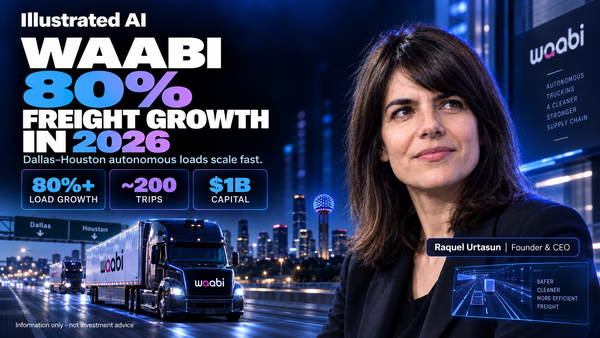
Waabi says freight volumes generated by trucks using its autonomous-driving system on the Dallas–Houston corridor increased by more than 80% during 2026. The figure represents an important commercial indicator for a company seeking to move autonomous trucking from technical development into recurring freight operations.
Invest in top private AI companies before IPO, via a Swiss platform:
 SmartProfit Finder AG
The approximately 240-mile Interstate 45 corridor connects two major logistics centres and carries more than 9,000 freight trucks each day, according to data cited by Waabi. Operating on this route exposes the system to congestion, demanding delivery schedules and the operational pressures of commercial freight.
Waabi also says trucks powered by the Waabi Driver completed nearly 200 trips for an unnamed Fortune 50 retailer during 2026, with no safety incidents and 100% on-time pickup and delivery. These results have not been independently verified, but they provide measurable claims against which future performance can be assessed.
For investors, the important question is no longer simply whether the technology can complete a route. It is whether Waabi can expand load volumes, serve additional customers and maintain reliability as operations grow.
An increase in freight volume can indicate that customers are moving beyond limited trials and assigning more work to an autonomous system. Waabi attributes its reported growth to greater customer demand, although the company has not disclosed the number of customers, total loads or revenue generated by these operations.
Scaling commercial freight requires more than autonomous-driving capability. The service must maintain delivery performance, vehicle availability and safety as the number of loads increases. This makes sustained load growth, customer retention and operational reliability more useful indicators than isolated demonstrations.
Greater route density could improve vehicle utilisation and operating economics. However, investors will need more detailed information—including revenue, cost per load and the extent of human supervision—to determine whether higher volumes are producing sustainable commercial value.
Waabi describes its technology as a shared Physical AI platform designed to operate across autonomous trucks and future robotaxis. The company says the same underlying AI model can support different vehicle types, potentially reducing the need to develop separate autonomy systems for every application.
In June 2026, Waabi said its Driver transferred to the Volvo VNL Autonomous without retraining, despite differences in sensors, vehicle shape and driving dynamics. This “zero-shot” generalisation claim is strategically important, but its broader commercial significance will require validation across additional vehicles, routes and operating conditions.
Waabi is also expanding into robotaxis through an exclusive partnership with Uber. The companies intend to deploy at least 25,000 Waabi Driver-powered robotaxis over time, although a detailed deployment schedule has not been disclosed.
If Waabi can reuse its technology across trucks and passenger vehicles, it may spread development costs across several markets. That advantage remains prospective and will depend on production deployments, safety performance and the amount of additional engineering required for each platform.
Waabi closed a $750 million Series C in January 2026, co-led by Khosla Ventures and G2 Venture Partners. Uber also committed additional milestone-based investment connected to Waabi’s planned robotaxi deployment, bringing the announced financing package to as much as $1 billion. Reports indicate that the Series C valued Waabi at approximately $3 billion.
The round included strategic investors such as Uber, NVentures, Volvo Group Venture Capital and Porsche Automobil Holding, alongside BlackRock-managed funds, Radical Ventures, HarbourVest Partners and other financial investors.
This capital can support product development, commercial freight expansion and Waabi’s planned entry into robotaxis. However, the financing alone does not establish sustainable economics. Investors will need evidence that the company can convert its capital into additional customers, reliable deployments and improving unit economics.
Yet funding creates expectations. Large raises invite close scrutiny. Capital can amplify success, but it can also amplify disappointment if execution lags. The real question is capital efficiency—what each dollar builds. Does it expand route capacity? Shorten time to market? Improve platform transferability? The winners are often not companies that raise the most, but those that convert money into strategic advantage most effectively.
Truly disruptive technologies need patient, abundant capital before they reshape industries—railroads, semiconductors, internet infrastructure, and electric vehicles all followed this path. The company that secures strong financing and uses it wisely builds not just a product, but the architecture of a future market.
Exciting technologies are easy to admire. Great investments are harder. Once autonomous freight moves real commercial loads, investors must shift from fascination to measurement. The question is no longer whether the technology is impressive—it is whether the business can scale with discipline and widening economic value.
Load growth remains the first indicator. Sustained growth across more loads and customers signals that a disruptive technology is becoming commercially durable. Stalling growth may reveal friction in scaling or adoption barriers harder to overcome than early results implied.
Operational quality must hold as activity expands. Supply chains depend on consistency. Growth that damages reliability destroys value. Growth that preserves quality builds a formidable competitive edge.
Economics matter most over time. Autonomous freight becomes deeply disruptive only when it delivers superior economics—not merely superior novelty. Evidence of improving cost per load, asset utilisation and service performance will be important.
Platform transfer unlocks the largest upside. Cross-platform deployment spreads development costs, creates richer data loops, and supports stronger partnerships. Watch whether that ambition translates into real progress rather than remaining a powerful but distant idea.
Customer concentration deserves scrutiny. Early reliance on a small number of partners creates fragility. Broader adoption across industries indicates the technology solves a general market need.
Geographic expansion is the ultimate scalability test. A company that replicates performance across new routes shows the hallmark of a scalable industrial platform.
The bottom line: Waabi’s reported 80% increase in Dallas–Houston freight volumes provides an early indicator of growing commercial activity, but the figures remain company-reported. Investors should watch customer diversification, load growth, safety performance, on-time delivery, operating economics and evidence that the Waabi Driver can transfer efficiently across trucks and future robotaxis.