Nvidia’s Big Bet on SSI’s AI Compute Leap
– 4 min read
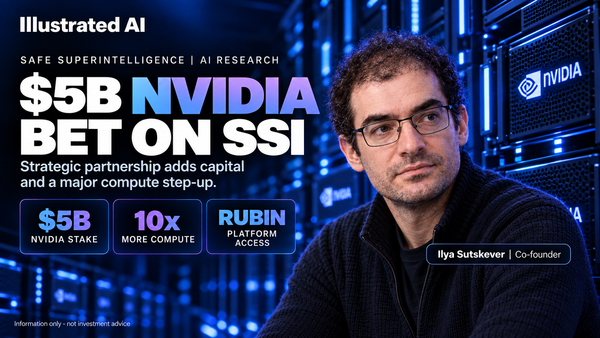
Safe Superintelligence Inc. and Nvidia have announced a long-term strategic partnership that combines an Nvidia investment with access to the company’s next-generation Vera Rubin computing platform. The companies say the arrangement will increase SSI’s computing capacity by an order of magnitude.
Invest in top private AI companies before IPO, via a Swiss platform:
 SmartProfit Finder AG
SSI was founded in 2024 by former OpenAI chief scientist Ilya Sutskever, Daniel Gross and Daniel Levy with the stated objective of developing safe superintelligence. Gross left the company in June 2025, after which Sutskever became CEO and Levy became president. The company has disclosed little about its research and has not released a public commercial product.
Access to substantially more computing capacity could allow SSI to test its research at a larger scale. However, additional compute does not guarantee technical progress. The commercial and scientific importance of the partnership will depend on whether SSI produces measurable research results, safety evidence or deployable technology.
SSI raised $2 billion in 2025 at a reported valuation of $32 billion, despite having no publicly released commercial product. Its investors include Greenoaks, Andreessen Horowitz, DST Global and Sequoia Capital. Nvidia’s latest investment strengthens that group, although the companies have not disclosed its financial terms.
This valuation reflects investor confidence in Sutskever’s research record and SSI’s potential rather than demonstrated revenue or commercial adoption. That creates an unusual investment profile: considerable technical ambition and access to capital, but limited public evidence with which to assess progress.
Investors should therefore distinguish research credibility from commercial validation. The relevant evidence will be technical results, responsible safety evaluation, the efficiency with which SSI uses its expanded infrastructure and, eventually, whether its research produces economically valuable systems.
When the dominant AI hardware company deepens its relationship with a frontier research lab through both infrastructure access and equity investment, the result is something far more strategic than a simple transaction.
Nvidia occupies a remarkable position in the AI economy. If advanced AI is a gold rush, Nvidia has been selling the picks, shovels, rail lines, and power generators simultaneously. When such a company also becomes an investor, the relationship transforms. SSI gains more than capital: it receives access to Nvidia’s next-generation Vera Rubin platform and an opportunity to collaborate on current and future computing systems. In frontier AI, where infrastructure delays can cripple research, that advantage is enormous.
The relationship may also benefit Nvidia by providing information about the infrastructure demands of frontier AI research. The companies plan to collaborate on Nvidia’s current and future computing platforms, allowing SSI’s research requirements and technical findings to inform future development.
The partnership illustrates how the roles of infrastructure supplier, investor and technical collaborator are increasingly overlapping in frontier AI. This structure may accelerate development, but it could also increase the advantages enjoyed by laboratories with access to leading hardware providers.
Greater computing capacity creates an opportunity to run larger experiments, but it does not ensure better models or safer systems. Results will still depend on SSI’s research direction, data, evaluation methods and ability to translate additional infrastructure into measurable progress.
This is particularly important because SSI’s stated objective combines advanced capability with safety and alignment. Investors and researchers will need evidence that both objectives are progressing together.
The partnership therefore raises expectations. SSI now has greater access to capital and advanced infrastructure, but its research remains largely undisclosed. Future assessment should focus on demonstrated technical results rather than assuming that increased compute will automatically produce breakthroughs.
A powerful shift is unfolding across frontier AI. Capital alone is no longer enough. Winners increasingly need a full stack of strategic resources: money, chips, data-centre capacity, networking, power, and the ability to assemble it all quickly.
The scarce asset is no longer just money — it's the combination of money and access. A company can raise billions and still struggle without enough advanced hardware or engineering support. That's why alliances between AI labs and infrastructure giants are becoming critical. They're solving the real bottlenecks of the age.
This merging of capital and infrastructure could reshape market concentration. If only a limited number of companies can secure top-tier compute relationships at scale, the frontier may become increasingly concentrated among a small group of deeply connected players — accelerating progress, but raising barriers to entry for challengers.
The core lesson is clear. The future of AI will not be won solely by companies with the grandest visions. It will be won by those that can unite vision with machinery, research with execution, and capital with access.
The bottom line: Nvidia’s investment and Vera Rubin partnership could expand SSI’s computing capacity tenfold, but the financial terms and detailed infrastructure commitment have not been disclosed. The evidence to watch is whether SSI converts that capacity into verifiable research progress, credible safety results and technology with long-term commercial value.