Scandit Expands Vision AI Into Self-Checkout Loss Prevention
– 4 min read
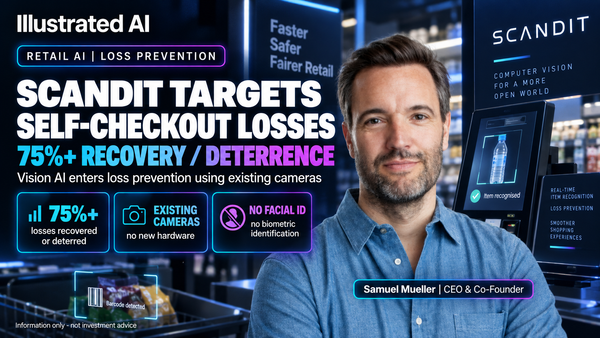
Scandit has launched Self-Checkout Loss Prevention, a vision-AI product designed to identify missed scans, items left in baskets and abandoned transactions before checkout is completed. The system compares video from a lane camera with scanner and point-of-sale data, prompting shoppers to correct flagged items or alerting an employee when escalation is required.
Invest in top private AI companies before IPO, via a Swiss platform:
 SmartProfit Finder AG
Scandit says the product can recover or deter more than 75% of self-checkout losses. This figure is based on Scandit’s calculations and has not been independently verified through a named customer deployment. The company has also not disclosed pricing, contracted customers or revenue generated by the product.
The commercial proposition is balancing loss reduction with customer experience. Retailers need to identify transaction discrepancies without creating unnecessary interventions for customers or additional workload for store employees. Whether Scandit can achieve that balance consistently will depend on detection accuracy, false-positive rates and performance across different store environments.
Scandit says its product can work with built-in checkout cameras, standard overhead security cameras or other compatible existing camera infrastructure. Video is processed locally using a per-station processing unit, removing the need for a dedicated central store server. Retailers without suitable cameras or processing capacity may still require additional equipment.
Reusing existing cameras could reduce installation costs and simplify deployment across mixed store estates. However, the scale of this advantage will depend on camera compatibility, integration with checkout and point-of-sale systems, installation time and total cost per lane.
Scandit says the loss-prevention product analyses item movement and transaction activity rather than identifying individual shoppers. It does not use facial recognition, create biometric templates or attempt to recognise customers across separate visits.
Video is processed locally at the checkout station, which Scandit says is designed to support retailers in meeting their GDPR obligations. This architecture may reduce some privacy risks, but using the product does not automatically establish legal compliance. Retailers remain responsible for notices, data handling, retention policies and the lawful operation of their checkout systems.
Privacy design may influence adoption because retailers must balance loss prevention against customer trust and regulatory obligations. The relevant evidence will include how the system stores or deletes video, how alerts are reviewed and whether customers experience unnecessary interventions.
Scandit built its reputation on smart data capture. Loss prevention at self-checkout pushes the company into a fundamentally different category: operational judgment. The system observes movement, compares it against scanner and point-of-sale data, identifies mismatches, and triggers a workflow before the transaction closes. That is not passive recognition. It is real-time decision-making where money is won or lost.
The product extends Scandit’s existing retail portfolio, which includes scanning, shelf intelligence, store operations and age-verification tools. Age Verified Self-Checkout is a separate product with a different architecture and uses a one-time facial age estimate on the customer’s device; it should not be presented as part of the non-biometric loss-prevention system.
Selling multiple products to existing retail customers could support cross-selling and increase recurring usage. However, commercial defensibility and pricing power will depend on customer adoption, integration depth, accuracy, renewal rates and competition from established retail-technology providers.
The pitch is practical: software that protects margin in a part of the store where loss is already measurable and visible. Skeptics will rightly separate promise from proof. The real test is performance across mixed lighting, varied layouts, crowded baskets, and inconsistent hardware. A system that catches losses but constantly interrupts honest customers trades one problem for another.
Conversion from pilot programmes to chain-wide deployment will be an important commercial indicator. Scandit has not yet disclosed named customers, deployment volumes or chain-wide rollouts for the product. Investors should watch whether existing-camera compatibility and local processing translate into faster installation, lower costs and sustained production use.
Retail operators will judge this on execution: shrink reduction, labor savings, and operational simplicity. If the technology proves reliable across real store conditions, checkout loss prevention may become the gateway to a broader intelligence layer spanning the entire store.
The bottom line: Scandit’s self-checkout product extends its vision-AI platform into a measurable retail problem: transaction loss. Its software-first architecture, local processing and non-biometric item detection could support adoption, but the commercial case remains early. The evidence to watch is named customer deployments, independently verified loss reduction, false-positive rates, installation cost, chain-wide rollout and recurring revenue contribution.