Simplexity Robotics: Big Funding, New Wheeled Humanoid, and the Push for Commercial Scale
– 4 min read
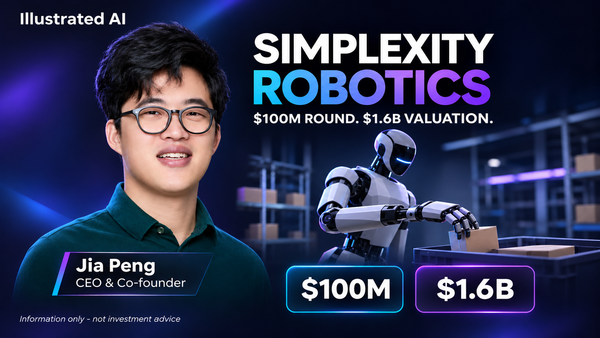
Bloomberg reported on 23 November 2026 that Simplexity Robotics raised $100 million in a pre-Series A led by Ant Group, valuing the company at $1.6 billion, according to chairman and co-founder Wang Kai. Existing investors including Alibaba, Tencent, HongShan Capital and Lanchi Ventures participated. The financing establishes investor backing, rather than independently demonstrated reliability or profitable deployment economics.
Invest in top private AI companies before IPO, via a Swiss platform:
 SmartProfit Finder AG

Robotics has long lived in a frustrating middle ground: machines that impress in demos but fail under everyday pressure. So when capital flows in at size, the market is expressing confidence that this team may solve one of technology's hardest puzzles—making intelligent physical machines useful, affordable, and reliable enough to matter at scale.
This reflects a broader belief that "physical AI" may become the next major technology battleground. Intelligence that sees, moves, grasps, and completes tasks in the real world could transform how work gets done in lobbies, hospitals, warehouses, and factories. The financing provides resources, while the robot launch creates a practical test of the company’s technical and commercial ambitions. Together, they move the question from what could happen in theory to what can happen repeatedly in practice.
Simplexity unveiled iX on 23 November, demonstrating a wheeled humanoid preparing and delivering drinks, fetching objects and guiding visitors. These demonstrations illustrate intended service applications, rather than sustained performance across customer sites.
A wheeled base could simplify locomotion in suitable indoor environments. Any advantage in energy consumption, speed, stability or safety needs assessment against comparable systems, operating conditions and task requirements. Instead of mastering bipedal balance, engineers can focus on what customers actually pay for: perception, navigation, and precise manipulation. That is the hidden brilliance of practical robotics—success belongs not to the most human-like machine, but to the most commercially useful one.
The service focus matters because public spaces are demanding. People move unpredictably, tasks change, and safety expectations are high. A robot must coexist socially, not just function technically. Indoor public venues are potential target environments, but suitability depends on pedestrian traffic, accessibility, thresholds, lift access, emergency procedures and the tasks customers need completed. A family of machines, rather than a single device, further suggests a portfolio strategy: learn from one platform, reuse software across others, and target multiple customer needs.
The most difficult moment in robotics is not building a machine that works once—it is building a company that makes it work again and again, for customer after customer. Commercial life is a different test from the lab. Lighting changes, floors vary, Wi-Fi fails, and customers pay for reliable outcomes, not potential.
Repeatability is the central commercial challenge. It demands manufacturing discipline, field service capability, software updates, spare parts logistics, and the ability to learn from live deployments at speed. Simplexity announced delivery of its first 100 i7 Pro robots on 6 July 2026, a milestone also described by component supplier MCT. This concerns the earlier i7 Pro programme and does not establish iX delivery volumes, paid utilisation or fleet-wide operating performance.
Robotics businesses face a double challenge software firms avoid: improving both brains and bodies simultaneously. If software advances but hardware stays fragile, the customer still suffers. The entire stack must mature together. Deployment experience could improve subsequent systems if the company can collect and use suitable data, retrain models and validate gains. More installations alone do not establish a compounding learning advantage. The true milestone is not a launch event. It is the moment a robot becomes boring in the best possible way: arrives, installs, performs, stays online, and delivers enough value that customers want more.
The next chapter is where noise falls away and operational numbers begin to matter: paid deployments, repeat orders, task completion rates, uptime, and unit economics. These measures decide whether a robotics company is becoming a real business or remaining an expensive experiment.
Reliability is a feature as important as intelligence. A service robot that freezes in a busy space creates immediate disruption. Uptime—how often the machine is available and functioning when needed—may be the most underrated metric in the field. High uptime builds trust, and trust is essential when machines operate around workers and the public.
Repeat purchasing is the strongest commercial signal. When a customer orders more units after direct experience, it suggests the value proposition is working. Narrow excellence can also be more valuable than broad mediocrity—a robot that performs a small set of high-value tasks very well may generate stronger demand than one that does many things adequately.
Unit economics determine whether expansion creates value. Investors should watch paid deployments, repeat orders, task completion, productive uptime, human interventions and customer payback. Margins must account for manufacturing, installation, maintenance, compute and field support. The financing and launch do not yet establish dependable autonomy or profitable operation at scale.