Sierra’s $30B AI Agent Bet in Private Markets
– 3 min read
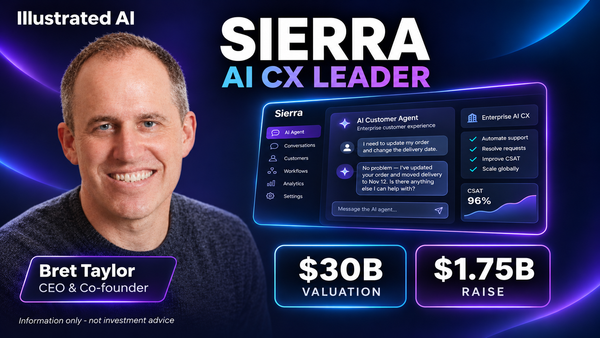
Sierra announced on 23 November 2026 that it is raising $1.75 billion in a Series F at a $30 billion valuation, led by Greenoaks and Lightspeed Venture Partners. Previous lead investors including Benchmark, Sequoia, GV and Tiger Global are participating. The announcement describes an ongoing raise, rather than explicitly confirming completion. Financing demonstrates investor backing, rather than independently established reliability or profitability.
Invest in top private AI companies before IPO, via a Swiss platform:
 SmartProfit Finder AG

In May 2026, Sierra announced a $950 million financing at a valuation exceeding $15 billion. The latest valuation represents a substantial increase over that benchmark, rather than a doubling of an earlier fundraising target. Financing valuations do not measure equivalent growth in revenue or realised shareholder returns.
Large fundraising rounds do more than add cash. They give companies room to move faster, recruit scarce talent, and deepen integrations that make enterprise software hard to replace. This financing also reflects a broader shift in thinking. The focus is moving from AI as a clever assistant to AI as a dependable worker. That is the moment when novelty gives way to outcomes.
There is a critical difference between a system that talks and one that gets things done. A conversational system may explain a policy, while an agent can also use authorised tools to verify account details, check internal systems and initiate actions. Successful resolution depends on system design, permissions, data quality and appropriate escalation.
Sierra says its agents connect to enterprise systems of record to support tasks such as order returns, insurance claims and mortgage origination. Actual capabilities depend on integrations, permissions and workflow design. Product functionality alone does not establish reliable completion across customers or eliminate the need for testing, monitoring and human escalation.
Sierra emphasises outcome-based pricing, charging for defined results such as a resolved problem or retained subscriber. It also uses consumption-style pricing where appropriate. The company acknowledges that outcome pricing adds contractual, operational and accounting complexity and depends on results being attributable to the software. This structure does not itself establish customer savings or stronger provider margins.
The model creates both opportunity and discipline. If the AI system handles tasks accurately and cheaply, margins can expand. If delivering outcomes requires heavy intervention or frequent errors, the economics weaken fast. That pressure is a feature: a company cannot hide weak performance behind usage metrics for long. For the broader market, selling outcomes signals maturity. Technology becomes truly disruptive when buyers rethink how they allocate budgets and measure return on investment.
Sierra reported on 30 October 2026 that ARR exceeded $400 million, having doubled from $200 million in five months. These are company-reported figures. ARR is distinct from recognised annual revenue and cash collected, and the growth figures alone do not establish retention, customer concentration or profitability.
Yet the announced valuation implies enormous expectations. Investors are paying for the belief that momentum can continue and that Sierra can capture a leading position before rivals close in. That raises hard questions experienced investors ask: How repeatable is demand? Are customers renewing and expanding? How much human effort is required after deployment? What happens to margins at scale? Growth tells a thrilling story. Valuation adds suspense. What matters next is whether the business can turn speed into staying power.
Competition is intensifying from both AI-native startups and established vendors with deep customer relationships. The winners will be decided by specific proof points, not broad promises.
Renewal and expansion matter most. A customer signing once is encouraging; a customer renewing and broadening use cases is much more powerful. Cost per successful resolution, escalation rates, model flexibility, and gross margins after inference costs are where economic truth will be found. Integration into customer workflows could support repeat spending and increase switching costs. Durable retention and pricing power still depend on reliability, measurable value, pricing, portability and available alternatives.
Sierra’s announced financing and company-reported ARR growth support expansion of its enterprise-agent business. They do not establish broadly reproducible customer savings or sustainable profitability. Investors should watch financing completion, recognised revenue, ARR definitions, renewals, customer concentration, independently measured resolution quality and margins after inference, implementation and human support costs.