Mistral AI’s Sovereign AI Growth Strategy
– 3 min read
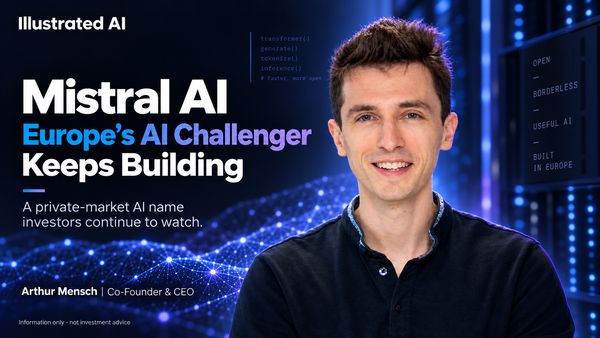
Artificial intelligence is no longer just a competition over software capability. It increasingly depends on compute, infrastructure, geography and control. Mistral AI has emerged as one of Europe's most ambitious attempts to build a regional alternative to larger U.S.-based AI providers.
Invest in top private AI companies before IPO, via a Swiss platform:
 SmartProfit Finder AG
The company is building itself not only as a maker of advanced models but as a platform for what many call sovereign AI, meaning AI that can be shaped, hosted, and governed to fit local laws, industries, and strategic priorities. That promise is especially powerful in regions that do not want to rely entirely on foreign technology for critical digital systems. The investment case combines frontier technology, enormous infrastructure funding, political push for regional independence, and one central question: can bold ambition be converted into durable value?
Mistral AI's last confirmed financing provides the first anchor. In September 2025, the company raised €1.7 billion in a Series C at an €11.7 billion post-money valuation, led by ASML, which invested €1.3 billion. In 2026, separate reports said Mistral was discussing a new fundraising of roughly €3 billion at a potential valuation of around €20 billion. Those discussions should be treated as reported terms rather than a completed financing.
Valuation can influence financing flexibility. For a given amount of new capital, a higher valuation can reduce dilution and may strengthen a company's position in recruiting and strategic negotiations.
Brilliant software alone is not enough to compete. A company needs access to huge computing resources, turning AI from a software story into an industrial one. Mistral has set out plans to build up to one gigawatt of AI compute capacity in Europe by 2030. This is not a modest server expansion. It is a vision of large-scale digital infrastructure capable of serving major enterprises and regulated sectors across regions.
The company is not simply renting generic computing power wherever available. It is framing compute as something that should be localized, governed, and aligned with specific jurisdictions, turning data centers into strategic assets linked to sovereignty and economic independence. If that capacity can be matched with sustained enterprise demand, the infrastructure could become an important foundation for recurring commercial workloads rather than simply a large capital commitment. Capacity feeds deployments, deployments feed revenue, and revenue justifies further expansion.
Sovereign AI means giving customers greater control over where data is stored, where models run, who governs the infrastructure, and how deployment economics work over time. For banks, telecom operators and public institutions handling sensitive or regulated workloads, control over data location and deployment can be particularly important. The company's approach combines customizable models with local infrastructure options that stay inside chosen jurisdictions, speaking directly to high-stakes buyers likely to generate long-term, high-value contracts.
As localized AI systems become integrated into workflows, compliance processes and governance structures, switching costs can increase. Deeper integration may also support longer-term customer relationships, although retention and recurring revenue ultimately depend on product performance and commercial execution. Sovereign AI also reflects how markets evolve. In the earliest stage, users chase novelty. In the next stage, institutions demand structure. A company that understands this shift early can position itself where the next wave of spending is likely to go. Control is starting to sound like a premium feature, and this company is trying to turn that into an edge.
Strategic capital is already part of the story. ASML led Mistral's confirmed Series C and became an approximately 11% shareholder on a fully diluted basis. More recently, Samsung has reportedly discussed participating in the next financing at a valuation of roughly €20 billion, although those talks have not been announced as a completed transaction.
Not all capital is equal. Money from a strategic investor can carry extra value bundled with channels, supply-chain leverage, or customer access. Even so, observers must avoid mistaking narrative momentum for commercial proof. A partnership announcement is not the same as recurring commercial revenue. The next test is straightforward: can relationships that look impressive on paper turn into measurable advantages? Can infrastructure partnerships create real compute availability? Can strategic investors expand customer reach? The market will judge not by announcements, but by usage, revenue, and staying power. In a sector becoming an industrial system rather than a software category, partners are not ornaments. They are strategic enablers.