Peak Energy raises $157M to power AI infrastructure
– 4 min read
The race to build AI looks like a contest over processors and software, but beneath the excitement sits a physical problem. Every model trained and every query answered must be powered in the real world. That turns electricity from a background utility into a strategic asset. Access to reliable power is becoming as important as access to semiconductors.
Invest in top private AI companies before IPO, via a Swiss platform:
 SmartProfit Finder AG

Many assume that rising compute demand simply means buying more servers and plugging them in. Reality is more complicated. Grids have limits, and data centers can face power spikes at exactly the wrong moments. The challenge is often not total annual electricity, but whether enough can be delivered at the right time. That timing issue can slow expansion, raise costs, and force deployment delays.
Battery storage can shift electricity consumption and help manage short-duration peaks. Its usefulness depends on discharge power, usable energy capacity, charging opportunities and efficiency losses. Storage does not create electricity or, by itself, resolve a persistent shortage of generation or grid capacity.
AI workloads are intense and unpredictable. As data centers grow more power-dense, even small improvements in electricity management translate into meaningful economic gains. Investors increasingly recognize that the businesses relieving power bottlenecks can become strategically essential, serving one of the fastest-growing infrastructure needs in the economy. The glamour may sit in algorithms, but profits can also emerge from the infrastructure keeping those algorithms running.
A battery is simply a tool for holding energy and releasing it later. What matters is whether it is safe, affordable, reliable, and suited to the job. That is where sodium-ion technology becomes interesting. Lithium-ion has long dominated, but being established does not mean being unbeatable, especially when AI data centers create a new set of operating conditions.
Sodium’s abundance offers a potential supply-chain advantage, but finished-system costs also depend on other materials, manufacturing yields, efficiency and operating life. Peak describes its system as passively cooled. Any resulting installation, maintenance or operating-cost advantage requires assessment under representative conditions; it should not be assumed for sodium-ion systems generally.
The proposition fits the logic of specialization. A battery optimized for AI infrastructure does not need to replace lithium-ion everywhere to become commercially important. It only needs to be better for a valuable use case: shifting electricity use, reducing stress during peak periods, and improving operational flexibility. If it performs well in that segment, which is itself expanding rapidly, it can establish credibility and drive broader adoption.
Disruption rarely arrives by asking permission. It enters through overlooked weaknesses in the status quo. In energy storage for AI infrastructure, that weakness may be the cost and complexity of managing power under growing demand. A sodium-ion system built for simpler cooling and data-center economics is positioned to exploit exactly that gap.
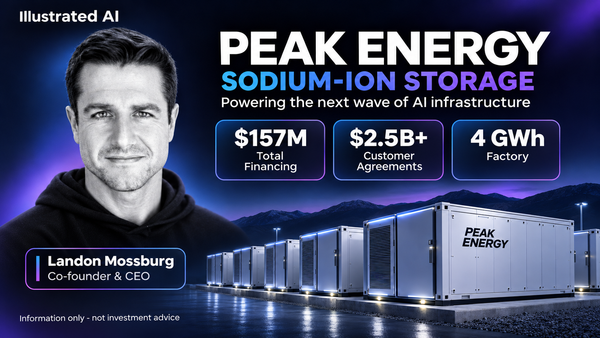
Peak Energy announced on 24 November 2026 that its expanded Series B financing totals $157 million, comprising $132 million in equity and a $25 million HSBC debt facility. The Series B was initially announced in October and led by General Motors Ventures.
The company says the financing will support manufacturing expansion, a data-centre pilot and commercial deployments beginning in 2027. The debt facility is intended to support project deliveries and supply-chain growth. Facility availability is distinct from cash drawn, and lender participation does not independently establish product performance or profitable operations.
Peak reports more than $2.5 billion in customer agreements, compared with more than $1 billion cited in October. The announcements do not establish comparable contract scope, cancellation provisions, delivery schedules or cash collection. These figures indicate company-reported commercial commitments, rather than recognised revenue or guaranteed profitable sales.
Peak’s July announcement described a Sacramento facility designed to produce up to 4 GWh of battery systems annually, with production and shipments expected in the first quarter of 2027. This is planned annual manufacturing capacity, rather than commissioned output, electricity generation or installed storage capacity. Commissioning, manufacturing yields and customer acceptance remain important milestones.
The interaction between customer demand and production capacity is the real story. Demand without capacity leads to frustration. Capacity without demand leads to waste. Commercial progress depends on converting agreements into accepted deliveries while maintaining quality, controlling costs and collecting payments.
Every disruptive company reaches the same crossroads. Vision has been laid out, capital raised, customers engaged. Then reality asks the hard question: can the company outperform in the field? The next chapter will be written not by aspiration but by evidence.
Factory commissioning is one of the most important milestones. A manufacturing plan on paper means little until equipment is installed, processes are qualified, and output flows reliably. Successful ramp-up transforms investor confidence because it proves the company can make real systems at meaningful scale. Equally important is whether customer agreements convert into accepted deliveries, recognised revenue and collected payments at sustainable margins.
Peak plans a data-centre pilot and claims energy-cost reductions of up to 20% compared with conventional storage systems. That comparison does not establish a 20% reduction in a data centre’s total electricity bill. Assessment requires the baseline, tariffs, duty cycle, efficiency, degradation and full installed costs.
Peak Energy’s financing and reported customer agreements support expansion of its sodium-ion storage business. They do not establish commissioned manufacturing capacity, independently verified savings or profitable deployments. Investors should watch factory qualification, production yields, accepted deliveries, pilot results, collections and margins after installation, maintenance and financing costs.