Oura’s AI Care Expansion
– 6 min read
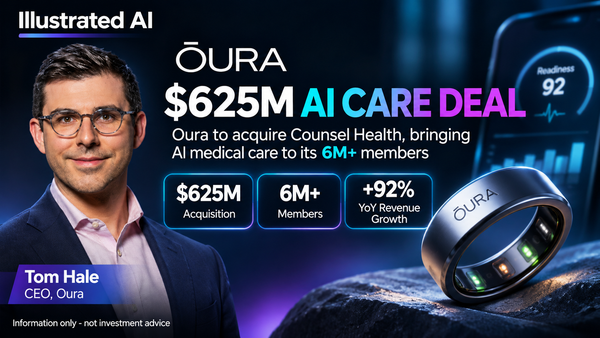
Oura announced on 10 November 2026 that it had agreed to acquire Counsel Health for $625 million in cash, subject to purchase-price adjustments. Completion is expected before year-end, subject to customary closing conditions. The agreement builds on an existing partnership connecting Oura members with Counsel’s medical AI and licensed physicians. It is not a completed acquisition.
Invest in top private AI companies before IPO, via a Swiss platform:
 SmartProfit Finder AG

A quiet revolution begins with a ring. For years, wearables measured steps, tracked sleep, and translated body signals into dashboards. Useful, but limited. Knowing something is happening is not the same as knowing what to do next. The real leap comes when technology moves beyond observation and starts guiding action.
The company built its reputation on collecting continuous biometric data and turning it into insight. Millions embraced that promise. The ring sat quietly on the finger, gathering information about sleep, recovery, and movement. But it stopped at the edge of healthcare. It could suggest patterns. It could not diagnose, prescribe, refer, or offer clinical accountability.
That gap matters. In moments of concern, people do not want charts. They want context, reassurance, and sometimes treatment. By combining wearable data with an AI-driven care platform including physician review, the business model changes shape. The ring becomes an entry point, not the finish line. The software becomes part of a workflow leading to actual medical guidance.
The economics of healthcare differ sharply from gadgets. Hardware is cyclical and vulnerable to competition. Services supporting ongoing health needs could encourage repeat use, but retention depends on access, quality, pricing and demonstrated value. Moving from measurement tools to clinically supervised care opens a deeper customer relationship integrated into everyday life and connected to decisions that matter far beyond fitness goals.
Wearable measurements can provide longitudinal context alongside symptoms and medical history. Whether that context enables earlier detection or improves clinical outcomes requires validation for specific uses. Oura says members must give permission before Counsel physicians can access their Oura data and past conversations. Technology stops being a mirror and starts becoming a guide.
Speed alone does not make AI valuable in healthcare. A fast answer is worthless if it is wrong or unsafe. The real breakthrough is AI that becomes clinically useful, helping the right people make better decisions under proper safeguards, with human escalation when needed.
Counsel combines medical AI with access to board-certified physicians. Its software supports medical history-taking, records review and guideline retrieval. Patients can involve a physician who can diagnose, prescribe and refer when appropriate. Physician supervision does not mean every AI response receives individual physician review. Faster access alone does not establish greater accuracy, safety or consistency.
Wearable data adds a critical dimension. Continuous biometrics, sleep disruption, temperature changes, heart-rate trends, and activity shifts provide contextual clues that AI organizes alongside symptom history. A person reporting fatigue and poor sleep tells a broad story. If the connected system also sees days of elevated physiological stress signals and unusual temperature variation, the case gains meaningful context without the machine practicing medicine independently.
Trust is the currency. Consumers will not tolerate health errors easily. Clinicians will resist tools creating legal exposure. Clinical oversight must be meaningful, not cosmetic. Escalation rules must work. Privacy must be respected. When AI quietly connects data, context, clinicians, and patients into a safer loop, it stops being a novelty and becomes part of how care is delivered.
The proposed cash acquisition represents a substantial capital commitment. Oura reports more than six million members and preliminary, unaudited fiscal 2026 revenue of approximately $1.75 billion, up 92% year on year. Revenue for the quarter ended 30 September reached $533 million, up 153%. These figures describe Oura’s existing business, rather than adoption or profitability of the combined care offering.
Oura’s membership provides a potential distribution channel for Counsel. Commercial benefits depend on eligibility, consent, service pricing, adoption and retention, alongside clinical delivery and integration costs. A large membership base does not establish demand for an additional care service.
Acquiring an established platform could shorten development time, but the disclosed price alone does not establish a valuation premium or an attractive return. Integration speed, clinical performance and incremental cash flows will determine the acquisition’s economics.
Disciplined investors know size is not success. Can the acquired capability increase revenue per member, improve retention, and create enterprise growth while controlling clinical costs? Growth numbers provide context, not proof. Membership size provides distribution, not guaranteed conversion. The chain that matters is cash paid, members served, revenue grown, services adopted, costs managed, and trust maintained.
Competition in digital health is no longer a race to build the best gadget. The next battle is about who owns the relationship that follows the data. The market is shifting from devices that monitor to platforms that guide, connect, and intervene.
Smart-ring makers now compete with fitness platforms, wellness subscriptions, telehealth providers, and AI-native clinical platforms. The ring on a finger competes with any company trying to become the user's trusted interface for health decisions. The most powerful model combines continuous context, clinical accountability, and software-driven scale, creating a service with memory that understands patterns over time, processes symptom input, and escalates to physicians when necessary.
That moat is not automatic. Clinical services require staffing, regulation, and quality control. Data permissions must be lawful. Consumer trust must be maintained. Building a scalable, compliant care engine is far harder than launching a wellness app, which is precisely why barriers to entry rise and opportunity grows for those who succeed.
Once a company offers care guidance, users hold it to a higher standard. Trust becomes both a source of strength and a point of fragility. Yet the strategic logic remains compelling. Moving into guided care could deepen customer relationships while adding clinical staffing, governance and service obligations. Stronger economics would require evidence of sustained paid adoption, retention and margins after those costs. The competitive battleground is no longer about telling users the most about their bodies. It is about helping them act meaningfully on that knowledge.
Exciting strategies are easy to announce and hard to execute. The real investment case depends on what happens after the headlines fade. Investors should focus on the mechanics that convert ambition into durable value.
Watch integration first. Systems must connect, teams align, and product roadmaps synchronize. The care layer must feel coherent inside the subscription experience, not bolted on. Next, watch conversion. Millions of members create theoretical opportunity, but commercial reality depends on how many actually choose and pay for the care offering.
Retention reveals whether the company becomes genuinely useful. Longer subscriptions could increase customer lifetime value if the additional revenue exceeds acquisition, clinical delivery and support costs. Unit economics are equally important. Clinical cost per encounter, physician utilization, and the balance between automation and human review determine whether scaling becomes sustainable.
Safety and outcome data will be crucial. Users and partners need clarity about how biometric data enters AI systems, when clinicians become involved, and how privacy is protected. Platforms demonstrating practical benefits—such as faster responses, appropriate referrals and fewer unnecessary escalations—could gain credibility with consumers, employers and health systems.
Underneath all metrics lies one strategic question: can the company turn millions of daily measurements into clinically useful services at sustainable cost? Data is abundant. Useful action is scarce. Sustainable action that users trust and pay for is scarcer still. If the business delivers that combination, it redefines its category.
Oura’s proposed acquisition connects an established wearable business with an existing AI-assisted care platform. It does not establish improved clinical outcomes or profitable care delivery at scale. Investors should watch transaction completion, consent-based integration, paid adoption, clinical safety, retention and margins after physician and support costs.