NVIDIA Powers the AI Infrastructure Boom
– 4 min read
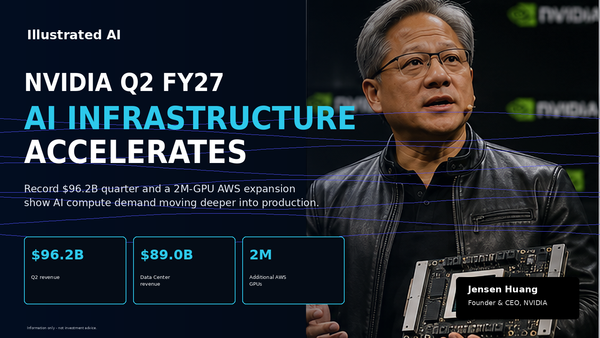
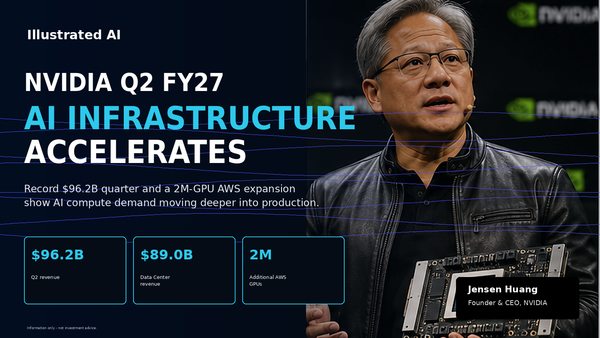
AI is no longer a lab experiment. It has become a massive industrial build-out resembling the creation of railways or the internet. NVIDIA stands as the clearest barometer of this shift. Quarterly revenue of $96.2 billion, up 106% year-over-year, signals an economy reorganizing around compute. This is not niche excitement. It is demand arriving in waves from cloud providers, enterprises, and researchers deploying AI in production.
Invest in top private AI companies before IPO, via a Swiss platform:
 SmartProfit Finder AG
Production demand is heavier and more durable than experimentation. When AI runs real services and automates business operations, the bottleneck moves from imagination to infrastructure. Can suppliers deliver enough hardware? Can data centers be built fast enough? NVIDIA's growth reflects serious long-term commitments from the world's largest organizations. AI devours computing power. Training models, running them at scale, and expanding into robotics and automation creates insatiable appetite. AI is software resting on a mountain of hardware, and the future is ordering servers now.
NVIDIA's $89.0 billion in Data Center revenue makes one thing clear: the economic engine behind the AI boom is physical and software infrastructure. Data centers were once back-office utilities. AI has transformed them into strategic assets where raw compute becomes language models, autonomous systems, and business automation.
NVIDIA's role extends beyond supplying chips. It delivers an integrated system of processors, networking, software, and memory designed to work together. The Vera Rubin platform ramping into full rack-scale deployments exemplifies this. Customers including CoreWeave, Google Cloud, Microsoft Azure, and Oracle Cloud Infrastructure are not buying casually. They are embedding AI into mainstream cloud strategy. Once AI is woven into cloud offerings, demand becomes recurring, switching becomes difficult, and scaling becomes natural. The data center is now the beating heart of machine intelligence.
AWS planning to deploy 2 million additional NVIDIA GPUs across 2027 and 2028 reveals what major platforms truly believe. This multi-year commitment signals AI demand is no longer a temporary surge but is embedded in long-term infrastructure roadmaps. The plan includes Blackwell Ultra, Rubin, and Rubin Ultra systems, meaning AWS is preparing for successive generations of increasingly powerful platforms.
The collaboration spans CPUs, networking, open models, and robotics, supporting agentic AI, scientific discovery, enterprise automation, and robotics. This diversity signals resilience. Infrastructure built for multiple fast-growing domains creates a wider, more durable opportunity. AI has become a capacity business, and by committing early and heavily, AWS ensures it has enough digital muscle to capture demand rather than lose it. Orders measured in millions show what industrial confidence looks like in the AI age.
The real transformation at NVIDIA is moving beyond components toward integrated AI factories. These deployments take in data and instructions, then produce models, predictions, and decisions. Performance depends on how the whole system works together. NVIDIA builds around GPUs with Vera CPUs, Spectrum networking, NVLink connections, CUDA software libraries, and robotics platforms. Each layer strengthens the others.
Integrated systems are far harder to displace than standalone products. When value comes from tight coordination across multiple layers, the offering becomes strategic. Software creates additional moats. CUDA's ecosystem means developers already know how to work within NVIDIA's environment, creating familiarity and inertia. For investors, the full-stack strategy supports both growth through selling more of a larger system and durability through deeper embedding in customer operations. The chip is only the starting point. The real prize is the factory built around it.
NVIDIA's approximately $108 billion revenue outlook for the next quarter would push results above a threshold that seemed unreal not long ago. Yet demand alone does not guarantee results. Supply availability, networking, memory, power, and data-center construction must all synchronize. A delay in one part can hold back value across an entire deployment.
Customer concentration among hyperscalers is powerful but dynamic. Gross-margin trends deserve attention as scaling brings changing product mix and costs. Competition from custom silicon and alternative accelerators exists, though in rapidly expanding industries multiple approaches can coexist. The crucial question is whether AI delivers productivity gains that sustain investment. Evidence of production-oriented workloads is encouraging because real business use supports more durable spending than experimentation. The debate is not whether AI matters. It is how efficiently and sustainably the infrastructure boom can be delivered. The opportunity is tied to one of the biggest technology build-outs in decades, and the stakes are exceptionally high.