Erebor: Banking the AI Infrastructure Boom
– 4 min read
Beneath every headline-grabbing AI innovation sits something quieter but equally important: specialized financial support. A new financial layer is emerging around the AI economy—not building chatbots or designing chips, but funding the physical backbone of the AI age: servers, power systems, manufacturing equipment, and data-center capacity.
Invest in top private AI companies before IPO, via a Swiss platform:
 SmartProfit Finder AG
Traditional finance doesn't always fit fast-growing technology businesses. A company racing to secure compute power and build infrastructure may have powerful investors, expensive hardware, and long-term strategic value, yet still look unusual through a standard banking lens. That gap creates an opening for specialist financial institutions like Erebor, whose role is to become part of the operating system behind the AI build-out.
Every technological revolution eventually needs bankers who understand it well enough to fund it. Railroads, telecommunications, and renewable energy all needed specialist financiers. Now AI, transforming from digital fascination into physical industry, needs them too.
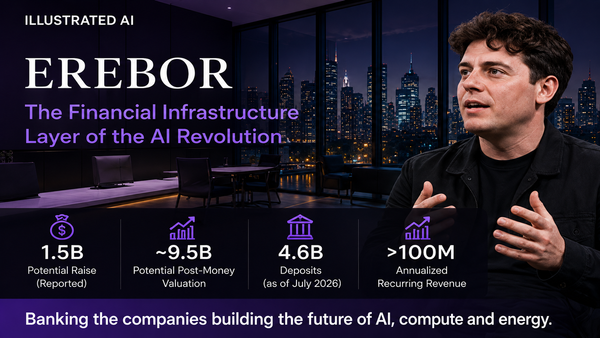
A reported raise of around $1.5 billion at an $8 billion pre-money valuation signals that sophisticated investors may be seeing something larger than a trendy banking story—a strategic position in a market only beginning to reveal its scale. Reported financing discussions of this magnitude suggest investors are no longer focused solely on AI applications; they're beginning to fund the support systems that let those sectors scale.
Still, valuation is a signal, not a verdict. Banking operates under a different standard than software. It handles deposits, manages liquidity, makes credit decisions, and must preserve trust at all times. Speed is attractive, but control is non-negotiable. The smartest investor posture is curiosity sharpened by caution: Can this institution create products that generic financial institutions struggle to offer? Is there a repeatable advantage here, or just temporary hype?
Reported deposits rising from roughly $1.1 billion in March to $4.6 billion by July is eye-catching. In banking, deposits signal trust and operational integration—customers using treasury services, managing working capital, and building ongoing commercial relationships. Reported annualized recurring revenue above $100 million adds another layer, suggesting activity is translating into real economics.
But smart analysis begins here, not ends. Who are the depositors? Are they stable operating businesses or highly concentrated venture-backed clients? Are deposits sticky or flight-prone? Rapid growth can magnify weak foundations if controls and liquidity planning don't scale alongside headline numbers. Growth tells the world customers are arriving. Quality determines whether they stay—and in banking, staying power is where real value is built.
AI runs on machines, facilities, energy, and industrial logistics. Behind every polished application sits GPUs, server racks, cooling systems, data-center leases, and power agreements. Many AI infrastructure businesses are young, richly backed, and strategically important—yet hard to assess using old templates. Their capital needs surge before revenue catches up.
A specialist lender evaluates a broader mix of signals: equity backing, hardware value, compute commitments, and infrastructure contracts. This expertise matters because timing matters—companies must spend heavily upfront to capture opportunity. A specialist institution engaging earlier, while still managing risk carefully, becomes invaluable. Clients may begin with deposits, then add borrowing, cash management, and payment solutions. Over time, the financial provider becomes part of the client's infrastructure.
The idea is simple once the jargon falls away: AI needs machines, machines need money, and not every bank knows how to finance those machines intelligently. The ones that do may help decide who gets built, who scales, and who gets left behind.
A financing involving Valar Atomics illustrates this thesis in practice. Valar's $1 billion Series B was paired with a separate $200 million credit facility led by Erebor as administrative agent. Valar develops modular nuclear systems aimed at supplying AI infrastructure's enormous power needs—linking capital, energy, and computation in one chain. This is what specialist infrastructure lending looks like: positioning at the intersection of several major trends simultaneously.
Specialization creates a flywheel: more clients generate more sector knowledge, which improves underwriting and product design, attracting still more clients. Once an institution handles deposits, payments, treasury, and credit, it becomes woven into the customer's daily functioning. Switching is possible, but not painless.
Yet in banking, specialization is powerful only when matched by control. Overconfidence in a fashionable theme can reveal too late that enthusiasm is not collateral. Underwriting quality, concentration risk, liquidity management, and regulatory capital all matter. A specialist bank must know when to say no, how to price uncertainty, and how to survive if several clients hit trouble at once.
The essential questions are straightforward: Can the institution keep winning relevant relationships while preserving credit quality? Can it satisfy regulatory demands without losing its growth edge? If yes, the upside could be substantial. AI's future will be financed, powered, and managed through institutions that understand industrial-scale complexity. The winners won't just spot the boom—they'll survive it.