Nscale IPO Tests Public Appetite for AI Infrastructure Hypergrowth
– 4 min read
Artificial intelligence often sounds weightless, but behind every elegant AI response sits a massive physical machine economy. The real story is about land, power, cooling, data centers, chips, and industrial-scale planning.
Invest in top private AI companies before IPO, via a Swiss platform:
 SmartProfit Finder AG
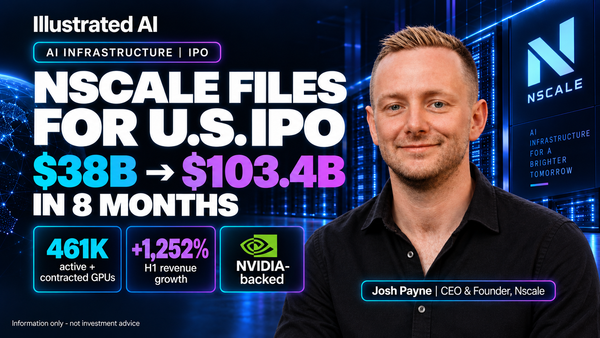
Nscale has filed for an initial public offering on the New York Stock Exchange under the ticker NSCL. The number of shares, offering price and prospective public valuation have not yet been disclosed. Its filing provides investors with a detailed view of the revenue growth, contract commitments and financing requirements behind its infrastructure expansion.
Nscale stands at the center of this shift. It is assembling the backbone of a new computing era, building the equivalent of roads, ports, and power stations for intelligence itself. Unlike traditional software businesses that grow without heavy physical investment, AI infrastructure demands giant upfront capital before revenue fully arrives.
Nscale's model spans powered land, energy access, data center development, GPU fleets, and cloud software, controlling the full chain needed to deliver AI at scale. The company reported approximately 25,000 active GPUs and 461,000 active and contracted GPUs as of late August 2026, alongside roughly 1.37 gigawatts of active and contracted power capacity, alongside a potential power pipeline exceeding 10 gigawatts. These figures combine infrastructure already operating with capacity that remains contracted or under development. Nscale’s commercial outcome will therefore depend on securing financing, equipment and power while completing facilities according to customer schedules.
Nscale reported first-half 2026 revenue of $140.6 million, up from $10.4 million a year earlier, representing growth of 1,252 percent. Active and contracted total contract value climbed to $103.4 billion by the end of August 2026, up from $38.0 billion at the end of 2025.
Sustaining this growth will require power availability, hardware procurement, data-centre construction and customer onboarding to remain aligned. Increasing demand can support additional infrastructure investment, but expansion also increases Nscale’s financing, construction and operational exposure.
Nscale reported $103.4 billion of active and contracted total contract value as of 31 August 2026. This figure represents prospective revenue across the committed terms of signed agreements; it is not recognised revenue, cash received or a conventional short-term backlog.
Only $2.6 billion—approximately 2.5% of the total—was classified as active at that date. The remaining value depends on Nscale financing, constructing and activating the required infrastructure and then meeting its service obligations. The weighted-average contract life was approximately 5.7 years.
Long-duration agreements can provide substantial revenue visibility, but the difference between active and contracted value is important. Investors must assess delivery schedules, financing requirements, termination provisions and the rate at which contracted capacity becomes operational.
Nscale reported a net loss of $1.02 billion in the first half of 2026 on revenue of $140.6 million. The loss included approximately $457.1 million of fair-value losses, primarily associated with warrant liabilities, and $113.8 million of share-based compensation.
However, the loss cannot be attributed solely to non-cash accounting effects or infrastructure expansion. Cost of revenue reached $189.6 million, exceeding reported revenue, while adjusted EBITDA remained negative at approximately $199.2 million. These figures show that Nscale has not yet demonstrated profitable service delivery at its current scale.
The company also disclosed approximately $24 billion of commitments for technology equipment and $3.5 billion for data-centre construction and related services. This creates substantial financing and execution requirements before much of the contracted value can become active revenue.
Nscale raised $2 billion in a Series C round in March 2026 at a $14.6 billion private valuation. The capital supports its expansion, but investors should evaluate future borrowing, customer advances, capital expenditure and possible shareholder dilution alongside revenue growth.
Nscale’s IPO filing exposes significant customer concentration. Its largest customer generated 52% of first-half 2026 revenue. Agreements associated with Microsoft and Anthropic represent approximately 85% of disclosed total contract value, making successful delivery to a small number of major customers central to the investment case.
Investors should examine how quickly contracted capacity becomes operational, whether construction remains on schedule and whether revenue growth produces improving gross margins. The financing attached to future deployments is equally important: contracted demand does not remove the capital required to purchase equipment and complete data centres.
Nscale has also agreed to acquire Anyscale for approximately $1.65 billion in equity. The transaction remains subject to closing conditions and regulatory approvals. Anyscale could strengthen Nscale’s software capabilities for distributed AI workloads, but investors must assess integration, additional dilution and whether the acquisition generates measurable commercial benefits.
The IPO will therefore test more than investor demand for AI infrastructure. It will test whether Nscale can convert a very large contract book into operating capacity, recognised revenue and sustainable margins.
The bottom line: Nscale’s first-half revenue growth and $103.4 billion of active and contracted value demonstrate substantial demand for AI infrastructure. However, only $2.6 billion of that contract value was active at the end of August 2026, while the company remains loss-making and faces significant equipment, construction and financing commitments. Public investors should focus on capacity activation, customer concentration, gross margins, adjusted EBITDA, capital requirements and the conversion of contracted value into recognised revenue.