General Intuition: Turning Gameplay Data into Real-World Robotics AI
– 5 min read
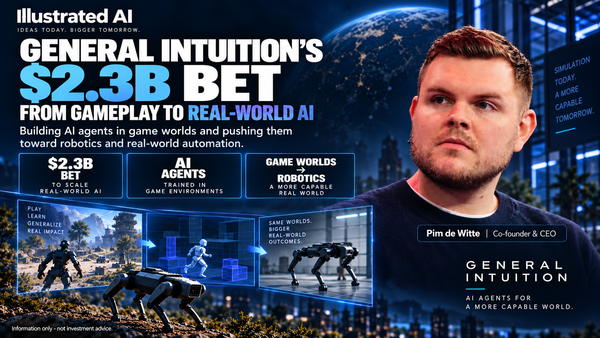
General Intuition is developing world and action models trained partly on gameplay data, based on the thesis that virtual environments can help AI systems learn how actions affect outcomes. The company was spun out of Medal, a gameplay-clipping platform founded by General Intuition CEO Pim de Witte.
Invest in top private AI companies before IPO, via a Swiss platform:
 SmartProfit Finder AG
Unlike passive video, action-labelled gameplay can connect visual observations with player inputs and subsequent outcomes. General Intuition argues that this information can help models learn spatial and temporal relationships relevant to games, simulations and potentially robotics.
Medal says its users upload billions of gameplay clips annually. General Intuition describes these environments as potential training grounds for models designed to perceive, predict and act. However, the company has not publicly disclosed how much of Medal’s content is available for training, how much contains usable action labels or how representative the data is across different environments.
The central technical question is whether capabilities learned from games can transfer reliably to physical systems. General Intuition’s strategy involves pre-training models on virtual activity and adapting them with real-world data, but the effectiveness and economics of this approach still require validation across robots, tasks and operating conditions.
Not all data is equally valuable. A mountain of information is limited if it only shows what happened and never explains why. General Intuition pairs each gameplay clip with the exact inputs that produced the behavior on screen — a distinction that carries enormous consequences.
Traditional video helps a model identify objects and motion, but it struggles to understand the decision chain underneath. Action-labelled data closes that gap, tying visual experience to command and consequence. The model sees the link between choice and result — essential for physical AI that must constantly connect perception to action, judging distance, timing, balance, and risk.
Scale and variety amplify this advantage. Millions of users behave differently — making mistakes, improvising, retrying, and experimenting. This creates a broad behavioural dataset rather than a narrow script. Failure matters because intelligence often grows from understanding what does not work. Games compress this complexity: a player navigates uncertainty, coordinates timing, responds to surprise obstacles, and recovers from errors, all in short sequences that become valuable lessons for machines.
For investors, access to large volumes of action-labelled data could provide differentiation. However, the durability of that advantage will depend on data rights, label quality, environmental diversity and whether the resulting models outperform systems trained with simulation or real-world robotics data. Dataset scale alone does not establish a defensible commercial advantage.
General Intuition has demonstrated its approach on a quadruped robot, according to company presentations and reporting. The test provides an early indication that its models can be adapted beyond games, but it does not establish reliable performance at commercial scale. Physical environments introduce noisy sensors, changing surfaces and safety requirements that are absent or simplified in virtual worlds.
General Intuition’s approach uses action-labelled gameplay as a pre-training layer before adapting models with physical-world data. This follows the broader foundation-model approach of pre-training on large datasets and then specialising systems for particular tasks. If the method transfers effectively to robotics, it could reduce the amount of expensive physical data required for development.
If the approach proves transferable, companies could adapt a pre-trained model to specific hardware or operating conditions rather than developing every system entirely from scratch. Potential applications include warehousing, industrial inspection and autonomous platforms. The key test is repeatability: strong performance across many settings, hardware systems, and real-world conditions that were never directly encountered in training. That is what separates intriguing demos from scalable businesses.
General Intuition raised a $320 million Series A in June 2026 at a reported $2.3 billion post-money valuation. Khosla Ventures led the financing, with participation from investors including General Catalyst, Hedosophia, Bezos Expeditions, Innovation Endeavors and Nico Rosberg. The company had previously raised approximately $134 million when it launched in 2025.
The company says much of the new capital will support computing infrastructure, model pre-training, research and broader access to its commercial API. General Intuition also says it has onboarded initial partners across gaming, simulation and robotics, although it has not disclosed their identities, production usage or associated revenue.
Subsequent reporting has linked General Intuition to fundraising discussions at a $6 billion pre-money valuation. Unless a completed transaction and its terms are confirmed, that figure should be presented as a reported valuation under discussion rather than an established financing value.
Investor interest reflects a broader shift towards AI systems capable of acting in virtual and physical environments. However, funding and valuation do not establish successful technology transfer or commercial demand. The central evidence will come from customer deployments, technical performance and the economics of training and operating the models.
Big ideas attract attention. Durable businesses earn trust. The journey from striking concept to lasting value depends on a few critical proof points.
Adoption: General Intuition says it has onboarded initial partners, but investors need evidence that these engagements are progressing into paid production deployments and recurring usage.
Sim-to-real performance: Investors need signs that virtual pre-training meaningfully improves real-world results: faster robot training, better navigation, stronger adaptability, or reduced need for expensive physical data collection.
Data flywheel: If gameplay data is supplemented by proprietary real-world data from customer deployments, the system could improve in a self-reinforcing loop — more customers generate more data, better models attract more customers, building a durable competitive moat.
Platform strength and capital discipline: The company aims to provide reusable models across industries. Investors will watch whether the same core system supports diverse use cases without breaking, and whether heavy compute spending produces better models and clearer commercial pathways rather than simply larger costs.
Competition will come from frontier AI laboratories, robotics companies and industrial automation providers. General Intuition’s connection to Medal may provide access to a distinctive source of gameplay data, but its long-term position will depend on technical execution, data rights, model performance and successful commercial deployment.
The bottom line: General Intuition’s $320 million Series A reflects substantial investor interest in using gameplay data to train action-oriented AI models. The evidence to watch is independently assessed sim-to-real performance, paid customer adoption, deployment across multiple hardware platforms, training efficiency and disclosed commercial revenue. The thesis is compelling, but its value will ultimately depend on whether learning from virtual actions produces reliable and economical performance in the physical world.