ElevenLabs Hits $22B as Voice AI Surges into Enterprise Infrastructure
– 4 min read
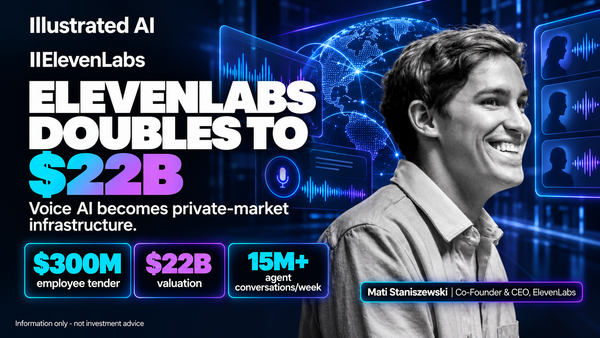
ElevenLabs has completed a $300 million employee tender offer at a $22 billion valuation, double the $11 billion valuation established by its February 2026 Series D. The latest transaction provides evidence of strong investor demand for ElevenLabs shares, although a secondary tender does not independently establish that voice AI has become essential infrastructure. What began as text-to-speech technology has evolved into systems that can listen, reply and complete tasks across customer service, sales and operations. Voice platforms may become harder to replace when customers integrate them with communications systems, operational workflows and proprietary data. ElevenLabs has not disclosed retention or switching data demonstrating that effect across its customer base.
Invest in top private AI companies before IPO, via a Swiss platform:
 SmartProfit Finder AG
Wellington Management and T. Rowe Price led the tender, with participation from new and existing institutional investors. Their purchases indicate willingness to acquire shares at the $22 billion valuation, but they do not independently validate future revenue growth, profitability or public-market value. Voice can make interactions with technology more immediate and accessible, particularly in customer-service and commercial workflows. If speech becomes a default interface for customer support and commercial workflows, the companies providing reliable voice infrastructure could become deeply embedded in the modern enterprise.
The $300 million transaction was an employee tender, not a traditional fundraising round. The transaction provided liquidity to participating employees and existing shareholders. Because it was a secondary share sale rather than a primary financing, the proceeds did not provide new operating capital to ElevenLabs. Institutional investors agreed to acquire existing shares at the valuation used for the tender. This provides a private-market pricing signal, although the transaction’s limited liquidity and negotiated terms restrict direct comparisons with a public-market valuation.
Tender offers allow employees and other eligible shareholders to realise part of the value of otherwise illiquid private-company shares. Providing employees with liquidity before an IPO may support recruitment and retention. The participation of new investors also broadens the shareholder base, although ElevenLabs has not disclosed how many employees sold shares or whether the programme has affected retention. The $22 billion valuation provides evidence that participating institutions accepted the tender price, but it does not establish what investors would pay in a future public offering.
ElevenLabs is expanding beyond speech generation into conversational systems that connect users with software and business workflows. Many legacy interactive voice-response systems rely on predefined menus and scripted workflows. Advanced conversational agents manage dynamic interactions, pull relevant information, ask clarifying questions and trigger actions in connected business systems. The system can therefore move beyond speech generation towards participation in connected workflows.
ElevenLabs says its agents now handle more than 15 million conversations per week, three times the level reported in February. This indicates substantial usage, but the company has not disclosed how conversations are defined, how many customers generate them or what proportion represents paid production activity. Voice agents can operate around the clock, scale during demand spikes and support functions including customer service, sales, appointment booking and lead qualification. Integration with customer journeys, communications systems and business data could create switching friction and support recurring revenue. ElevenLabs has not disclosed retention or renewal data demonstrating the strength of that effect. The ability to complete tasks could expand the commercial applications of voice AI beyond speech generation.
ElevenLabs says enterprise customers account for 55% of revenue. The company has not disclosed recognised revenue by product, customer concentration, net revenue retention or enterprise gross margins. Adopting AI for core operations can require internal approvals, security reviews and compliance assessments. These requirements can make successful enterprise deployments more operationally significant than experimental product trials. ElevenLabs says organisations including Stripe, Deutsche Telekom, SevenRooms, Admiral, Customers Bank and Cadence have deployed ElevenAgents since February, alongside the governments of Ukraine and Greece. These relationships indicate adoption across several sectors, but ElevenLabs has not disclosed individual contract values, implementation volumes or renewal rates. Adoption across multiple sectors could support a broader platform opportunity, although the commercial importance of these deployments remains undisclosed.
Deployments spanning voice, chat, email and other channels may become more deeply integrated with customer workflows. Whether this produces meaningful switching costs will depend on contract duration, integration depth, retention and available alternatives. ElevenLabs says feedback from live deployments helps it refine its models and products. However, the company has not disclosed how customer information is used, what contractual restrictions apply or whether deployment data is incorporated into model training. The relevant evidence will be whether enterprise deployments expand, renew and generate attractive margins over time.
ElevenLabs reported surpassing $500 million in company-wide ARR during the first four months of 2026, up from $350 million at the end of 2025. It also says ElevenAgents’ ARR has more than tripled since February. ARR is a run-rate measure rather than recognised annual revenue, and the company has not disclosed audited revenue, gross margins or profitability.
The next question is whether ElevenLabs can preserve its competitive position as large technology platforms invest more heavily in native speech and conversational agents. Features that once felt rare can become standard. A company in voice AI cannot rely on novelty — it needs a moat built from execution, reliability and customer trust.
Investors should watch whether conversation volume continues growing, whether enterprise customers expand their deployments and whether monetisation per interaction supports profitable scale. The deeper strategic question is whether conversational AI becomes a lasting enterprise interaction layer or gets absorbed into broader platforms as one feature among many. ElevenLabs’ long-term position will depend on whether its technical capabilities translate into customer retention, enterprise contract expansion and sustainable margins.
The bottom line: ElevenLabs’ $300 million employee tender at a $22 billion valuation reflects substantial institutional demand and gives participating shareholders liquidity without adding capital to the company’s balance sheet. Its company-reported conversation volume, ARR and enterprise-revenue share indicate strong commercial momentum, but detailed financial disclosure remains limited. Investors should watch recognised revenue, retention, customer concentration, gross margins, computing costs and whether enterprise adoption produces durable profitability.