Isar Aerospace’s Orbital Breakthrough
– 4 min read
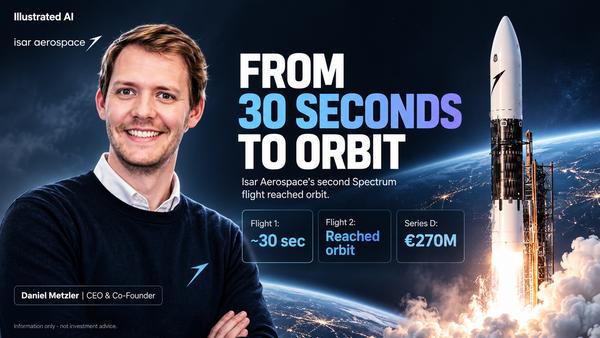
Space is unforgiving, and Isar Aerospace has now experienced both sides of that reality. On Spectrum's first test flight in March 2025, the rocket flew for roughly 30 seconds before a loss of attitude control led to a flight-termination command and an unpowered descent into the sea. Painful, but useful: the vehicle cleared the pad, systems operated in flight, and engineers collected real-world data that could feed directly into the next vehicle.
Invest in top private AI companies before IPO, via a Swiss platform:
 SmartProfit Finder AG
Then came the second flight. The rocket reached orbit and deployed payloads. That is not a small improvement. It is a move from test disappointment to actual mission achievement, and it matters because space technology proves a truth investors often forget: progress is not linear. One mission can compress years of uncertainty in a single night.
A successful orbital launch meaningfully lowers technical risk, proving hardware can operate in the environment it was built for. It also reveals organizational learning. The company did not merely build a rocket. It built the ability to adapt under pressure. The jump from 30 seconds to orbit tells a bigger story than engineering redemption: breakthroughs often arrive not as smooth progress, but as a hard-won leap after visible failure.
Rockets must survive ignition, intense vibration, maximum aerodynamic stress, separation events, vacuum conditions, and orbital insertion. That is why flight data is the truth serum of aerospace. A company can discuss engine performance for years, but none of it carries the same weight as hardware flying a real mission.
Before successful flight data, a company is largely a technical thesis. After it, the debate shifts from "can this work at all?" to "how reliably and profitably can this be repeated?" That is a major shift. In private markets, reduced uncertainty can be as valuable as raw growth. One successful mission makes the next customer conversation easier, attracts stronger talent, and secures more favorable financing.
Yet flight data should not be romanticized. One good mission does not create a durable business. Aerospace history is filled with systems that flew successfully and still struggled with reliability or production scale. The key is learning enough to make future missions more repeatable, efficient, and commercially dependable.
Building a rocket company requires designing engines, manufacturing structures, qualifying components, securing facilities, and surviving long development cycles before revenue arrives. In June 2026, Isar Aerospace completed a €270 million Series D financing to support its global expansion and the ramp-up of serial production of Spectrum. The financing provides additional capital for the transition from engineering development toward a repeatable commercial launch business.
Designing one rocket that reaches orbit is hard. Building many on a repeatable schedule is a different sport. That means factories, supply chains, and quality systems all working with industrial discipline. Isar Aerospace's new 40,000-square-meter production facility near Munich is designed to manufacture up to 40 Spectrum launch vehicles per year, showing that the company is preparing for launch cadence rather than occasional missions.
Cadence is the heartbeat of a launch business. Frequent successful launches spread fixed costs, accelerate learning, and build customer confidence. Technical success can actually increase funding needs, because demand for production, infrastructure, and talent rises once the market takes the company seriously. Bold ideas win headlines. Scaled execution wins markets.
A rocket reaching orbit is exciting. A customer signing a mission is validating. Satellites represent years of work and large budgets, so customers buy confidence in precision, timing, and reliability. A defined agreement for an active-debris-removal mission is especially significant, linking the launcher to one of the most urgent problems in orbit: crowded, hazardous zones filled with old satellites and discarded rocket parts.
A signed mission is far more meaningful than broad market optimism. It shows that someone has chosen this provider for a specific purpose, on a defined timeline, with a real operational goal. Dedicated launch services offer customers better alignment with desired orbit and timing than rideshare alternatives, making control valuable enough to justify the cost.
Trust in launch is cumulative. Multiple successful missions, delivered on schedule, establish a reputation that is powerful precisely because the cost of failure is so high. A dependable European launch platform also offers strategic value, giving governments and companies genuine options for orbital access and greater independence.
Reaching orbit is one of the most demanding technical feats in industry, but in business terms it is often the beginning of a more revealing test: can it be done again, on time, at quality, and at a margin that makes sense? The market pays sustainably for a dependable service, not a spectacular event.
Repeatability is where economics emerge. Heavy fixed costs become manageable when spread across more missions. Higher cadence improves learning, sharpens process control, and creates a flywheel where each mission makes the next one better. Yet cadence is incredibly hard. Suppliers, engines, integration, launch sites, and teams must all function reliably. One weak link disrupts schedules and margins.
For investors, this phase is exciting because technical proof has arrived, but dangerous because operational excellence is less dramatic and equally difficult. The most important signal is whether the business starts behaving predictably: consistent schedules, quality, and production progress matter more over time than any single headline. Orbit was the headline. Repeatability is the verdict. One flight can change the story. Only many flights can change the industry.