Lute’s Touch AI Could Reshape Robotics
– 4 min read
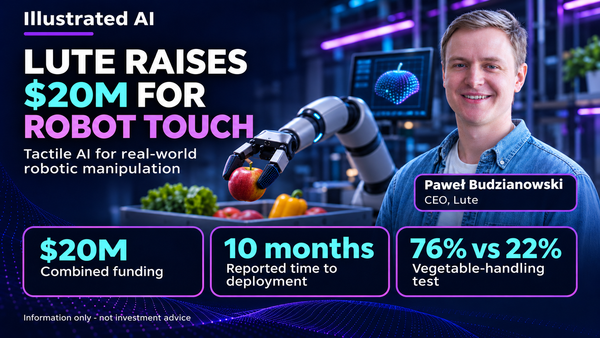
Lute announced on 25 November 2026 that it raised $20 million across seed and pre-seed funding. OTB Ventures and FORWARD.one co-led the seed, following a pre-seed led by Credo Ventures and Seedcamp. The funding will support data acquisition, model development and customer deployments. Financing does not establish independently validated performance or profitable deployment economics.
Invest in top private AI companies before IPO, via a Swiss platform:
 SmartProfit Finder AG

Robots can identify objects with astonishing precision, yet the real world rewards touch over recognition. Knowing when to grip gently, hold firmly, or react to something slipping is the gap Lute is trying to close.
Lute is developing models that combine tactile input with vision. The company says it co-designed compact elastomer-based sensors with partners and incorporated them into a portable data-collection setup. Its disclosed sensor output includes contact location, load and pressure over time. These disclosures do not establish reliable measurement of every material property or handling condition.
This matters because modern industry handles objects that are soft, flexible, slippery, and inconsistent. Vision gets a robot only part of the way. Cameras can reveal visible movement and deformation, while tactile sensing provides additional information about contact and loading that may be difficult to infer from images alone.
Lute's central idea is powerful in implication: give robots a sense of touch and let them learn from that data the way advanced AI learns from images and language. Soft tactile sensors capture pressure and slip signals, paired with video to create a fuller picture of reality. In the AI economy, that contact data could be where durable advantage begins.
A robot without touch is like a worker whose hands are asleep. Cameras show where an object is and how it moves, but once contact is made, new questions arise: Is the surface slick? Has the grip begun to slide? Is force uneven? Vision can hint at these things; contact sensors measure them directly.
Pressure is one of the most critical signals. Too little force and an object falls; too much and it gets damaged. Slipping is another major challenge. Humans tighten grip instinctively when something shifts. For robots, detecting slip is the difference between success and failure during lifting, placement, or sorting.
The real power emerges when these signals become training data for AI models. A robot learns what combinations of sight, force, and motion lead to good outcomes, building judgment over time. This is especially valuable for deformable objects: vegetables, snack packages, fabrics, and flexible materials that change shape when handled and behave differently from one item to the next.
Better handling means fewer dropped items, less damaged stock, fewer interruptions, and fewer human interventions. A robot that handles delicate or irregular objects reliably opens entirely new categories of automation. Reliability, not spectacle, is where value compounds.
Lute reports that Lute-0 achieved 76% success on vegetable manipulation versus 22% for π0.5, and 98% versus 70% on deformable snacks. These are company-run evaluations on selected retail tasks. The comparison does not isolate the contribution of tactile input from differences in model architecture, training, hardware or evaluation setup.
The results justify further investigation, but intuitive plausibility does not independently validate them. Assessment requires trial counts, success definitions, uncertainty estimates, comparable operating conditions and tests that isolate the contribution of touch. Performance on selected tasks does not establish reliability across unfamiliar objects or sites.
What careful observers should watch next: independent measurement, named paying customers, reported intervention rates, and deployment economics. In robotics, commercial viability depends not only on peak performance but on how gracefully a system handles exceptions day after day in real operations.
Lute is not reinventing every piece of hardware. Instead, it aims to supply intelligence to systems integrators using existing robot hardware. That approach could be commercially powerful. Many robotics deployments require expensive custom engineering for each site and workflow, slowing adoption and limiting scale.
If tactile-rich AI can be layered onto existing systems, customers may gain better performance without entirely new robots. Systems integrators could use this intelligence as an upgrade, reducing costly custom work and shortening deployment cycles. The same approach transferring reliably between sites is where the economics become compelling.
Remote human assistance adds a practical bridge. Lute says remote human support is available when robots need help, with failures and interventions feeding into its training process. Remote assistance could help recover interrupted tasks, but its value depends on response times, operator workload, connectivity and cost. Intervention records may support later training; improvements require suitable data, retraining and validation.
Deployment data could support improvements if Lute has appropriate collection and training rights and can demonstrate gains across sites. More deployments or interventions alone do not establish better models, lower support costs or a durable learning advantage.
Dreams do not create returns. Execution does. For investors, the real question is whether Lute can turn advanced models into dependable physical capacity, working often enough, cheaply enough, and broadly enough to matter in daily operations.
Key indicators to monitor: named paying customers beyond early pilots; independent task reliability measurements across diverse conditions; intervention rates that demonstrate economic viability; and deployment economics showing a clear payback period. Does the math work outside a presentation slide?
Tactile datasets could support differentiation, but defensibility depends on collection costs, permitted use, task coverage and measurable improvements relative to alternatives. Commercial value requires reliable transfer to customer hardware and workflows at an acceptable total cost.
Lute’s financing and company-reported evaluations support further development of its tactile-and-visual robotics models. They do not establish broadly reproducible reliability, a durable data advantage or sustainable profitability. Investors should watch named paid deployments, independent comparisons, task success, human interventions, customer payback and margins after hardware integration, inference and remote support.