LangChain’s $3B Rise as AI Agent Infrastructure Leader
– 4 min read
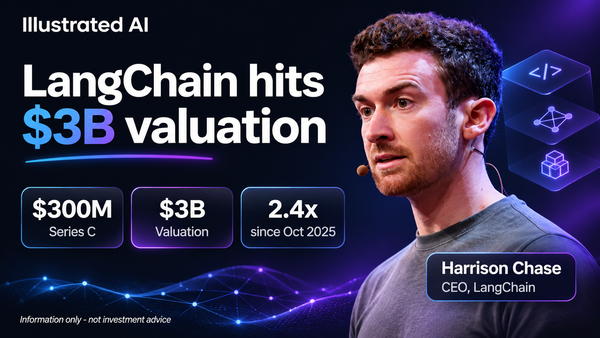
LangChain announced a $300 million Series C on 13 November 2026 at a $3 billion valuation. CapitalG led the round, with participation from GIC, DFJ Growth, IVP and Sapphire Ventures. The financing supports its platform for building, deploying, evaluating and governing AI agents. It demonstrates investor backing, rather than independently established agent reliability or profitability.
Invest in top private AI companies before IPO, via a Swiss platform:
 SmartProfit Finder AG
The valuation is 2.4 times the $1.25 billion LangChain announced with its $125 million Series B in October 2025. This compares financing valuations, rather than revenue growth or realised investor returns.
Businesses do not simply want answers from AI. They want outcomes. An AI agent can pursue goals through multiple steps, retrieve information and use software tools. Its autonomy and need for human supervision depend on the task, permissions and system design. That power also carries risk. A digital worker can fail, overspend, misuse data, or produce bad results at scale. Companies need something like air traffic control for AI.
The real commercial opportunity sits not only in the model itself, but in the layer that manages deployment, evaluation, monitoring, and governance. Raw intelligence is valuable. Managed intelligence is where business value becomes scalable.
LangChain’s open-source frameworks, including LangChain and LangGraph, help developers build agent systems. Its commercial LangSmith platform provides tools for deployment, observability, evaluation and governance. Open-source usage and adoption of the commercial platform are distinct measures.
When a simple AI demo becomes a mission-critical workflow, questions multiply fast. How is the agent behaving in production? Why did it fail? What data did it access? Did it break company policy? Can its decisions be audited? These questions determine whether AI moves from a pilot project to a trusted operational system.
LangSmith provides visibility into agent activity and tools for evaluating behaviour and managing access to models, tools and data. These capabilities can support operational oversight, but do not by themselves establish compliance, prevent every unsafe action or guarantee reliable task completion. Configuration, permissions, testing and human oversight remain important.
Where does lasting value accumulate when many businesses can access capable models from multiple sources? The answer may lie less in the intelligence itself and more in the system built around it. Two firms can use the same underlying model and produce very different business outcomes depending on how well they wrap it in operational systems.
A control layer sitting above the model can benefit from model churn rather than be threatened by it. If truly cross-model, it becomes the consistent interface while underlying engines evolve. Governance adds further value: enterprises need rules around what data an agent can access, how much it can spend, and how its actions are logged. A platform providing those guardrails becomes part of the trust infrastructure of AI.
Sustained agent deployment could support recurring demand for monitoring and evaluation. Revenue durability and pricing power depend on paid usage, retention, contract terms, differentiation and competition. Growing operational complexity alone does not establish attractive margins.
LangChain says more than 7,000 organisations rely on LangSmith. This company-reported figure indicates adoption, but does not establish how many are paying, their spending levels, retention or customer concentration. The funding announcement does not disclose revenue or profitability.
A seasoned investor immediately asks: What does "use" actually mean? How many organizations are paying? Are contracts expanding? Are customers staying? Without those answers, adoption remains encouraging but incomplete as an investment metric.
Retention is a critical test. Great enterprise software starts in one team and spreads. Integration into evaluation pipelines, governance policies and deployment routines could increase switching costs. Retention still depends on reliability, pricing, migration options and measurable customer value. But stickiness must be earned. A $3 billion private valuation is an assumption about future monetization depth. Revenue quality, gross margins, and expansion rates will ultimately determine whether the optimism was visionary or premature.
Fast-growing markets rarely stay open for long. Model providers want to extend beyond raw intelligence. Cloud hyperscalers want to own enterprise workflows through bundling. Specialist startups target orchestration, observability, and governance. All are converging on the same goal: becoming the system enterprises trust to run AI agents at scale.
LangChain’s open-source roots and model flexibility are potential competitive strengths. Actual portability depends on integrations, runtime dependencies, deployment configuration, data migration and contractual terms. Supporting multiple models does not eliminate switching costs.
Yet bundling by large ecosystem players remains a major threat. The platform must prove it is meaningfully better, not just more neutral. Reliability will be the market's harshest judge. A platform synonymous with production-grade reliability could carve out an enduring position. A record of reliable service could support customer trust and retention, but durable differentiation requires evidence of performance, renewal rates and competitive economics.
The bottom line: LangChain’s financing and company-reported LangSmith adoption support expansion of its agent-engineering business. They do not establish dependable agent outcomes, durable pricing power or sustainable profitability. Investors should watch paid customer growth, recognised revenue, retention, customer concentration, service reliability and margins after infrastructure and support costs.