Agile Robots’ $500M Raise Signals Physical AI’s Industrial Breakout
– 5 min read
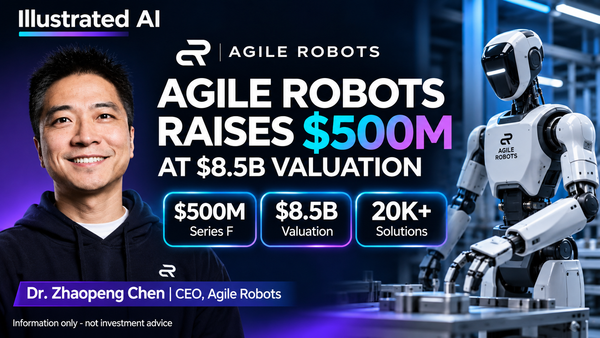
Agile Robots announced on 12 November 2026 that it had closed a $500 million Series F at an $8.5 billion valuation. SoftBank Group led the round, with participation from NVIDIA, Hitachi Group, T.Capital and others. The company says total capital raised now stands at $2 billion. Proceeds will support US expansion, additional production capacity including in Germany and entry into new markets.
Invest in top private AI companies before IPO, via a Swiss platform:
 SmartProfit Finder AG

Physical AI is moving beyond demonstrations and into factories, warehouses, and production systems where performance is measured by uptime, output, safety, and cost. This marks the moment robotics stops being a futuristic promise and becomes industrial infrastructure. A deployed system must survive heat, dust, repetition, and relentless customer expectations. It has to work on Monday morning, not just at a product launch.
The most interesting companies are no longer proving a robot can move like a human. They are proving machines can operate as reliable, adaptive workers across real industrial environments. Factories are full of repetitive work, labor bottlenecks, and constant pressure to produce more with fewer disruptions. Traditional automation struggles when environments become unpredictable. A more adaptive machine creates value by bringing flexibility to tasks that previously required human judgment or expensive custom engineering.
Agile Robots reports more than 20,000 robotic solutions installed worldwide. This indicates an established deployment base across its broader automation portfolio, rather than 20,000 humanoid robots or independently validated autonomous systems. Installation counts alone do not establish productive utilisation, customer savings, safety performance or profitable service economics.
Agile Robots says its Fürstenfeldbruck facility has annual capacity for up to 10,000 legged and wheeled humanoid robots. This describes stated manufacturing capacity, rather than completed production, accepted deliveries or paid demand.
A $500 million financing does more than add cash to a balance sheet. It signals that industrial physical AI is being treated as a serious strategic opportunity. Large rounds in advanced hardware and AI are about compressing time, allowing a company to build production capacity faster, expand geographically, and move toward industrial scale before competitors close the gap.
Robotics cannot scale like software. Physical AI needs factories, components, supply chains, testing systems, and service networks. Capital is essential. An $8.5 billion valuation is a negotiated snapshot of investor expectations, not proof of profitability. It prices in a future where physical AI becomes a major industrial category. Whether the valuation is justified depends on revenue growth, margins, capital requirements, dilution and competitive performance. Growth in the physical-AI market alone does not establish an attractive investment return.
The stated use of proceeds reveals the opportunity: US expansion into one of the world's most important industrial markets, additional production capacity in Germany, and entry into new geographies. Together, these plans describe a company preparing not just to innovate, but to industrialize. In physical AI, that transition is where fortunes are made or lost.
A company focused only on humanoids makes a narrow wager that human-shaped robots will quickly become practical and affordable across real workplaces. A broader platform offers more routes to growth. Robotic arms handle precision tasks, dexterous hands improve manipulation, mobile robots transport materials, and AI software coordinates everything. This product family gives customers options and the company multiple ways to win.
Customers may adopt automation workflow by workflow. A broad portfolio could provide several routes to revenue while newer systems develop, but diversification also adds engineering, integration and support costs. Its commercial value depends on demand, margins and repeat orders across the product range.
Existing deployments generate practical knowledge that becomes a competitive asset. For customers, an integrated platform simplifies adoption rather than stitching together multiple vendors. For investors, established products provide a commercial base alongside newer systems. Whether they generate sufficient cash to fund further development depends on segment margins, working-capital needs and support costs. A single robot can impress. A platform can endure.
Industrial automation is a crowded and demanding field. Established suppliers already serve factories worldwide. New startups chase adaptive robotics, humanoid mobility, warehouse automation, and AI-driven control systems. The prize is enormous because even small productivity improvements across industrial systems translate into massive value. But customers are cautious. They buy technology to protect margins and reduce operational risk, not for entertainment.
Incumbent competitors may be unglamorous but carry deep customer relationships and decades of trust. In manufacturing, reliability outranks novelty. Startups counter by moving faster and building around modern AI from the ground up. Combining hardware, software and operational experience could support differentiation. A learning advantage requires appropriate data rights, useful training examples and validated reductions in failures, intervention rates or deployment costs. More deployments alone do not establish that advantage.
Economics are the hidden arena of competition. Two robots may appear similar, but the winner is often easier to install, cheaper to maintain, and faster to pay back. The company that best translates AI into dependable physical work gains the greatest advantage. In industrial markets, excitement opens the door. Performance keeps it open.
The biggest trap in emerging technology is mistaking momentum for proof. The real test is whether ambition converts into repeatable economics. The first signal is commercial conversion: are customers moving beyond trials into repeat orders? Repeat demand is the clearest sign that robotics is becoming infrastructure rather than novelty.
The second is factory utilization. Capacity is not output, and output is not demand. Observers should track units actually produced, shipped, and installed relative to stated capability. The third is unit economics: gross margins, service intensity, and customer payback periods. A capable robot that is too expensive to maintain or takes too long to deliver financial benefit will stall regardless of its technical brilliance.
The fourth is funding discipline. Hardware businesses consume capital at astonishing speed. The key question is whether spending builds a stronger commercial engine or simply extends a compelling narrative. Disciplined growth means aligning expansion with real demand and improving product economics rather than chasing every market at once.
The bottom line: Agile Robots’ financing and company-reported installation base support its industrial-robotics expansion. They do not establish profitable humanoid deployment, fleet-wide autonomy or a durable learning advantage. Investors should watch repeat orders, productive utilisation, manufacturing yields, customer payback, human-support requirements and margins after installation, maintenance and field service.