ElevenLabs’ $33B Bet on Enterprise Voice AI
– 5 min read
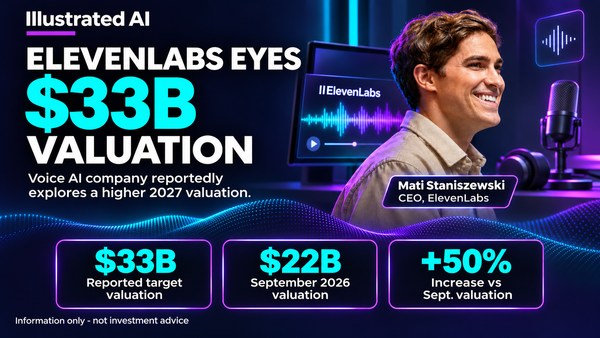
Bloomberg reported on 25 November 2026 that ElevenLabs was in preliminary fundraising discussions targeting a $33 billion valuation.
Invest in top private AI companies before IPO, via a Swiss platform:
 SmartProfit Finder AG

What began as a tool for realistic speech generation is evolving into something far more valuable: a conversational platform that listens, understands context, and helps businesses interact with customers at scale. The opportunity now reaches into customer service, digital assistants, and enterprise automation.
The key shift is that voice stopped being a one-way output and became a two-way interface. A synthetic voice reads text aloud. An intelligent voice agent holds conversations, answers questions, routes requests, and connects with business systems in real time. That is a different product, a different revenue engine, and potentially a different kind of company.
Voice can provide a familiar interface, but enterprise deployment still requires integration, testing, accessibility support and reliable escalation. Ease of speaking does not establish ease of implementation or suitability for every customer.
Enterprise voice agents could support recurring spending and broader customer relationships. Their economics depend on contract terms, paid usage, renewals and the costs of implementation, inference and support.
Voice AI is no longer just about sounding real. It is about becoming useful at the center of business communication.
ElevenLabs announced a $500 million Series D at an $11 billion valuation in February 2026. In September, it announced a completed $300 million employee tender at a $22 billion valuation. The tender provided shareholder liquidity and should not be presented as equivalent to new capital raised by the company. The reported $33 billion target remains distinct from both completed transactions.
Context matters here. A jump between financing levels does not automatically mean the business doubled in fundamental value. Sometimes revenue is genuinely accelerating and products are expanding into more valuable use cases. Other times, valuation movements reflect market sentiment or investor competition for limited private AI exposure.
It also helps to distinguish transaction types. A formal funding round delivers new capital for hiring, infrastructure, and product development. An employee tender offer allows existing shareholders to sell shares, establishing a price without necessarily bringing new money into the business. Both can look like major financing events, but financially they are not the same.
Whether a higher valuation is justified depends on revenue quality, retention, margins, competitive performance and the rights attached to any eventual financing. That price reflects what the company could become rather than what it is today, which is where private markets can look bold, visionary, and occasionally excessive all at once.
A big valuation is not proof. It is a powerful bet on what the company might become.
Enterprise adoption is what separates novelty from durability. When businesses wire voice AI into customer operations and support channels, the technology starts to matter in budgets and long-term strategy. Enterprises do not experiment casually. They ask whether a product saves money, improves service, or handles scale better than existing systems.
ElevenLabs said in September that its agents handled more than 15 million conversations weekly and that enterprise customers accounted for 55% of revenue. These company-reported figures indicate activity and revenue mix, rather than independently measured resolution quality, customer savings or profitable adoption. Conversation counts do not establish how much human work was displaced.
Integration into enterprise workflows could increase switching costs. Durable retention still depends on reliability, measurable customer value, pricing, portability and available alternatives.
Still, caution applies. Company-reported figures require scrutiny. Investors need to understand churn, contract duration, pricing resilience, and gross margin. Enterprise adoption is not a finish line. It is the point at which tougher questions begin.
Enterprise adoption is where clever technology stops performing tricks and starts doing real economic work.
ElevenLabs reported in May 2026 that ARR had exceeded $500 million during the first four months of the year. This is a dated company disclosure, rather than a current independently verified figure. ARR is distinct from recognised annual revenue, contracted future revenue and cash collected; its interpretation depends on calculation methods and the treatment of usage-based spending.
Headline numbers always need interpretation. Investors want to know how much revenue is truly recurring, whether customer concentration creates hidden risk, and whether growth is being sustained efficiently or through aggressive spending. Revenue growth is powerful, but its quality matters equally.
Gross margins are critical. Voice AI requires substantial computing and infrastructure investment. Sustainable margins depend on revenue per interaction relative to inference, infrastructure and support costs. Rising usage alone does not establish improving or deteriorating economics. Retention matters too. Customers who stay, expand usage, and adopt additional features create compounding value. Those who fade away make recurring revenue look more fragile than it appeared.
Disciplined analysis also requires separating confirmed operating data from media estimates circulating around private companies. In fast-moving technology sectors, treating rumor as fact can become expensive quickly.
Revenue growth creates excitement. Recurring revenue creates belief.
Voice AI has arrived at the hardest question in business: who keeps winning when everyone sees the opportunity? Large model developers, specialist speech companies, and enterprise software vendors all recognize that spoken interaction could become a dominant digital interface. The future will be decided by execution, differentiation, and economics, not novelty alone.
Durable differentiation comes from latency, reliability, multilingual quality, enterprise integrations, and predictable production performance. The winning edge may not come from impressive demos but from working dependably in real business environments where mistakes and downtime carry real consequences.
Key metrics to monitor include customer retention, gross margin, and whether conversation volumes translate into lasting recurring revenue. Investors should also watch financing details closely. How much capital enters the business? What rights accompany the investment? Those specifics often reveal more than a headline valuation figure.
Larger technology players present genuine competitive pressure through advantages in computing scale and foundational model development. Specialists can counter with speed and product focus, but maintaining that edge demands continuous innovation. Investors must assess whether competitive advantages are widening or becoming vulnerable to replication.
The prize is significant. Reliable voice infrastructure could reshape how companies engage customers across every industry. That is why competition will be fierce and differentiation will matter enormously.
ElevenLabs’ enterprise expansion indicates commercial opportunity, but reported fundraising targets and conversation volumes do not establish sustainable profitability. Investors should watch financing terms, recognised revenue, ARR definitions, renewals, resolution quality and margins after inference, implementation and support costs.