Unitree’s $4,900 Humanoid Robot Lowers the Cost Barrier for Embodied AI
– 5 min read
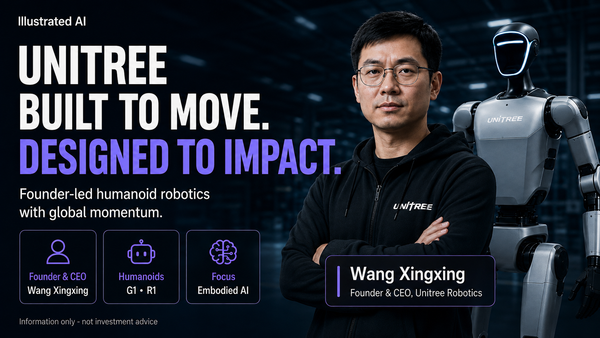
The shock isn't that a humanoid robot exists. The real shock is the number attached to one. A functioning humanoid platform at $4,900 changes everything emotionally. What once sounded like a moonshot purchase now sounds like something a university lab, startup team, or ambitious developer might actually budget for. That's how industries begin to shift: first the machine is admired from a distance, then the price gets close enough that people stop watching and start experimenting.
Invest in top private AI companies before IPO, via a Swiss platform:
 SmartProfit Finder AG
Expensive prototypes keep technology trapped inside elite circles. Fewer machines mean fewer users, fewer ideas, and fewer breakthroughs. When price falls dramatically, the gates open. More hands get on the technology, more software gets written, more data gets collected, and the pace of learning accelerates.
This robot isn't presented as a magical home helper. Instead, it's framed as a lightweight, customizable humanoid platform — less glamorous, but more important. Platforms are what ecosystems are built on. The story is no longer about whether one robot can do everything. It's about whether enough people can access the hardware to discover what these machines do best. Personal computers didn't begin as universal business tools. Smartphones didn't arrive fully formed. They improved through repeated use and expanding networks of creators. Lower-cost humanoid hardware could follow the same path.
Digital AI feels weightless — software scaling to millions of users at almost no distribution cost. Embodied AI is different. It needs motors, joints, batteries, sensors, and maintenance. It must move, balance, grip, and survive real environments. Every deployment requires a physical machine, making hardware economics central to everything.
A robot cannot master physical tasks by reading about them. It needs motion data, practice, and interaction with imperfect real-world conditions. More affordable robots mean more machines in more locations, generating more real-world data, improving control systems, attracting more users. The cycle repeats — and these loops often separate clever inventions from durable industries.
Support for voice interaction, joint control interfaces, and mainstream simulation tools means developers aren't just buying a body with motors. They're entering a system where software and hardware evolve together. A robot becomes more valuable when builders can actually work with it. Open, customizable platforms generate communities. Communities generate momentum.
The future of embodied AI won't be decided by the most impressive demo. It will be shaped by whoever creates the widest, fastest learning system around physical intelligence. In a field where the world itself is the training ground, access is a competitive advantage.
One robot at one price creates attention. A range across multiple price points creates a market. A product ladder gives beginners a place to start, advanced users room to upgrade, and commercial buyers a path to higher performance. Instead of one dramatic headline product, it builds an ecosystem of participation.
Users evolve. Their needs change. A structured product range lets them grow within the same ecosystem instead of jumping to a different vendor — a familiar pattern across personal computing, cameras, and cloud software. At the lower end, an affordable humanoid supports software development and motion testing. As requirements grow, higher-tier products offer stronger endurance, better sensing, and industrial durability.
A ladder also creates developer loyalty. Once teams write software, tune motion routines, and build workflows around a platform, switching becomes costly. That familiarity becomes a form of lock-in — a positive one if the platform keeps improving. A lower-cost robot isn't merely a smaller sale. It can be the front door to a longer commercial relationship, with revenue flowing from hardware, software support, accessories, and deployment services.
There's a cultural effect too. A visible range of humanoid robots makes the field feel less like a distant curiosity and more like a genuine category — attracting developers, talent, and capital. Great industries are rarely built by a single perfect machine. They're built by practical pathways that let people enter, improve, and scale.
For a long time, humanoid robotics lived in a strange financial zone — fascinating, but with few public benchmarks. That changes when a major robotics company goes public. A listing turns a futuristic theme into a market object with share prices, financial disclosure, and analyst coverage. The field becomes easier to compare, model, and include in portfolio conversations.
A publicly traded robotics company arriving just as lower-cost humanoid hardware broadens access gives investors a focal point — a reference asset for expressing a view on a trend before the final market structure is visible. That creates enthusiasm, but also volatility, because expectations can race ahead of reality.
Reality in humanoid robotics remains demanding. Commercial use cases are still forming. Reliability in messy environments is difficult. Machines must complete jobs often enough, safely enough, and cheaply enough to justify their existence. Leadership acknowledging that general-purpose humanoids still need major gains in efficiency and generalization actually strengthens the long-term case. Markets are more durable when ambition is paired with realism.
If a company's hardware becomes widely used by labs and early commercial teams, it gains data, visibility, and ecosystem strength before the market matures — translating into brand leadership even if large-scale profitability takes time. When a technology gains both a falling cost curve and a public benchmark, capital follows fast.
The most exciting phase of any disruptive technology comes after the headlines, when the world asks: what is this actually good for? Developer adoption is the clearest signal. If universities and AI labs buy these machines in meaningful numbers, the platform becomes a standard tool. Standards concentrate ideas, lower friction, and turn hardware into the common language of a field.
Software integration matters equally. The real promise of embodied AI lies in connecting language, vision, and action — hearing a command, identifying tools visually, judging distance, planning movement, and adjusting when something shifts. The breakthrough won't come from intelligence in isolation. It will come from intelligence fused with physical action.
Industrial settings are natural proving grounds. A robot doesn't need to replace every human activity to become commercially meaningful. It simply needs to perform certain tasks well enough to save time, reduce strain, or fill labor gaps. Warehouses, inspection environments, and manufacturing spaces originally designed for human bodies all offer practical opportunities for humanoid form factors.
Cost versus capability remains the defining tension. Lower prices are attractive only if reliability, safety, and endurance keep pace. Competition will sharpen this process, forcing each player to define what edge they truly own — chaotic in early markets, but enormously productive.
Access changes the search. When hardware stops being prohibitively expensive, more people can hunt for the breakthrough — better actuator designs, improved hand control, refined natural-language task execution. It's impossible to know exactly where the decisive advance will emerge. What matters is that a larger pool of participants can now go looking.
The bottom line: the breakthrough isn't perfection. It's access. And access is how revolutions begin.