Instinct’s $2.5B Bet on Action-Oriented AI Agents
– 4 min read
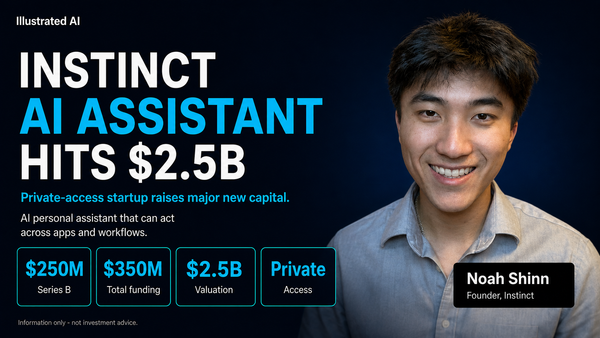
Something important changed when investors poured $250 million into a young company still in private beta, pushing its valuation to $2.5 billion — up from roughly $500 million just weeks earlier. This was not excitement over another chatbot. It was a bet that AI was no longer being valued for what it could say, but for what it could do.
Invest in top private AI companies before IPO, via a Swiss platform:
 SmartProfit Finder AG
A chatbot answers a question and waits. An agent understands an objective, remembers context, connects to tools, and carries out a sequence of actions. One is a conversation partner. The other resembles a digital employee. That distinction matters because value in technology grows when software moves closer to outcomes. An AI that recommends a restaurant is useful. One that books the table, updates the calendar, messages the group, and arranges transport feels indispensable.
The market's message was simple: talking AI was exciting, but working AI could be enormous.
One of the smartest product decisions was also the simplest: don't force users to learn a new interface. Instead of a standalone dashboard, the assistant was designed to fit existing habits — text it, call it, or let it connect to email, calendars, and location. It meets people where their lives already happen.
Real tasks spill across inboxes, maps, shopping carts, and conversations. An assistant built around familiar channels feels less like software and more like support. The first wave of generative AI trained users to think in prompts, keeping the burden on the human. A real assistant shifts that burden to the machine — moving from advice to execution.
The payoff compounds over time. The more the assistant learns routines and preferences, the more useful it becomes. The more useful it becomes, the harder it is to replace.
The real elegance was not adding another screen. It was making AI feel like help rather than homework.
The most valuable digital businesses sit at points of decision — shaping where attention goes and how money moves. A powerful personal agent could become exactly that kind of gatekeeper. Instead of users visiting ten separate services, they tell one trusted assistant what they want. The assistant handles the rest, effectively becoming the new front door to the digital world.
Front doors gather context. Over time, an agent learns budgets, preferences, routines, and priorities — making switching costly and loyalty natural. Commercially, an assistant that completes transactions could earn subscription fees, referral economics, or become a distribution platform for merchants and service providers.
Investors were asking one big question: if millions of people outsource digital errands to an AI assistant, who owns that relationship?
The excitement was not about one app winning downloads. It was about one agent becoming the default middleman for daily digital life.
The industry is moving from chatbots to operators. Chatbots respond and explain. Operators act — canceling subscriptions, booking tickets, managing logistics. This changes the economics of AI because action connects software to real spending. Every household and business runs on repetitive processes: scheduling, purchasing, following up, tracking. If AI can reliably absorb even a portion of those burdens, the market expands far beyond media and search.
The best analogy is the difference between a map and a driver. A map is helpful, but the journey stays in human hands. A driver changes the experience entirely. Agentic AI promises that shift for digital work — but the standard is no longer eloquence. It is dependability.
The future of AI was no longer about sounding intelligent. It was about becoming genuinely useful.
Excitement opens the door; execution keeps it open. Broader audiences are less patient than early adopters, and action-oriented AI is far heavier than chat — managing unique workflows across calendars, shopping systems, and live services at scale. A funny chatbot mistake gets forgotten. A faulty operator misses a flight or wastes money. Reliability is not a bonus here; it is the product.
Monetization must also prove durable — whether through subscriptions, transaction economics, or premium tiers. Crucially, the assistant must feel loyal to the user, not to hidden commercial partners. In a category built on delegation, perceived trust is everything. Meanwhile, large technology players are unlikely to ignore this market for long.
The key milestones are straightforward: broader availability will test real demand, repeat usage will reveal habit formation, and reliability at scale will determine whether delegation feels safe enough to become routine.
The next chapter is brutally simple: can the assistant earn the right to become indispensable?