Crusoe and the Rise of AI Infrastructure
– 4 min read
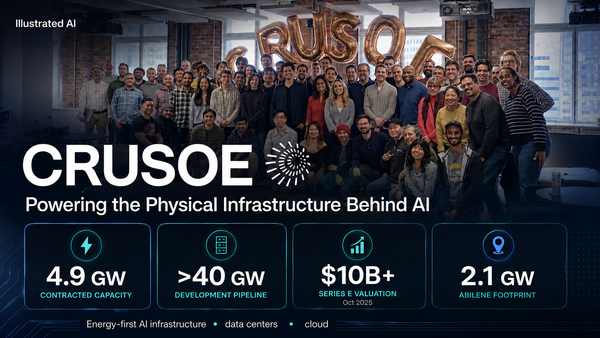
Artificial intelligence may feel weightless, but behind every elegant AI response sits a very physical reality: massive buildings, industrial cooling systems, specialized chips, and electricity flowing nonstop. The next stage of the AI economy is no longer just about who has the smartest software. It is increasingly about who can actually power the machines.
Invest in top private AI companies before IPO, via a Swiss platform:
 SmartProfit Finder AG
Crusoe has built its strategy around that insight. Rather than treating power as a background utility, the company treats energy as the starting point, linking power, land, facilities, cloud infrastructure, and AI workloads into one integrated system. AI stops looking like a purely digital revolution and starts looking like a new wave of industrial development. The winners may be the firms that can build the essential physical layer fast enough and at large enough scale to serve hyperscalers racing against each other.
For investors, this reframes the opportunity entirely. Applications can come and go. Model leaders can shift. But the need for power, cooling, land, and high-density facilities only intensifies as AI spreads deeper into business and society. Whoever can reliably turn electricity into intelligence may help define the next chapter of technological growth.
Crusoe is assembling multiple layers into a single operating model stretching from energy sourcing to data-center development to AI cloud delivery. The logic is simple: AI infrastructure coordination has itself become a competitive advantage. By controlling more of the chain, Crusoe removes friction, reduces delays, and gains more control over timelines and costs.
The scale of this vision becomes clear in Abilene, Texas, where an original campus designed for 1.2 gigawatts supports Oracle Cloud Infrastructure, while a new 900-megawatt campus supports Microsoft. Together, projected local capacity reaches roughly 2.1 gigawatts — the language of utilities and heavy industry, revealing just how far the sector has moved beyond traditional cloud deployment.
For customers, a single provider combining power, buildings, deployment, and AI-focused cloud operations simplifies procurement and improves reliability. For investors, vertical integration captures value across multiple layers, though it demands scrutiny of capital intensity and execution risk. In the AI era, companies that combine the physical and digital worlds most effectively may become the most strategically important businesses in the market.
Crusoe has disclosed 4.9 gigawatts of contracted AI infrastructure capacity, with a wider pipeline exceeding 40 gigawatts. Those figures point to an ecosystem scrambling to reserve the future before it arrives. AI capacity cannot be summoned instantly — facilities require years of site preparation, grid connections, permits, and hardware sourcing, making early reservation strategically essential.
The customer roster underscores this shift. Oracle, Microsoft, and reporting linking Meta and Google to contracted capacity signals that access to infrastructure has become a genuine competitive resource, not just an operational detail. A further 1-gigawatt campus planned in Childress, Texas, suggests a repeatable industrial strategy rather than isolated projects.
For investors, the key question is conversion: how efficiently plans become operational assets. Bottlenecks capture value because they are hard to replicate quickly. If AI-ready infrastructure remains scarce while demand intensifies, providers with credible scale may gain stronger pricing power and more durable strategic relevance. In infrastructure markets, credibility compounds.
Crusoe's funding trajectory reflects the market's shifting view with unusual force. A late 2024 financing round valued the company at $2.8 billion. Less than a year later, valuation climbed above $10 billion, with subsequent reporting indicating discussions around figures approaching $30 billion. The direction is what matters: investors are beginning to price AI infrastructure as a strategic foundation of the next computing era.
Capital itself is a strategic weapon here. A company with access to large funding pools can secure sites earlier, order equipment sooner, and withstand the complexity of industrial-scale execution better than weaker rivals. The physical layer is gaining strategic prestige because data-center campuses, energy access, and deployment expertise do not appear overnight.
High valuations carry high expectations. Investors will eventually demand evidence that contracted projects become operating assets and that returns justify capital intensity. But the appetite for this segment reveals a broader recognition: the infrastructure behind intelligence may be worth backing at scale, as companies capable of controlling the roads, power lines, and factories of the new economy become deeply important.
Advanced AI systems need dependable, continuous electricity. Crusoe treats energy as something to be actively designed and optimized, working across grid electricity, natural gas, solar, wind, battery storage, and behind-the-meter generation to increase flexibility and reduce dependence on any single source.
The most eye-catching element is a partnership with Aalo Atomics to explore nuclear-powered AI infrastructure, with a proof-of-concept targeting 2027 and larger deployment ambitions toward the end of the decade. The logic is straightforward: nuclear offers consistent, round-the-clock, low-carbon electricity — an extremely attractive combination for workloads that cannot pause when wind drops or clouds pass over solar panels. The path involves real regulatory and technical challenges, but the willingness to explore such options signals the scale of the opportunity.
AI is forcing a convergence between technology and energy policy. Reliable, cost-effective power influences margins, project timelines, and environmental positioning. Infrastructure providers that can combine reliability with lower-carbon options may be especially well placed as scrutiny on energy consumption rises.