Agility Robotics’ $400M Raise for Humanoid Warehouse Robots
– 3 min read
Agility Robotics and the Humanoid Robot Revolution
Agility Robotics is raising $400 million in a funding round that reflects growing investor interest in commercial humanoid robotics. The financing, led by the venture arm of private equity firm WP Global with participation from SoftBank, values the company at a $1.75 billion pre-investment valuation. The transaction places Agility among a growing group of private technology companies focused on scaling robotics platforms for industrial applications.
Invest in top private AI companies before IPO, via a Swiss platform:
 SmartProfit Finder AG
The fundraising effort builds on previous strategic backing, including Amazon's investment through its Industrial Innovation Fund as part of a $150 million financing round. Participation from major investors and strategic partners provides Agility with additional resources to expand manufacturing capacity, improve product performance, recruit talent, and support broader commercial deployment.
Digit's Advanced Capabilities and Real-World Applications
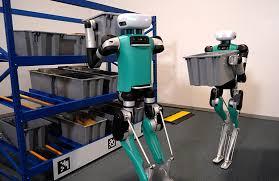
Agility's humanoid robot, Digit, is designed to perform warehouse and logistics tasks in environments built for human workers. Standing 5 feet 9 inches tall, the robot's human-like dimensions allow it to operate within existing facilities without requiring significant infrastructure modifications. Its bipedal design enables movement through warehouse layouts and workspaces commonly used by employees.
Recent updates have expanded Digit's operational capabilities. Improvements include longer battery life, autonomous docking for recharging, and enhanced safety systems. Cameras, sensors, and LiDAR technology help the robot navigate around people, equipment, shelving, and other obstacles commonly found in warehouse environments.
The robot's updated limbs and end effectors provide greater flexibility when handling objects from different positions and orientations. With a payload capacity of up to 35 pounds, Digit is capable of identifying, lifting, and transporting storage containers and other warehouse materials while operating autonomously within designated work areas.
Strategic Partnership and Warehouse Testing
The partnership between Agility Robotics and Amazon provides an opportunity to evaluate humanoid robotics technology in large-scale logistics environments. At an Amazon fulfillment center south of Seattle, Digit has been tested on tote consolidation tasks, including organizing and repositioning storage containers after inventory removal. Such activities are common within warehouse operations and are often considered suitable candidates for automation.
Amazon's involvement offers Agility access to one of the world's largest logistics networks and provides an environment for testing the technology under real operating conditions. The robot's design also includes visual indicators, such as LED eyes that signal movement direction, helping improve predictability and awareness for nearby workers.
Leadership and Company Foundation
Based in Salem, Oregon, Agility Robotics originated as a spinout from Oregon State University, drawing on years of robotics and mobility research. The company has been led for the past year by Peggy Johnson, a former Microsoft executive and former CEO of Magic Leap. Her appointment reflects Agility's focus on expanding commercial operations and scaling production capabilities.
The company has announced plans for a manufacturing facility in Salem capable of eventually producing more than 10,000 robots annually. This expansion supports Agility's objective of increasing production capacity and meeting expected demand from industrial customers. The company is currently ranked No. 6 on the GeekWire 200 index of Pacific Northwest startups.
Market Growth and Competitive Landscape
The humanoid robotics sector continues to attract growing interest from investors and technology companies. Warehouses and logistics facilities are often viewed as potential deployment environments because humanoid robots can operate within spaces originally designed for human workers without requiring major structural changes.
Competition within the sector is increasing as companies such as 1X, Cobot, and Figure AI continue developing commercial humanoid robotics platforms. This competitive environment is contributing to ongoing advances in hardware, software, safety systems, and operational efficiency.
Manufacturing scale, product reliability, and deployment speed are becoming increasingly important factors as companies move from research and testing toward broader commercialization. Agility's combination of academic research, industrial partnerships, commercial testing programs, experienced leadership, and manufacturing expansion positions the company among the participants competing for market share in the emerging humanoid robotics industry.
The combination of new funding, commercial partnerships, product development, and increasing competition suggests that humanoid robotics is entering a more mature phase of commercialization. As companies continue to expand deployments and production capacity, the sector is expected to remain a closely watched area within the broader robotics and automation market.