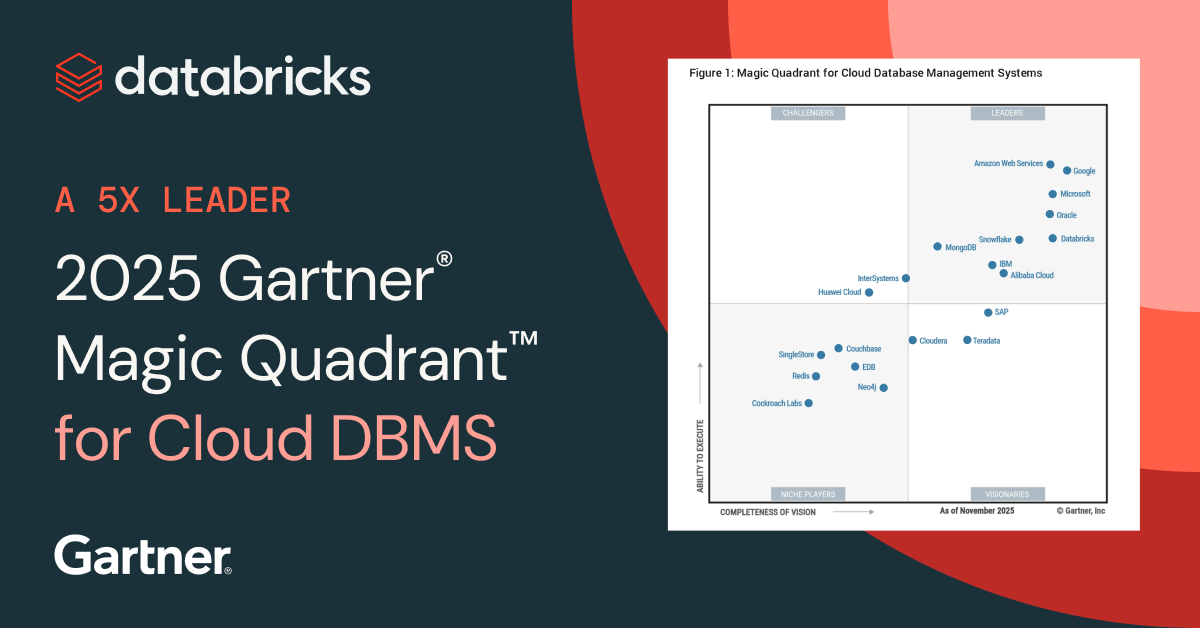
Databricks Emerges as Unified Data & AI Leader in 2025 Gartner Cloud Database Magic Quadrant
– 3 min read

Databricks has been named a Leader in the 2025 Gartner Magic Quadrant for Cloud Database Management Systems, marking its fifth consecutive appearance in this category. A notable change in this year’s evaluation is that Gartner assessed Databricks for both analytical and operational database capabilities, following the introduction of Lakebase.
Invest in top private AI companies before IPO, via a Swiss platform:
 Smartprofit Finder AG
This development reflects the platform’s shift from being focused primarily on analytics toward supporting a broader range of workloads, including operational data management.
Databricks has been widely used for analytical workloads such as reporting, business intelligence, and machine learning. With Lakebase extending support to operational databases, the platform now encompasses both transactional processing and analytical use cases.
The 2025 evaluation positions Databricks as a platform capable of serving applications that require low-latency transactions while simultaneously supporting advanced analytics and AI within the same environment.
Lakebase is a fully managed, PostgreSQL-compatible database integrated directly into the Databricks Data Intelligence Platform. Its serverless architecture separates compute and storage, enabling automatic scaling and supporting low-latency transactional workloads.
Lakebase also includes branching and time-travel capabilities that facilitate safe development and historical data inspection. A key architectural feature is its alignment with the platform’s unified governance and metadata systems, allowing operational and analytical data to be managed under the same framework without relying on separate database stacks.
This reduces the need for data movement between OLTP and OLAP systems and enables applications to access transactional data and analytical signals within the same environment.
Databricks SQL continues to serve as the primary engine for analytical and business intelligence workloads on the platform. Gartner’s evaluation highlights its performance scalability, integration with Lakeflow for data engineering, and its role within the lakehouse architecture.
This analytical foundation remains central, with Lakebase extending the platform’s capabilities to include operational workloads while maintaining consistent governance and metadata.
Unity Catalog provides centralized governance across data, AI models, and metadata. It offers cataloging, fine-grained access policies, and lineage tracking.
Operational tables created within Lakebase automatically inherit the same governance controls applied to analytical datasets, supporting consistent management and reducing the need to maintain separate access and policy configurations across different systems.
Gartner identifies the pace of development across the Databricks platform as a strength. Over the past year, Databricks has expanded its capabilities in areas such as data engineering, AI development, and open data formats. Features introduced include AI agent tooling, enhancements to Lakeflow, and expanded support for Delta Lake and Apache Iceberg.
These additions reflect ongoing platform expansion into a broader data and AI ecosystem.
Organizations using the Databricks Data Intelligence Platform can consolidate operational, analytical, and AI workloads within a single environment. This integrated approach can streamline architecture, reduce the need for separate systems, and provide more immediate access to analytical and AI outputs on top of transactional data.
By combining operational databases with established analytical and AI capabilities under a unified governance model, the platform supports building applications that rely on both real-time transactions and analytical insights without requiring extensive data movement.
 Ina Felsheim